Indigenous Americas, Indigenous Lens: Brian Adams and Sarah Stacke
Listen to the interview on Apple, Spotify, or your listening platform of choice. Captioned interviews are available on YouTube.
The views and opinions expressed by speakers and presenters in connection with Art Restart are their own, and not an endorsement by the Thomas S. Kenan Institute for the Arts and the UNC School of the Arts. This interview has been edited for length and clarity.
For over 150 years, photography has played a powerful role in shaping how Indigenous peoples of the Americas are seen and too often misunderstood. Images made about Indigenous communities rather than by them have circulated widely in museums, textbooks and popular culture, reinforcing narratives of disappearance, distance or anthropological extraction. “In Light and Shadow,” the ambitious new book by photographers Brian Adams and Sarah Stacke, directly challenges that legacy, not by rejecting photography’s past but by radically re-centering who controls the archive, who tells the story and who the work is for.
Adams, an Iñupiaq photographer based in Anchorage, and Stacke, a Brooklyn-based photographer, writer and archival researcher, approach photography less as image-making than as long-term relationship-building and storytelling. Their collaboration grew out of “The 400 Years Project,” an expansive initiative marking the anniversary of the Mayflower by foregrounding Indigenous photographers across generations, geographies and the full range of photographic practice — from 19th-century studio portraits to contemporary conceptual work.
In this interview, Adams and Stacke discuss the ethical and logistical choices behind “In Light and Shadow,” the politics of archives and representation and what it means to be storytellers accountable to the people whose lives and histories they photograph.
Pier Carlo Talenti: Since “In Light and Shadow” is an expansion of “The 400 Years Project,” I’d love it if you’d share how both of you developed the idea for the latter project.
Sarah Stacke: With the 400th anniversary of the Mayflower’s arrival to North America looming, we wanted to do something that recognized that event’s impact on Indigenous Americans, so we put our heads together and we came up with “The 400 Years Project.” We thought that that was going to be just one big output in November of 2022, but then it just kept rolling. A little bit of funding came in here and a little bit came in there, and it kept going on.
Pier Carlo: Describe the outlines of the project and then also describe how it kept going on past 2022.
Sarah: Sure. We were looking at the evolution of Indigenous American identity and representation, and we commissioned original photo essays. We licensed existing ones. We created a digital library of Indigenous American photographers from the 19th century to the present. We had a big social media presence on Instagram, and we also had a third person, a third co-founder. Her name was Sheena Brings Plenty, and she was huge in our social media presence and also just involved in all parts of “The 400 Years Project.” That was really what “The 400 Years Project” consisted of.
Pier Carlo: How did you divvy up the work between the three of you?
[They both laugh.]
Sarah: It was a ton of work. All three of us did presentations and guest lectures. We all did photo-editing together. I did a lot of emails and researched historical photographers. Sheena was great at social, so she did a ton of the work on social media. And Brian just has such great relationships with so many contemporary Indigenous photographers, so he really led in that department. We were just really lucky that we work so well together and balance each other out.
Brian Adams: Yes.
Pier Carlo: Before you decided to create “In Light and Shadow,” was there an end product you had in mind for the project?
Brian: Not at the time. We started “The 400 Years Project,” and we were very happy how successful it was. It brought a lot of the community together, the photo community too, because with “The 400 Years Project”, it was a mixture of Indigenous photographers and non-Indigenous photographers. We were focused on celebrating great work being made in Indigenous communities.
Pier Carlo: So then talk about when you decided to create the book as an extension of the project.
Brian: Sarah’s memory might be better for that. [He laughs.] It was a few years ago.
Sarah: A publisher approached us, and that’s when the transition began from “The 400 Years Project” to “In Light and Shadow.”
Pier Carlo: So as you were building “The 400 Years Project,” you were creating an enormous archive. Were you going to make it widely available to anybody who wanted to see it?
Sarah: It was available. It was online; it existed as a website. All of the projects that we commissioned were online. The projects that we licensed were online. The digital library was online. It was all available in a beautiful website that we had specifically built for the project.
Pier Carlo: How incredible. What were you hearing from people who visited it and from the photographers you licensed and commissioned?
Sarah: People really enjoyed it because it was a mix of work. It was not just professional photographers, but it was people from enthusiasts to people who chronicled their families to fine artists. It was just a real mix of photographers.
Pier Carlo: In all the years you did this work, what was most surprising to both of you? Did you unearth photographs or people that you hadn’t previously known about?
Sarah: Brian, do you want to take that one first?
Brian: I think with “The 400 Years Project” and “In Light and Shadow,” we’ve been aware of all this work for so long, and we just wanted to get it on a platform where people can actually see it and appreciate it in one place. So it was mostly Sarah and I being like, “There’s all this amazing work out there. Let’s bring it all together and celebrate it in one place.” Because we know that the work has been actually being made for a long time, but —
Pier Carlo: There just wasn’t a central repository.
Brian: It wasn’t getting the attention we thought it deserved, so let’s go and do it ourselves.
Sarah: Yeah, there’s absolutely that. For me, in terms of things that really surprised me that I learned along the way with both “The 400 Years Project” and “In Light and Shadow,” I think about John Meek, Jr. II a lot. He was a native Hawaiian who opened a photography studio in 1867 in Honolulu. He auctioned his negatives in 1869, and they have yet to be recovered. But with that knowledge, I think both Brian and I are really confident the archives will reveal images made by Indigenous Americans even earlier than Meek, from the 1840s and the 1850s. And the 1860s is pretty early for Indigenous Americans, for anybody really, to be making photography in their own studios.
I also learned that the extractive language of photography — “take,” “capture” — was being questioned since the nascent days of the medium, which surprised me. Newspapers were questioning this ominous language of what it means to have your portrait “taken.” So those are things in the research that just really, really did surprise me.
Pier Carlo: Sarah, I know that, as much as you are a photographer, you are an archivist and a researcher. Which interests came first, or did they develop simultaneously?
Sarah: Definitely together. It would be hard to be interested in archives without then seeing something and wanting to research it and know more about it.
Pier Carlo: So when you take your own photos, are you always keeping in mind, “This will be part of an archive. I’m documenting this for the future”?
Sarah: Absolutely. And also always thinking about how I’m going to preserve my archive in a way that will protect the people and the way that the images are used and accessed in the future.
Pier Carlo: Do you call yourself ethnographers? Does that term mean anything to you?
Sarah: Not so much. I think we both call ourselves storytellers. I’ll speak for myself. I do not call myself an ethnographer. I describe myself as a photographer, a writer and an archival researcher; never do I describe myself as an ethnographer. I like to work in dialogue with communities and share stories, not necessarily collect data, study it and draw conclusions. But storytelling I think is at the crux of what both of us do.
Brian: Absolutely. Storytellers for sure.
Pier Carlo: How do you make sure your story and your artistic lens do not outweigh or become more important than the story of your photographic subject?
Brian: Oh, that’s a good question. I think as storytellers, we’re just obsessed with the people we’re photographing. You turn off any personal needs or wants and do whatever is best for who you’re trying to document and help tell their stories best as possible. There’s a lot of empathy involved in working in these communities.
Pier Carlo: Has either of you made mistakes along the way in approaching subjects?
Brian: I think everybody makes mistakes when you first get into the field. Everything’s a learning experience. Nothing off the top of my head, but I’m sure ... . Well, one example, one of my first mistakes: When I first went to Standing Rock, which Sarah was at too, I showed up and was just like, “Well, I guess I can just make photos wherever I want.” And within five minutes of being there, because I’m more accustomed to photographing Indigenous communities in Alaska, I wasn’t aware of the customs of Indigenous communities in the Lower 48. Yeah, so that was a learning experience. They were like, “Don’t even point your camera at ceremony.” I was like, “Oh, OK.”
Pier Carlo: Whereas in Alaska, there’s not quite the same sense of taboo?
Brian: Yeah, totally. So there’s just little things like that where it’s all a learning process. You just learn it day by day and just be respectful.
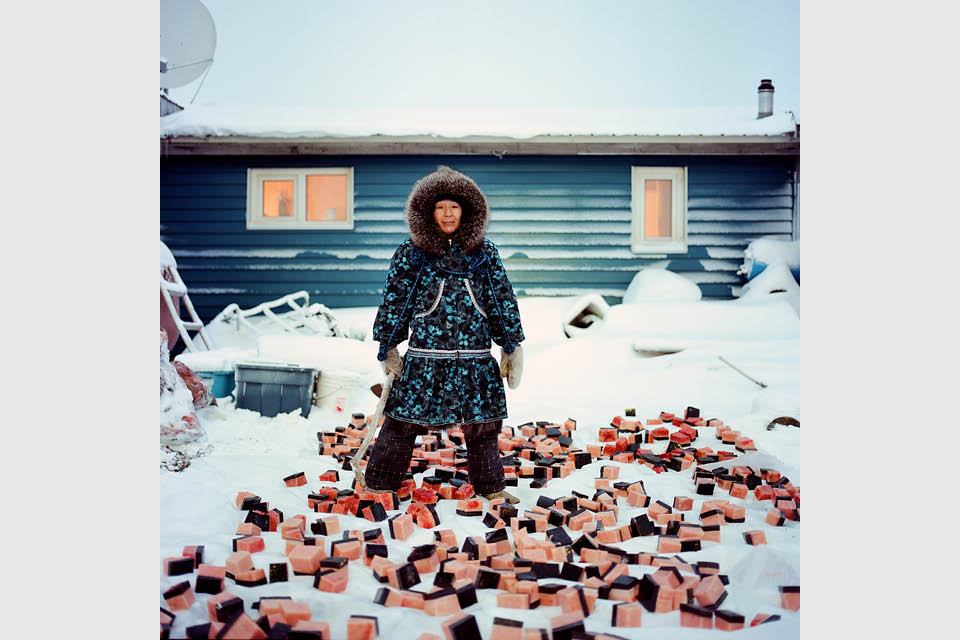
Marie Rexford preparing muktuk for a Thanksgiving Day feast, Kaktovik, Alaska, 2015. Photo: Brian Adams; Image courtesy of the authors.
Pier Carlo: What about for you, Sarah? A learning moment for you?
Sarah: Well, in addition to everything that Brian said, I would add time. For me, it’s been really important to spend time in communities, the same community. In addition to the work that I’ve done on this book and in Indigenous communities, I’ve worked in the same community in South Africa for going on 15 years. The community is 1.29 square miles, so it is a very small area. I go two or three times a year and spend time with the same three families, so it’s a lot of investment of time and building relationships. For me, that’s been incredibly important.
Another thing that I’ve learned and taken to heart is when I ask for feedback, to incorporate that feedback. If you’re going to ask for feedback, it’s pointless if you’re not going to take that feedback to heart.
Pier Carlo: You mean feedback from your subject?
Sarah: Exactly. Whether that’s about photographs to include or not to include. That became a really important and integral part of the process of creating “In Light and Shadow,” because nearly every single text was reviewed with either the artist, a descendant, the archive or a trusted source. And the feedback that we got from that person, we incorporated.
Pier Carlo: Is there one interview in particular that has really stayed with you, of all the ones you conducted for the book?
Sarah: I enjoyed them all, but the time I spent with Herb Randall at his house on the Shinnecock Reservation was really special. I think Herb was born in the 1930s, if I have that right, and he photographed the Civil Rights Movement in Mississippi. Just listening to his stories really felt like something that I will cherish forever. It was just so generous of him to invite me into his home and share those stories with me.
Pier Carlo: One thing I learned from the foreword of the book is a term called salvage ethnography, which I’d really not encountered before. If I understand it correctly, it’s the idea that non-Native people who took photos of Native people were feeding into this idea that Native people were vanishing, that they were salvaging the last remnants of disappearing civilizations. But in “In Light and Shadow,” you’re working very actively against that notion. Is that right?
Brian: Absolutely. It’s amazing to me how many books I still see come out today, contemporary books in the last 10 years from Indigenous communities, that start with the title, “The Last.” And it’s like, “No, we’re not the last. We’re still here. We’re still living, still thriving. It blows my mind, but we’re here.” What’s so cool about this book is it’s 70/30, where 70% of the photographers are historical photographers and then 30% are living and working photographers today. You can hire them today, and they’re working Indigenous communities today.
Sarah: That split was at the publisher’s request. The reason they wanted 70/30 is because the publisher largely features historical narratives.
Pier Carlo: In terms of all the images that you have seen now, not only from compiling the book but also through compiling “The 400 Years Project,” I'm just wondering if you think your artistry has been changed in any way.
Brian: That's fun. That's also another cool thing about the book, that these are all photographers that just love photography and —
Pier Carlo: Although not all of them were professionals.
Brian: Not all of them were professionals. But yeah, it's photographers that just love photography. And there's people like Kali Spitzer who has tintype photos in the book, and it's the same process that was used in the 1800s. It's really cool to see those same techniques of photography used today.
Pier Carlo: Sarah, has your artmaking been impacted at all by what you've seen in these years?
Sarah: Well, I think that's to be determined. I actually haven't made any photographs since finishing this book. I'm taking a breath.
Brian: You deserve a breath.
Sarah: Yes. But I am starting some new work, so we'll see, we'll see. After doing all of this nonfiction writing, I am starting to do some creative writing, and I'm starting some work in the Catskills. I think that it will be seen if the work that I have been looking at will influence the new imagery that I make, but I'm pretty confident that it will because that's what happens. You look at thousands and thousands of photographs, and it seeps into your brain, and of course it influences the way that you see moving forward.
Pier Carlo: Each of you must have one or two favorite images from the book. Can you tell me which ones they are?
Sarah: I actually find that impossible to answer. I truly do. I truly find it impossible to answer. I think one of the most beautiful things about “In Light and Shadow” is the complexity of photography that it highlights. There are some photographer stories that I love, but choosing a single photograph is impossible for me.
Brian: That’s totally fair. [Sarah laughs.] Yeah, it’s the same thing with me. Choosing one photograph is very hard. There are standout photos that I absolutely love. Cara Romero’s “Coyote Tales No. 1” is an amazing, beautiful photograph that makes me want to get out and go make photographs.
Pier Carlo: Can you describe it?
Brian: Yeah. It’s a photo illustration that she made about the story of Coyote, which is a central character in several Native American nations throughout the West, and it’s just working in the mischief of Coyote. It’s just an absolutely beautiful, very vibrant photo. I think about that photo often. It’s also photographed square, and I photograph square. I just always appreciate square.
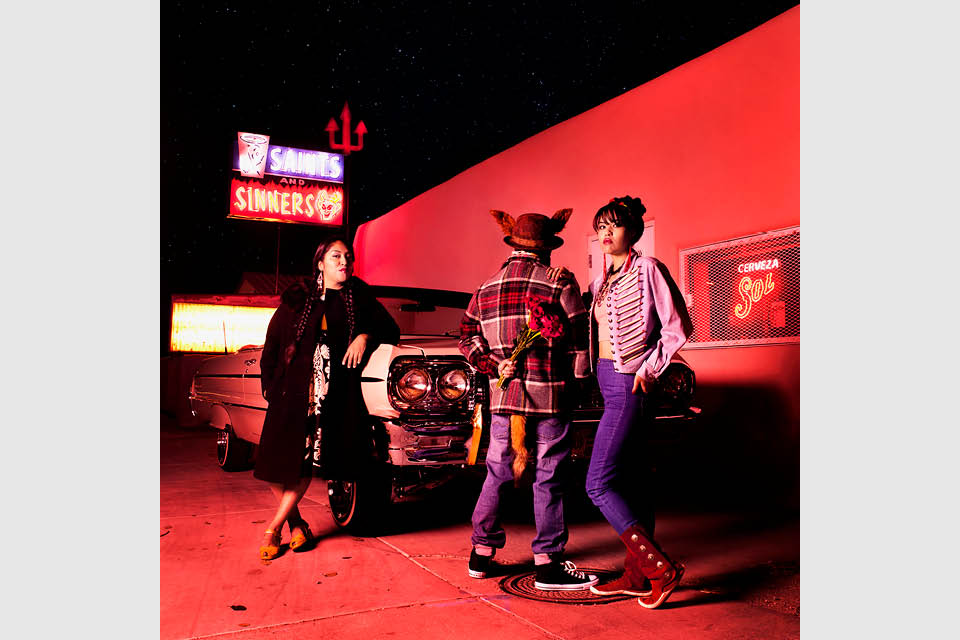
Coyote Tales No. 1, 2017; Photo: Cara Romero; Image courtesy of the authors.
Pier Carlo: How long have you been photographing square? What went into that decision?
Brian: I started photographing square with a Hasselblad camera in 2006. Before that, I was shooting with a 645 medium-format camera. Once I picked up a Hasselblad from a friend and looked through the lens, I was like, “Oh, this is how I see. There we go.” It just all made sense. I looked through and was like, “Oh, this is how I see. This is just an extension now of my body.”
It’s an all-mechanical camera. You don’t have to worry about batteries, so it’s like a semi-organic feeling. Yeah, it’s great. And it’s a great camera to have in Alaska because you don’t have to worry about batteries dying in the cold. [He laughs.]
Pier Carlo: Both of you travel like crazy. Sarah, you’re based in New York, but you’ve got this long-term project in South Africa and you often travel to Alaska. And Brian, Alaska is ginormous and you’ve crisscrossed it to document photos in both your books. I don’t know what my question is. [He laughs.] How do you keep your wits traveling so much and keep your warmth, your actual body warmth?
Brian: [Laughing] All the layers. All the layers. So many layers on.
Pier Carlo: You must have to take a lot of small planes.
Brian: Yes. I’m based in Anchorage, and it’s a great hub. It’s South-Central Alaska. I can get anywhere in Alaska from here really easily. You can take an Alaska Airlines jet to a hub, and then everything from there is small planes because the road system in Alaska is very limited. So after you hit a hub like Kotzebue or Utqiaġvik, Barrow, Bethel, those towns, you get to those villages and then from there, it’s all small planes.
Yeah, I’ve gotten really good at just sleeping on planes and [he laughs] trying to stay awake when we get closer to wherever we’re getting to.
Pier Carlo: Do you often have to ask your subjects for hospitality?
Brian: Typically, I try to stay in either schools or tribal offices. It’s a good way for me to decompress at the end of the day. I’m an introverted photographer, so I need a little decompression time at the end of the day. I’m happy to stay with relatives because I’m comfy and at home there, but there’s a lot of reasons where it’s just best to have that little bit of disconnect at the end of the day and recharge.
Also you’ve got to be careful about who you’re staying with because these towns are small. What if the person you’re staying with has offended half the town and then they associate you with that person?
Pier Carlo: Oh, right. That’s not necessarily the story you want to tell.
Brian: [Laughing] That affects the work. Politics involved. You’ve got to be careful.
Pier Carlo: Sarah, what first brought you to South Africa, and how did you make connections in the small community?
Sarah: When I was a grad student, I went there to work in the archives at the University of Cape Town. I was looking at imagery from apartheid, asking if it could be separated from apartheid, which in my conclusion it cannot be. And I came to that conclusion by speaking to many, many, many people.
When I was there, I met a young woman named Naomi Lottering, and she brought me home to her family who lives in a community called Manenberg, which was created by the apartheid government. It’s 1.29 square miles, and people in Manenberg are three times as likely to be murdered than anywhere else in the country. And the Lotterings were so warm and welcoming. From the moment I stepped foot into their home, I knew that I would like to photograph them if they said yes. And they did, so 15 years later, I’m still there.
Pier Carlo: I want to hear more about you involving your subjects in your work. Do you both show your photographic subjects the photos? And then how much input do they continue having on what you choose to develop?
Brian: Sarah, do you want to start that?
Sarah: Sure. Well, I’ll speak specifically about “Love From Manenberg,” which is the book that I published after 10 years of working in Manenberg. And with that book, yes, I showed the three families who are at the center of the work the layout of the book before it was published. I didn’t want there to be any surprises before the book was published, and I brought it back to the community. Yes, I showed them everything.
Pier Carlo: Brian?
Brian: So the way I approach my work ... . Well, first, obviously it’s all primarily environmental portraits, so there’s a great deal of consent within making the photographs.
Pier Carlo: Consent in terms of where the photograph will be taken?
Brian: Yes. And I’m very clear about what it’s going to be for, where it’s going to be used. And I avoid model releases at all costs, if I can. That way, there’s no way for the photos to be used commercially. Typically in small villages it’s easy to track down whoever you photographed if somebody does reach out to you to use a photograph in a commercial-use form, but that way the conversation stays alive with whoever you photographed.
Pier Carlo: Oh, that’s interesting. Because pulling out the waiver and having them sign it takes control completely out of their hands.
Brian: Yes, exactly. They already signed the form, but if there’s no model release, you have to reach out and get the permissions, which I think is great. So ideally, I like to keep all my work editorial, editorial usage, and just very clear and lots of conversations about how photos are going to be used. Because it bothers me when I see stock photos of Alaska Natives being used commercially, because they sign that form and they don’t even know what they’re being used to sell. I avoid that at all costs.
Pier Carlo: Brian, we have to talk about your image in “In Light and Shadow,” which is so fantastic. It is also the cover of your book “I Am Inuit,” correct?
Brian: Yes.
Pier Carlo: It’s so striking. First of all, can you describe it? And then I’d love to hear about the process of taking it.
Brian: Absolutely. I love the story. Sarah has heard the story probably too many times now.
Pier Carlo: She’s going to go outside and smoke a cigarette while you tell it.
[Sarah and Brian both laugh.]
Brian: Come back in, like, 10 minutes.
That photo was for the body of work “I Am Inuit.” It was the fourth village that I had visited for the project. We had a list of about 20 villages and hubs to visit for the project over the course of a year.
Pier Carlo: Had you ever been to that village before?
Brian: Once previously for a health corporation based in Utqiaġvik, so the first trip I went on was in and out. This one was great because I had days there to spend and just hang out with the community.
Marie Rexford, who’s in the photograph, was one of the first people I met in the village. She’s a powerhouse of a woman, very connected in the community and just so friendly and kind to me, which is just so nice to have when you’re visiting a village you’re not from. It’s really lovely. Marie Rexford in that photograph is surrounded by muktuk, which is bowhead whale. They’re preparing it for the Thanksgiving Day feast, which is about a week away from where we’re at right now, and so in the house behind her, a bunch of her family and friends and relatives are inside the house, butchering bowhead whale, preparing it for the Thanksgiving Day feast.
What Marie was doing was to take the bags of muktuk outside, because it’s freezing cold out, and lay them out. You can’t really see it well in the photograph, but there’s thin, clear cellophane plastic on the ground. The muktuk is on the cellophane, and she’s separating it with the stick she’s holding to let it freeze. Once it fully freezes, they’ll wrap it up. They want it to freeze because if it’s not frozen, they could congeal together.
Pier Carlo: I see. So it has to freeze quickly.
Brian: Yeah. So let it flash-freeze outside because it’s really cold and wrap it up and then put it away until the Thanksgiving Day feast.
For that photo, I just followed her outside. We’d been hanging out all day, and I followed her outside, saw what she was doing, set up the camera on the tripod and asked her if I could make a photo. And she was like, “Yeah.” And I was like, “Just right there.” And luckily there was a tiny little LED light behind me, a streetlamp, that helped illuminate it a little bit. That photo was made at eighth of a second at 2.8, super-slow shutter speed, super-dark, on film, and I just was like, “Hold still.” And she held still. We did about three frames and then moved on.
With the “I Am An Inuit Project,” I originally had a clear vision of how I wanted to photograph it. I wanted to do all-natural light. I wanted to do no-flash, just straight 6-by-6 medium-format film for the entire project. But when I went to Kaktovik, [laughing] I didn’t do enough research before I left, and I didn’t realize that at the time of the year I was there, there was only 40 minutes of daylight.
Pier Carlo: Wait, you’re in Alaska. You should know this.
Brian: But we get more light down in Anchorage.
Pier Carlo: Right. Because you’re in the tropical part of Alaska, I forgot.
Brian: So yeah, only 40 minutes of daylight at the time when I was there. After that, it was a good learning experience of like, “OK, let us at least double-check how much light we’re going to have per village I go to at this time of the year.” I started carrying around a flash after that, and then I set parameters around that flash too. I was like, “I’m only going to use a flash if I can bounce it off of something.”
Pier Carlo: So you had to make an adjustment, and you adjusted the rule.
Brian: Yeah, I adjusted the rule after Kaktovik.
Pier Carlo: What strikes me about the image too is its blue feeling, icy blue, and then the pops of the pink of the whale on the ground. It’s so striking.
Brian: Yeah. To me, I’m like, “Film, baby.” That’s my favorite. That’s that Kodak Portra coming through.
Pier Carlo: You don’t think you could get the same with digital?
Brian: No. And also it wouldn’t have told the story I wanted to tell. If I was shooting digital, it would’ve been hard horizontal or hard vertical, and with the square, you’re able to fit both in at the same time. Yeah, the mixture between the Kodak Portra and the LED light, it just really worked.
Pier Carlo: Before opening “In Light and Shadow,” I thought it was going to be a portrait of Indigenous peoples in North America, but it portrays Indigenous communities from the Arctic Circle down to Chile. It’s all of the Americas, so it’s an incredible compendium. Whose decision was that to make it all of the Americas?
Sarah: That was both of us.
Brian: Yeah.
Pier Carlo: How did you go about contacting people who were geographically very and culturally very distant from you?
Sarah: Oh, we had a Latin American coordinator for the book named Magalí Druscovich, who was amazing. She is single-handedly responsible for extending the pages beyond North America into Latin America. She helped us identify photographers, contact, research. She helped with everything related to Latin America, including navigating the archives there too, because it’s just different culturally.
Brian: Yeah, absolutely.
Pier Carlo: We heard from you, Sarah, about your next creative project, which sounds very exciting, working in fiction. Brian, what’s next on the plate for you?
Brian: Oh my gosh. Man, what’s next for me? We have more work to do for “In Light and Shadow”, which I’m looking forward to.
Pier Carlo: In what way?
Brian: More events coming up, maybe some exhibits coming up. We’re going to keep celebrating this book and pushing this book for probably a whole other year. We’re all proud of this book and want to make sure people get to see it and hold it.
Pier Carlo: Do you have a photographic trip coming up?
Brian: Yeah, I do have a photographic trip coming up. In Alaska, we were hit a couple of months ago by some pretty hard storms in Western Alaska.
Pier Carlo: And flooding.
Brian: Flooding, yes. In the next week, I’m going to be trying to go out to the village of Kipnuk and photographing how they’re rebuilding and coming back from those floods. A lot of the residents from Kipnuk are here in Anchorage and Bethel, so I’m going to try and connect with some of those families.
Pier Carlo: You mean they had to relocate because of the disaster?
Brian: They had to relocate.
Brian: Yes. Currently in that village of 700, there are only about 50 people there. Twenty-five of them are actually residents; the other 25 are contract workers helping to get the village back on the grid, get the power running, get the water running. My next project is just focusing on this story of Western Alaska. I’m working on that with the Anchorage Museum strictly for historical purposes right now.
Pier Carlo: And Sarah, the next time you pick up a camera, what do you think you might take a picture of?
Sarah: Oh, well, it will be part of this work in the Catskills. So along with the creative writing, my vision is to create a project that will combine my own photographs with archival imagery and creative writing. I’m asking questions about early American history in the region, mythology, the American unconscious, and I intend for it to center women. So we’ll see. We’ll see what that ends up being, but I’m excited about it.
January 22, 2026
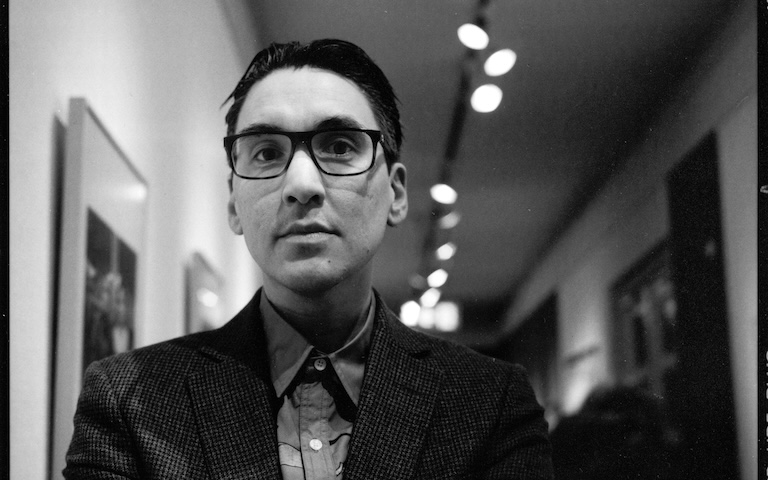
Brian Adams
Photographer
Brian Adams (Iñupiaq) is an editorial and commercial photographer based in Anchorage, Alaska, specializing in environmental portraiture. His work has been featured in both national and international publications, and his work documenting Alaskan Native villages has been showcased in galleries across the United States and Europe. His most recent book, "I Am Inuit," was published in December 2017. Brian is a board member of Indigevsion and a member of Diversify Photo. Photo credit: Stefan Kassel.
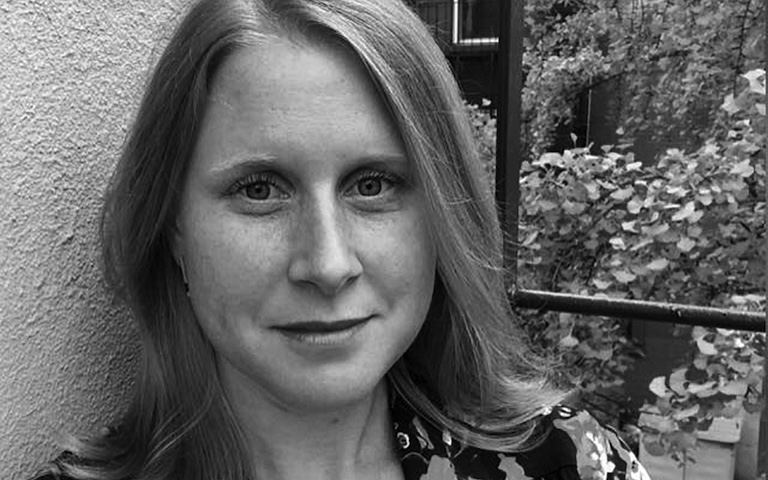
Sarah K. Stacke
Photographer, Writer, and Researcher
Sarah K. Stacke is a photographer, writer, and archival researcher based in Brooklyn, New York, and whenever she can be the hamlet of Andes in the Catskill Mountains. Through projects created in dialogue with communities, she shares stories about relationships to the land and its histories to excavate under-considered pasts and better understand the present. Her work appears in Harper’s Magazine, The New York Times, NPR, The Nation, The Washington Post, and National Geographic. Sarah is the author of “Photos Day or Night: The Archive of Hugh Mangum” (2018), “Love from Manenberg” (2022), “Burt Ginn: Half a Century as a Magnum Photographer” (2023), and “In Light and Shadow: A Photographic History from Indigenous America” (2025, co-authored with Iñupiaq photographer Brian Adams). She holds an MA from Duke University tailored to analyze the history of photographic representations, and she is pursuing an MFA in Image Text at Cornell University. A faculty member at the International Center of Photography (ICP), Sarah teaches courses about the use of archives in photo-based work and the ways archives can shape collective memory, identity, and the future.
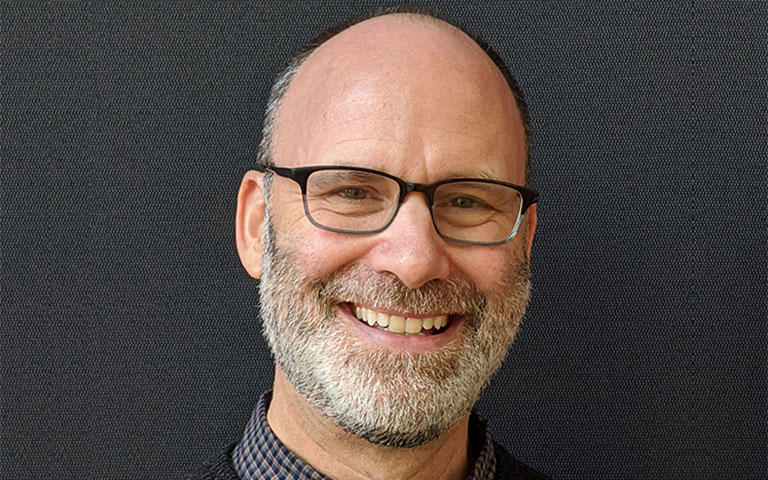
Pier Carlo Talenti
Podcast Producer & Host
Until 2016 Pier Carlo Talenti was the director of new play development at Center Theatre Group in Los Angeles where he oversaw one of the country’s most vigorous new-play commissioning programs. Over 20 years he developed scores of new works for the theater by the some of the country’s most innovative theater artists, and his combination salon/playwriting group, the Writers’ Workshop, counts among its alumni/ae extraordinary playwrights who are also currently producing and writing TV’s most exciting shows. He is currently a resident of Hillsborough, NC, where he is pursuing his own creative projects.