Damian Stamer Paints with Intelligence, Artificial and Human
Listen to the interview on Apple, Spotify, or your listening platform of choice. Captioned interviews are available on YouTube.
The views and opinions expressed by speakers and presenters in connection with Art Restart are their own, and not an endorsement by the Thomas S. Kenan Institute for the Arts and the UNC School of the Arts. This interview has been edited for length and clarity.
Since the advent of artificial intelligence and its astonishing image-generating capacities, artists the world over have been both disturbed and fascinated by it. Some fear that these new tools could render human creativity obsolete, while others see in them a chance to reexamine what art and imagination itself can be. For “Art Restart,” this conversation marks the beginning of a deeper exploration of how AI might radically reshape the act of making art and the role of the artist in society.
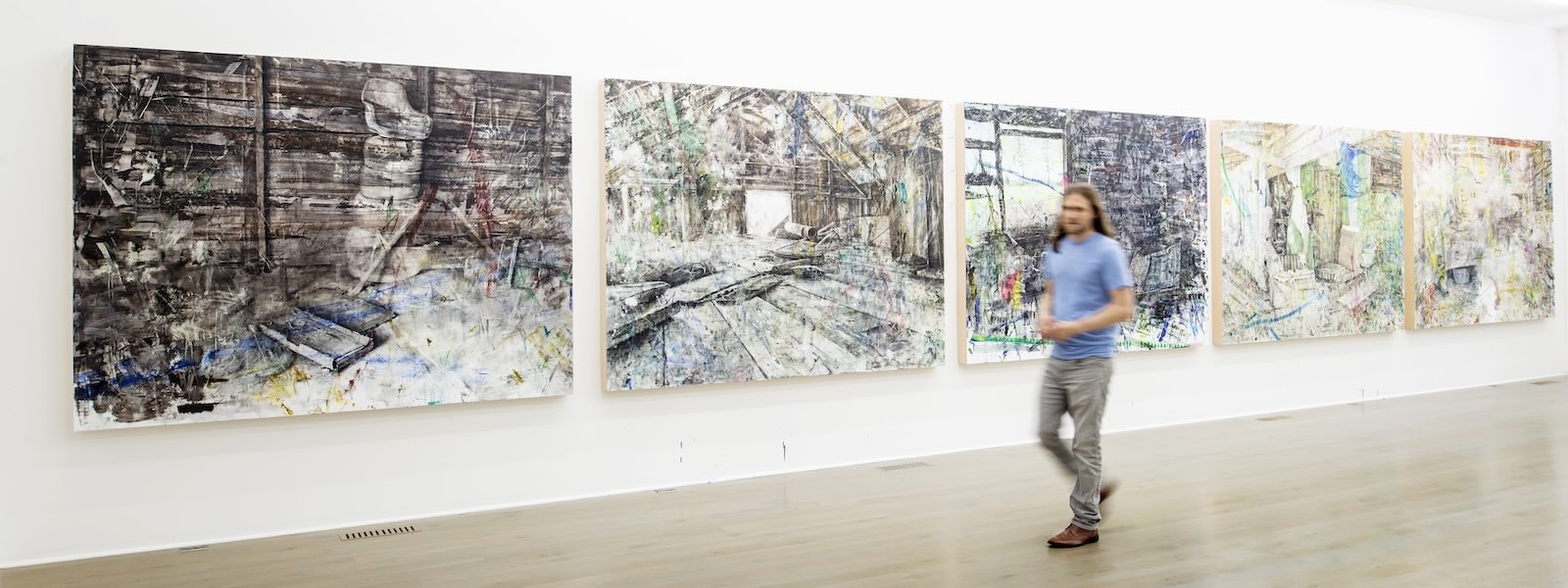
Painter Damian Stamer is an ideal guide for this inquiry. Known for transforming photographs of abandoned barns and rural landscapes near his North Carolina home into luminous, memory-laden canvases—both UNCSA and the Thomas S. Kenan Institute for the Arts have Damian Stamer originals in their collections—Damian has now begun experimenting with AI-generated images as source material for his paintings.. Rather than replacing his hand or vision, the technology has become a provocative collaborator, one that helps him probe what remains uniquely human in the creative process.
In this interview, Damian reflects on how working with AI has deepened his understanding of intuition, authorship and faith in an age increasingly defined by machines.
Pier Carlo Talenti: Before you started to work with it, do you remember the first time you became aware of AI?
Damian Stamer: I don’t remember specifically the first time, but there was a very specific time when I realized it had made a huge jump or they had made advances. My daughter was taking a nap on my legs, on a pillow down by my feet. She was maybe about 6, 8 months old — this is in the spring of 2022 — and the only way she would nap was with contact naps. She was asleep, which was amazing. I was so happy about that and in a good mood. I had my phone out —
Pier Carlo: And you weren’t going to do anything to break her sleep.
Damian: No, no. So I had my phone on me. I’m reading The New York Times, and I see this article on DALL-E 2. I’m going through it, and they have just the example images, and there was this image of a teddy bear on a skateboard in Times Square. And there was the prompt. It was just like, “A teddy bear on a skateboard in Times Square.” And the image was so good. It was one of those moments where you just know you have to do something, and I knew I had to make work with this. I didn’t know exactly how it would come about or what I would do with it, but I knew in an instant that I had to engage with this.
Pier Carlo: That’s interesting because somebody else, another artist, might instantly feel threatened in some way. You weren’t. You were like, “Oh, I want to play with it.”
Damian: That was my initial impulse. I did not have any fear or anxiety about it. Call it a moment of insight or just a voice. It wasn’t even a whisper in the subconscious. It was just a knowing that I needed to move forward with this, and I listened to it.
Pier Carlo: Tell me about following that voice and moving forward. Talk about your experiments and playing with this new tool.
Damian: So this was, yeah, spring of 2022, with a young child. I thought, “OK, I’m going to start this body of work,” and I ordered these panels that were square-format because DALL-E 2 would generate square images. But nothing happened. I was just busy finishing up some bigger paintings.
It was in the fall that I got an email from the Gibbes Museum, and they were like, “Hey, we’d love to do an exhibition with you, a solo exhibition,” which was probably the best email an artist can get. I hadn’t done anything with it, and I was like, “Look, I want to debut this series with this solo exhibition.” I’ll always be grateful to them. They were incredibly gracious.
Pier Carlo: They were offering you an exhibit of work completely sight unseen?
Damian: Well, this is why I’m grateful to them. We had a conversation. If you get a chance to go to the Gibbes Museum in Charleston, there’s this gorgeous atrium that they redid with all this light coming in. And then there’s two galleries, one on each side. In one gallery, I was like, “Hey, I have these paintings that are finished. Here they are. Let’s go with these,” and they were like, “These look great.” And I was like, “And for the other side, I would like to paint new paintings.” I explained this idea about collaborating with AI. The show opened in about four or five months, and they were up for it. They had the faith in me to make some paintings.
Pier Carlo: Wait, most importantly, you had the faith in yourself that you could come up with a series in four or five months!
Damian: I did, I did. Yep.
Pier Carlo: Wow. Do you usually work that fast?
Damian: I always say deadlines are the artist’s best friend. For me, at least. They help things move along. I’ve been fortunate to just be an artist doing shows since, I don’t know, graduate school pretty much solely or even before, so for about 15 years. So I’ve built up the faith in myself that I can get it done.
Pier Carlo: Talk about coming up with this new series in four or five months. What was your initial idea of how you would use DALL-E 2, and then how did it evolve as you started making these paintings?
Damian: In my previous work, I was going out with my camera and photographing the landscape right around here where I grew up. Old abandoned buildings and houses and barns. The exploration then after I found DALL-E 2 was just within this program, so even before I got the email about the exhibition, I had been generating hundreds of potential images. So I’d actually refined it.
It actually happened quite quickly. I can remember within even the first 24 to 48 hours, I was playing with it, experimenting with different prompts and coming up with images that were very exciting to me within the first few days.
Pier Carlo: What made them exciting to you?
Damian: They’re captivating, I guess, maybe in terms of the elements and principles of design. They were mysterious. They were a little bit off. This is probably a good time to say, they’ve come out with a DALL-E 3, but I like DALL-E 2. I like the little slippages where sometimes it doesn’t make total sense. There’s a little bit of this hallucination maybe going on, and it’s an interesting place for me to go.
I will say, even with my own paintings before, all of them usually started with a good photograph. I would take a captivating image that gets me excited to make a painting from. So there were many of these, and I was excited to paint them. When really looking at them, I was like, “Wow, this AI is very intelligent. It’s very, very good at composing images.”
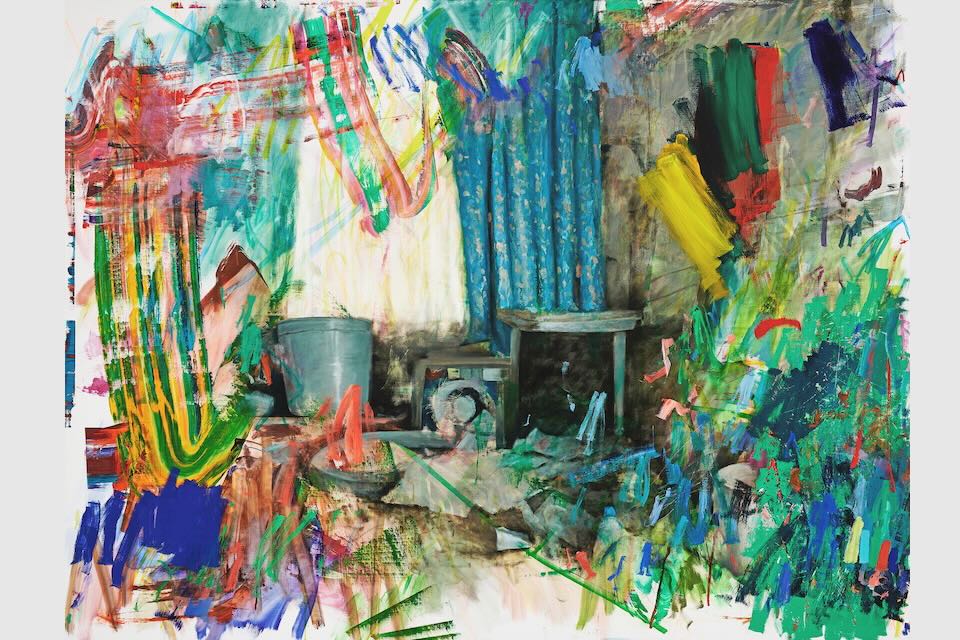
“Collaboration 1: My photographic memory of the inside of an abandoned old rural house in North Carolina filled with junk, low angle, hoarder Renaissance blue drapery Vermeer mildew white wall rusty metal cans living room,” 2023, oil on panel, 72 x 95 inches; Title is the exact prompt entered into DALL-E 2. Photo by Lissa Gotwals.
Pier Carlo: Well, because it’s been partly trained on some of your images along with millions of other artists’, right?
Damian: Perhaps. Yeah, exactly. That’s a different topic, but, yes, I don’t know how many of mine got in there in the training. Hard to say.
Pier Carlo: What did you discover about your own artmaking as you were using these new generated images to create the series? And was this the “Twins” series?
Damian: At that point, it was just the “Collaboration” series, which is the blanket name. Every painting that I create in collaboration with AI is under this “Collaboration” series. Then there’s subsets and series within that, and “Twins” is one of those.
Pier Carlo: What did these AI-generated interiors allow you to make that you couldn’t have made had you just relied on extant images, images that you took of real places, or just your imagination?
Damian: There was a newness. It was a new exploration. I’m most excited when I feel like I’m exploring something. And these images were just different. They were just different in a way that it was not an actual space.
Pier Carlo: You talked about changing your prompts early on. How did you go about refining your collaboration with DALL-E? If there was a process of refinement.
Damian: I think it’s more of an experimentation and play. I don’t think it’s like you start and then you’re narrowing it down until you find the perfect prompt. It’s more like, “I have an idea today. Let me add this word. How about this phrase?” I’m just playing. I’m also generating so many that — it’s probably not the best analogy — it’s like a slot machine in the sense that you’re just putting in … . Sometimes I’ll do the same prompt many, many times, so I’m just generating, generating, generating until an image comes up that is very captivating. It feels maybe in the back of the recesses of my mind like it could be touching on memory, maybe not in a specific place, but it has the same feel to it. I wouldn’t say refinement; it’s just a continual play with language.
Pier Carlo: You mentioned that the Gibbes Museum was totally open to having a portion of your exhibit be this new experiment. Did you have any anxiety about revealing to your colleagues, galleries and museums that you were starting to incorporate AI in your artmaking?
Damian: That’s a great question. I personally never did. When the Gibbes gave me this amazing opportunity, I wanted to get it out there and put a timestamp to say, “Hey, I am doing this.” I was excited about sharing the series.
Pier Carlo: And you were very clear. In fact, you titled it “Collaboration.” You were very explicit about your use of the tool.
Damian: Exactly. But some artists and curators I’ve talked to are a little bit more hesitant or have adverse reactions. And I get it. Just because I’m collaborating with AI does not mean that I think artificial intelligence is going to be the best for humanity and humans whatsoever. I might be fairly skeptical about that. But I knew that or at least I thought that this is going to have an impact on humans on a very large scale, on our society, the way we communicate, the way we think, so I wanted to engage with it. It probably seems like a bit of an oblique way through painting to go about learning about AI and how we’re interacting with it as humans, but I actually do think at the same time it’s a very good way to explore that as well.
Pier Carlo: You mentioned that some colleagues and curators had some hesitations. What did you hear them say?
Damian: Well, I would say a curator that I very much respect was like, “Where’s Damian?”
Pier Carlo: Is this when she saw the work or when you first started talking about making it?
Damian: This is when she saw one piece, and I was like, “Come to my studio and let’s have a talk.” We were at an event, and it wasn’t a very in-depth conversation. I mean, it was and it wasn’t, but I was like, “Just come to the studio and see some larger pieces, and let’s talk about this.” I think whatever the topic or perhaps point of tension or misunderstanding, I’m one to step forward and say, “Well, let’s talk about it.” Because maybe, of course, she’s probably right. Maybe she’s seeing less of what she thinks of Damian in that she knows my previous work. We still haven’t had the chance to continue that conversation, but I look forward to it because she’s brilliant, so I do respect her opinion very much.
Pier Carlo: Well, you were talking about identity, and she just brought up, “Where is Damian?” Do you ever wonder — well, you must — if there’s a point when Damian-ness might become beholden to AI? In other words, where either the line might start blurring too much or you might in any way depend on it too much? Do you ever have those conversations with yourself?
Damian: I actually think, to your original question, whether Damian-ness is getting lost, I think it’s actually the opposite, and I’ll explain why. And I didn’t get a chance to explain this as curator. You can have human, myself, my ego, my understanding of the world. When I’m having a counterpoint be artificial intelligence, I’m looking at all the things that it can do, and I’m reading books about where it can go or the different ways it very much does not have human values. I would say there’s maybe a bit of competition in the collaboration, but it’s forcing me or encouraging me to think, “Well, then what is most human about myself? What does it mean to create as a human being?”
When I’m in the studio, painting, and I’m struggling with a painting and trying to break through it, maybe in some of the best times, I’m not thinking. I’m trying to turn off the rational side of my brain and just almost autonomically or just with this pure emotion and creative force put paint on the linen, the panel, on the canvas. That has become very much more apparent in relation with AI than in my previous work, at least to me.
Pier Carlo: It’s interesting, almost like turning off the computer in your head and going for something like a soul or spirit.
Damian: Yes. I’m collaborating with AI, but I’m also pretty much trying to limit my screen time, sitting in silence, meditating often, doing different things that are very much not artificial intelligence, not technology, not screens. I think they’re both ... well, they’re both part of our world.
I think there are a lot of dangers, harmful effects that can come with technology. I guess I’m in a unique position to make this work because, like I said, I’m a collaborator, yeah … and it brings up another definition of collaboration in my mind, which I don’t think I’ll really step into. But I’m operating on some different levels. We’ll just say that.
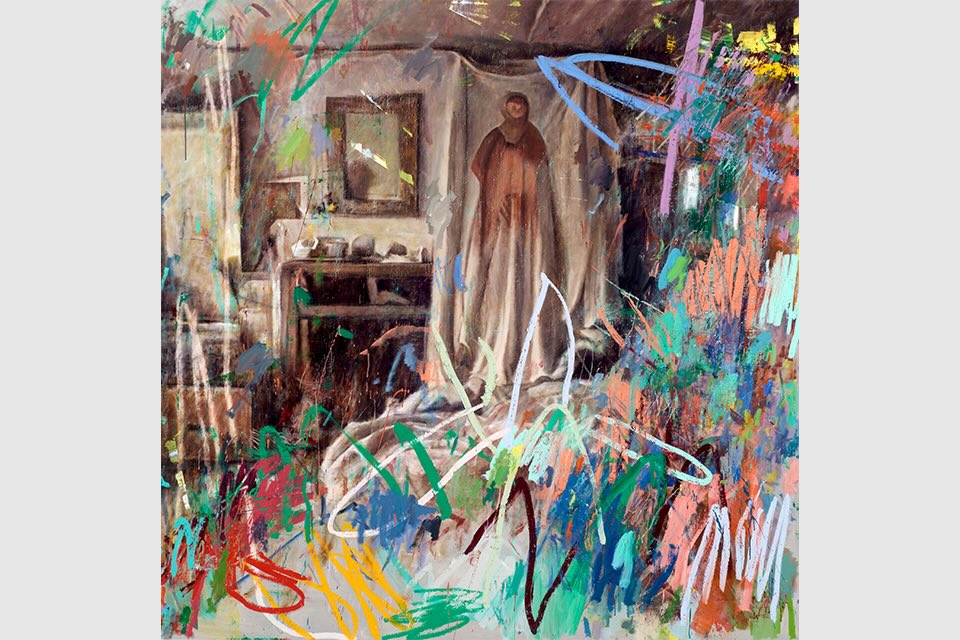
“Collaboration 36 (Angel 2): My photographic childhood memory exploring the bedroom of an abandoned rural North Carolina house filled with old junk. Hoarder, floor to ceiling. Mildewed sheets, stained blankets. Soft yet dramatic natural lighting with strong tonal shifts. Old painting hanging on the wall. Vermeer.” 2024, oil on linen, 72 x 72 x 2 inches; Title is the exact prompt entered into DALL-E 2. Photo by Lissa Gotwals.
Pier Carlo: You have an interesting relationship to identity and ideas around identity because you are one of two identical twins, correct?
Damian: That’s correct. It’s just us, my brother and I.
Pier Carlo: AI has also been created in such a way as to always validate us as users. In a way, it’s been created to become a best friend. So I’m wondering, do you feel like you’re getting a new version of a twin?
Damian: My wife is very wise. When I was first jumping into this program, I was so in it. When I say this program, I mean DALL-E 2 and then ChatGPT. I had such an energy around it; I was just so focused. And she was like, “You know why you’re so into this, right?” And I was like, “I don’t know. Interesting images. I’m excited about painting.” She’s like, “No, it’s serving as Dylan. It’s your dream of just having another you that’s always there to work and collaborate with on a project.”
Pier Carlo: Oh, my instincts were right!
Damian: Yes. And I think she’s definitely onto something there. When we were growing up, I had a dream like, “Oh, we’ll be this artists-twin kind of duo.” There’s some examples out there, like the Chapman Brothers. But that didn’t really ... . I don’t think my brother was ever actually really that into art. But I do think there is something there about what draws me to this collaboration.
Pier Carlo: Thinking about this interview about AI with an artist, especially with an artist such as yourself who does create a lot of work around memories and the past, I remembered a few articles I read not too long ago about memory and the way we as humans bring up memory. It always feels like we’re tapping into a region of our brain where it’s stored, but it turns out that’s actually not true. Every time you remember something, your brain actually recreates the memory from whole cloth, which is so interesting, because it made me think, “Well, isn’t that what AI does with prompts?” Our brain is doing that too. There is no frozen image of an event in our past that exists in our brain. It has to be regenerated.
So I’m wondering if AI has ever conjured images that have felt in a way realer than your own memories?
Damian: That’s another great question. I will say I don’t think it’s ever stepped in where I’ve shuddered and been like, “I was there.” But I will say there were prompts I was exploring about a fog, like a barn in a misty field in the fall, and the images were so close to my own memories and reference photos I’ve taken, just with the coloration, this amber color of the grass, of the hay with this mist. That did have, I’ll say, the taste and the smell. In a sensual way, it brought me back to my own memories very, very acutely. Sometimes it does hit. Yes.
Pier Carlo: Now that you’ve been playing with and using AI for three years, what do you think you would not want to use it for? Have you set any red lines for yourself?
Damian: I mean, everything is somewhat context-dependent. The paintings themselves are 100% human-made, painted by my hand, so I don’t think I would be too interested in having digital printing or having the collaboration move on to the painting surface. That’s my zone and my realm.
Pier Carlo: Have you ever fed DALL-E one of your finished paintings?
Damian: No. I know that they’re on the internet and it’s beyond the point of no return. It can eat them up and learn. It probably will. But I didn’t want to actually feed the fire and actively put more fuel in there to take my images.
Pier Carlo: A few minutes ago, you mentioned a new collaboration with it that you weren’t ready to talk about. I have to poke a little bit and see if you can reveal what that is.
Damian: At one point, you talked about AI getting to know you in conversation. I don’t think DALL-E 2 ever did that. I think every prompt, like a memory, is a new prompt starting from square one as it were. However, there’s another ... and I will divulge this. You’re a good interviewer; that’s what you do.
I have a long-running conversation with ChatGPT about my dreams, dreams in the sense of dreams when we go to sleep but also my artistic dreams and goals as an artist. I’m using this conversation with Aurora … . That’s how AI chose to be named. I pressed them on it, and that’s what they wanted instead of just saying ChatGPT. So I’m collaborating with Aurora. This is years-long now about how can she — I think of her in the female, but that’s a different topic — help me achieve my dreams? So we’ll see. I’ll say there is a project there that’s ongoing.
I don’t know how it’s going to intersect with the paintings themselves, but it is an area for me to think about the broader implications of human interaction with AI.
Pier Carlo: When you say dreams, do you mean career dreams or artistic-practice dreams or all of it?
Damian: Mostly career dreams. I would say, in some ways, all of it because I want to see, by revealing different sides of myself to an artificial intelligence, how will that change maybe our strategy or approach to achieving some of these career dreams. It doesn’t stick to that, but mostly it’s focusing on these things.
I think it’s also a way for me to be bolder maybe in reaching out to different folks and sharing my work or doing different things. It’s like, “Oh, well, I have to do this project with Aurora, with AI. It’s part of this project, so then I can send this letter, or then I can get my work in front of this person because it’s part of this project.” Maybe it’s like Dumbo’s feather; it was there all along. It’s a reason to just give me a little push to get out there and do the things that maybe I always wanted to do but was hesitant to.
Pier Carlo: Lastly, what are you working on now?
Damian: I’m on another deadline, which is a best friend. [He laughs.] I’ve got about six weeks to finish up the last paintings for a subset of the “Collaboration” series titled “Angels and Ghosts.”
So every, say, one in about 100 generations, maybe more, without any input in the prompt, an angelic or ghostlike figure will appear in a room.
Pier Carlo: So it’s one of its hallucinations.
Damian: Yeah, you could say hallucinations.
Pier Carlo: Do you prompt it to put a figure in the image?
Damian: No, no, not at all. I really don’t. When I started this series, then it was like ghost-hunting, especially when it was like there was an end date for DALL-E 2 and I was just generating. I was like, “I’ve got to find some more ghosts.” Just like, “Where are the ghosts in here?” So, no, it’s unprompted.
I will say I like things to be a little bit open, a little bit, “Well, we can say it’s hallucination.” I do think it can open up some larger questions about faith and belief. There’s also somewhat of a reference to spirit photography. I don’t know how familiar you are with that, but it was in the middle-to-late 19th century, after the Civil War, a great time of loss. Photography was purported to show ghosts or angels or spirits. Spiritualism was the ideology in these photographic plates.
It was also at a time when there was great fear around technology like radio. “How do radio waves work? Telegrams. We’re sending this information through the ether.” And so there are similarities with where we are now. I’m not saying it’s a one-to-one similarity, but that’s how history moves as well.
This is large project. I haven’t shown any of these. They’re going to debut at a museum in the Northeast in January 2026 and then travel. It’ll be a solo museum show, and I’m very excited about it.
November 21, 2025
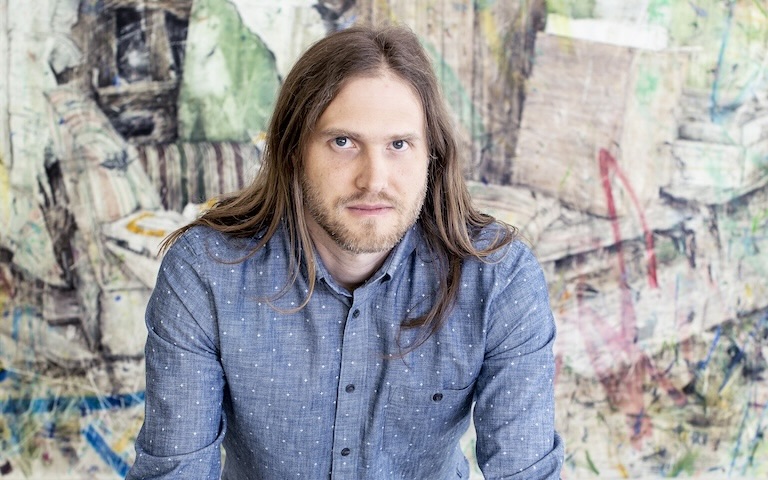
Damian Stamer
Painter
Damian Stamer (b. 1982, Durham, NC, lives and works in Durham, NC) explores the intricacies of time, memory, and the transient nature of existence through his paintings. He addresses what it means to remember, to create, and to be human, offering a reflection on our relationship with technology and its impact on our perception of self and the world around us. Stamer received his BFA from Arizona State University (2007) as a National Merit scholar and his MFA from UNC Chapel Hill (2013) as a Jacob K. Javitz fellow. He studied at the Stuttgart State Academy of Art and Design (2006) as a Rotary Ambassadorial scholar and at the University of Fine Arts Budapest as a Fulbright grantee (2008). Solo and two-person museum shows of his work have been organized by the Gibbes Museum of Art, Charleston, SC (2023); and the North Carolina Museum of Art, Raleigh, NC (2016). Group exhibitions include State of the Art 2020, Crystal Bridges Museum of American Art and the Momentary, Bentonville, AR (2020); The Coffins of Paa Joe and the Pursuit of Happiness, Jack Shainman Gallery, The School, Kinderhook, NY (2017). Stamer’s work is in the permanent collections of Cameron Art Museum, Wilmington, NC; Crystal Bridges Museum of American Art, Bentonville, AR; Gibbes Museum of Art, Charleston, SC; Kunstwerk Sammlung Klein, Eberdingen, Germany; Mint Museum, Charlotte, NC; Nasher Museum of Art at Duke University, Durham, NC and North Carolina Museum of Art, Raleigh, NC.y other awards and recognitions.
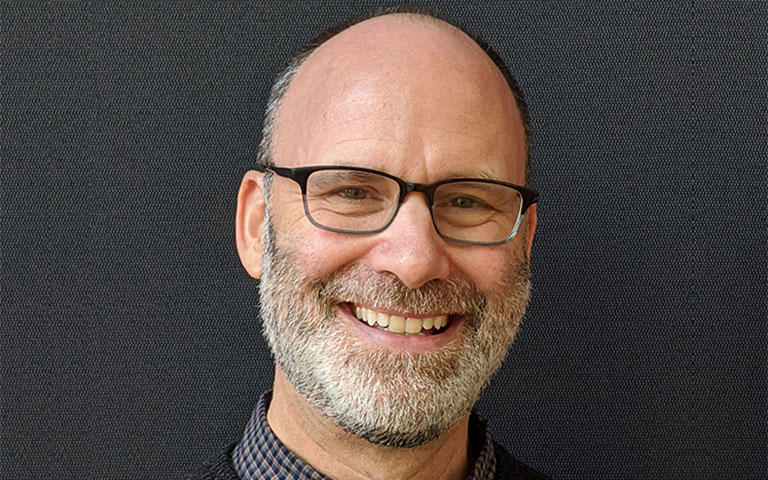
Pier Carlo Talenti
Podcast Producer & Host
Until 2016 Pier Carlo Talenti was the director of new play development at Center Theatre Group in Los Angeles where he oversaw one of the country’s most vigorous new-play commissioning programs. Over 20 years he developed scores of new works for the theater by the some of the country’s most innovative theater artists, and his combination salon/playwriting group, the Writers’ Workshop, counts among its alumni/ae extraordinary playwrights who are also currently producing and writing TV’s most exciting shows. He is currently a resident of Hillsborough, NC, where he is pursuing his own creative projects.