Dancing in All Senses: Davian Robinson
Listen to the interview on Apple, Spotify, or your listening platform of choice. Captioned interviews are available on YouTube.
The views and opinions expressed by speakers and presenters in connection with Art Restart are their own, and not an endorsement by the Thomas S. Kenan Institute for the Arts and the UNC School of the Arts. This interview has been edited for length and clarity.
Davian Robinson’s artistic journey has never followed a straight line. As a student at the Governor Morehead School for the Blind in Raleigh, NC, he discovered ballet and tap, launching a lifelong relationship with dance even as his vision continued to fade. At the same time, he was excelling in competitive athletics, eventually earning medals on the national stage as a para-cyclist. Years later, he returned to dance at UNC Charlotte, where he recommitted to the artform that had first taught him how to express his strength and resilience through movement.
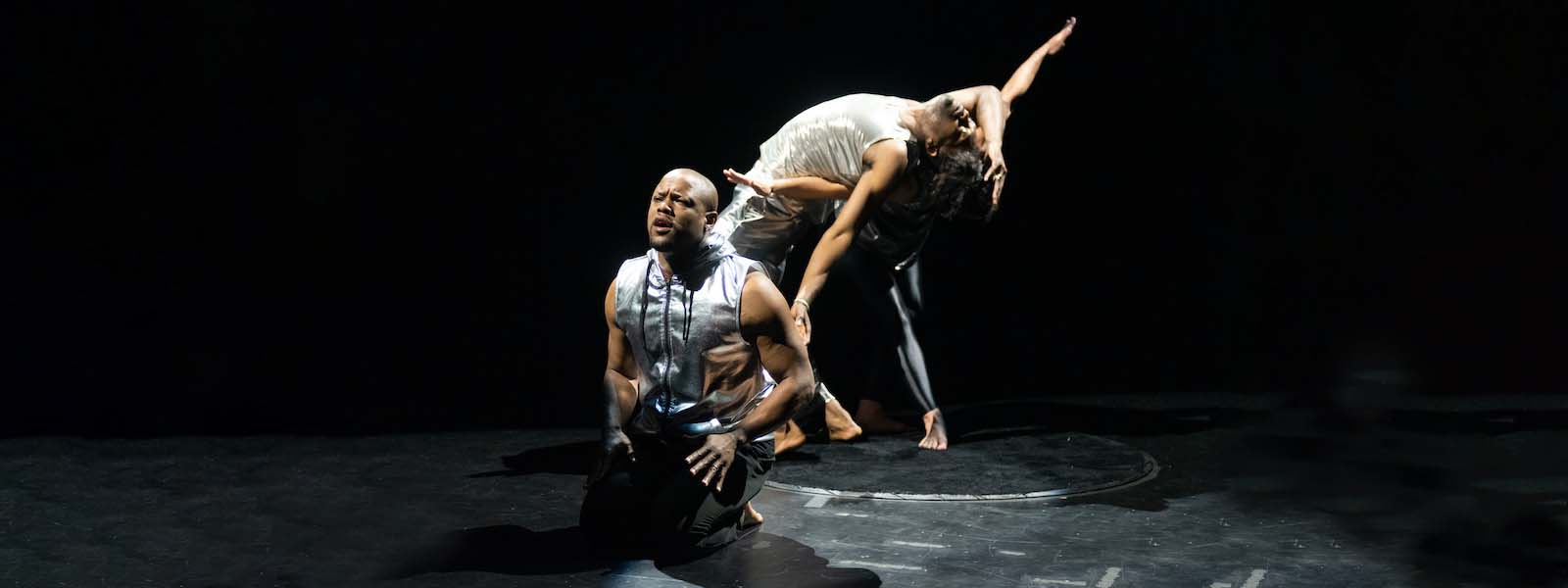
Since then, Robinson has emerged as both a powerful performer and an advocate for more inclusive ways of teaching and experiencing dance. His “Sensory Beyond Sight” workshop encourages participants — whether artists, athletes or professionals far outside the arts — to move beyond vision and tap into the body’s other senses. He also continues to expand his creative reach through collaboration, most recently with celebrated multimedia artist Janet Biggs in “Misregistration,” on view through September 22, 2025, at the Bechtler Museum of Modern Art in Charlotte.
In this interview, Davian reflects on how he developed his methodology as a dance student, the breakthroughs that shaped his teaching and choreography philosophy and how the world of dance can make itself more welcoming to visually impaired dancers and audiences alike.
Pier Carlo Talenti: I’d love to hear about your first dance class at UNC Charlotte. How did it go? It must have been scary.
Davian Robinson: When I first went through my first class, I would give it a C+ grade because I showed up and I did my best and I didn’t have a mentor. At that time, I also couldn’t see like I used to. My vision faded beforehand, because right in December of 2015, the last thing I could see was the time on the back of the stove; the time on the back of the stove was in green lettering. Anyway, so when I got to UNC Charlotte, I couldn’t see. The 20 feet away that I could see someone move, I could no longer see that. So all throughout class, I said, “Let me get in the same position I always was, where a teacher was off to my right and I’m 10 or 20 feet away.” Boom. And I just did what I could do. I said, “All right, cool.” It went OK, but I realized I could no longer use what vision I had, so I had to find another way.
I made it through, and my teacher, Professor Karen Hubbard, came to me and said, “Hey, DJ, I don’t want to tell you no, and I don’t want to tell you to try something different,” but she also said, “I’ve never had a blind person before, but I’m not going to turn you away. Let’s figure out how.” Basically she was saying, “I’m not going to say no, but I’m going to say yes.” With her help and the Department of Disability Services on campus and its director, Gina Smith, in combination with the dance department and Karen, we all came up with a systematic way to help me make it through my classes. Because I wanted to stay.
So we got a movement mentor. This was a person who had taken the classes previously and did well in the class. They gave me one-on-one coaching, hand-over-hand feedback, verbal communications to help me navigate the waters of my classes.
Pier Carlo: How many different mentors did you work with?
Davian: Throughout UNC Charlotte, off the top of my head, I want to say I worked with six different dance mentors in that span of time. It could have been seven, but I want to say six.
Pier Carlo: I’m not a dancer, but I’ve been in dance studios. Generally, one whole wall is a mirror, and as dancers learn, they’re looking at themselves to adjust their movements, right?
Davian: Mm-hmm.
Pier Carlo: So was your mentor essentially your mirror?
Davian: Basically, yes. I used them to replicate what I needed to see visually, because I’m a visual learner, because I have a framework in my mind of what I used to see.
Pier Carlo: Can I ask at what age you started losing your sight?
Davian: Yes. I would say 2014 was the last time I could clearly see, and that was actually the time when I went to my last dance class. I went to a hip-hop class at NC State. They had open class, and I went to that with a friend of mine. It was not easy, but I could still see enough to get through it. And it was nice. It was fun.
At UNC Charlotte, my dance mentor did serve as my mirror in a sense because they were able to, “OK, here’s a tendu. You’re going to stick your leg out in front with your toe pointed out and your whole leg straight out in front of you. You’re going to do it to the side, and you’re going to do it to the back.” They would model that for me, and then I would replicate it in my body, and then they would come and correct the posture or correct the alignment so that I could feel in my body how it was.
But there were also moments, though, in all those processes where, while I was using them as my mirror, I also at times wasn’t fully using myself to gauge what was truly the right positioning or the right way something was supposed to feel because it was always about what it looked like. Because I told my mentors that I wanted to be the best I could be in all of these different areas of dance, they pushed me to those limits. Even if it always wasn’t correct, they told me to go and do as best as I could in those instances so that I could just get through the technique in that moment and then go to the next thing. Then we would work on the fundamentals in our private time after class.
In class, there wasn’t a lot of time to always get it right. There were times where I got frustrated because I couldn’t get it right or I was behind or I was rushing, so I wasn’t getting all the steps right. But then I realized when we stepped to the side and into our private time, we were able to work on those fundamentals. Then I’d come back to class and be able to do the routine or the combinations with more preciseness, more fluidity and more confidence.
This changed from class to class, whether it was West African, whether it was modern, whether it was jazz or whether it was ballet.
Pier Carlo: What came most easily to you in your dance education journey and what’s been more of a challenge?
Davian: I would say the one thing that came the easiest to me in my process of learning dance in the collegiate ranks was my creative ability to come up with ideas and concepts around movement and my ability to just feel the music and let the music lead me. Because I’m a feelings-based person. I wear my emotions on my sleeve. I’m sensitive at times. But when I feel for myself, when I feel music, when I feel these things, it brings out these colorful emotions from my heart. I find it lights a fuse for me in that it pushes me to my creative hyper-focus and into taking concepts and ideas that are rolling in my head and putting them towards movement in a very succinct and creative way that still embodies my athletic and powerful prowess and fluidity as a dancer.
What was most challenging, though, is when I bumped up against moments of exclusion in my time, when the language within my classes ... . Even though I had my mentor, the language between my mentors or the teacher sometimes was not always clear. What they sometimes wanted may not have been as clarified to help me have the best understanding possible to get to the end result, which is ultimately learning the choreography and really dancing through it and moving through it with fluidity in a manner that made my professors and my mentor not necessarily proud but feeling confident that I’m moving in the right direction and they are giving me the right instructions at times.
But again, it was always during times for me when I was dealing with language and how they’re communicating. Can I just sit with how they’re communicating, even if it’s not 100% accurate? Or they’re struggling in that moment to communicate movement because they’re having a hard day or I’m having a hard day in my own body?
Pier Carlo: Well, I think if a choreographer has trouble communicating to you, they’re probably having trouble communicating to the whole class.
Davian: Yes and no. Because there are teachers who are ... I call them good teachers, bad teacher. This is a part of my workshop series. One of the elements that I have in my workshop is called Good Teacher, Bad Teacher. I did this because I had teachers who would communicate, and they would go, “OK, aaand one and two and three and four and five and six and seven.” And I’m like, “Wait, what? What did you just do?” And what they were doing was they just started moving and didn’t say one word. They might have done a kick-ball-change, shuffle step, kick-ball-change, shuffle step, turn, turn. And that’s what it was, but they didn’t say it. They just did it. So that’s the exclusionary part. My teachers sometimes depended solely on my mentor at times to tell me exactly what I just said without my teacher having to vocalize.
But then I had teachers who did vocalize, “OK, we’re going to do tendu, rond de jambe, en l’air, plié, relevé.” Those vocabularies. So even though my teacher also told me and I was also hearing it from my mentor, it gave me two different ways of hearing what they said so that I didn’t miss anything within the transaction or the translation of what they were trying to communicate in what they wanted in this particular sequence of movements. So for me at times the lack of communication or clarity was the most frustrating.
Pier Carlo: When you start working with other dancers or with a choreographer who’s new to you, do you establish ground rules? Do you establish how you prefer to be communicated with? And do you ever encounter resistance?
Davian: That’s a beautiful question to ask. I don’t like conflict [he laughs], and I also struggle at times. I have ADHD. I don’t say that lightly to be like, “Oh, it’s a crutch,” or anything of that nature. It’s just a part of my being in my person. I struggle with communicating my needs because I don’t want pushback and I can come off as a people-pleaser at times. And so there are elements when I first meet new people or new dancers, new choreographers, that ... . Not off the gate. I don’t come in and say, “Hey, this is what I need,” because there’s times where I feel like, “Wait, it’s a burden to tell them what I need,” though I know that to be a lie.
But what I have done is to be able to find the commonality, the common ground of that connection point outside of my disability, outside of my ADHD, outside of those two realms. “Where can we meet in the middle and connect first?” Then once that connection is had, then I gain the confidence and the capacity to share with them, “Hey, this is what I need. These are my expectations.” But at the same time, I am not that authoritative, hierarchical person that says, “You guys do this.” I work more collaboratively and communally with all those that I’m in conversation or collaboration with because it helps balance out my own ideas and concepts. It helps me balance out where we want to go so that everyone’s on the same page, everyone’s access needs are met and everyone’s voices are heard in a clear and concise and forward manner.
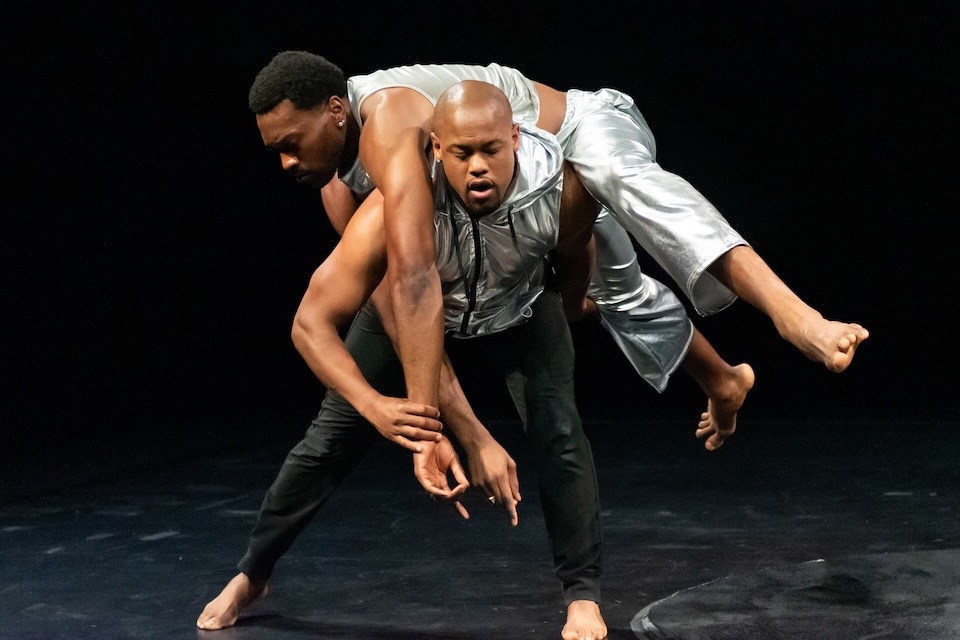
Davian Robinson lifts Vinson Fraley in “Misregistration,” choreography by Davian Robinson, at Virginia Tech in May 2025. Photo by Ethan Candelario.
Pier Carlo: You are also a choreographer, right?
Davian: Yes.
Pier Carlo: What was the first piece you ever choreographed? Was it a solo piece or did you choreograph other dancers?
Davian: The first piece that I ever choreographed was a rendition of “Wall to Wall” by Chris Brown. This had to be when I was in maybe middle school, so probably 2007, 2008.
Pier Carlo: Really?
Davian: It was at a talent show. I can remember watching the video in Miss Rebecca Rommen’s office. I was watching the video on her computer, and I was like, “Hmm.” And I also watched it back in our dormitories, and I was like, “Oh, OK, hmm. I like this.” So I took some of the movement — yeah, it was for a talent show and it was a solo — and I did it. And I was like, “Oh.” I mixed my own things into it, and that was really cool.
Later on, I will say the very, very, very first piece that I choreographed at UNC Charlotte was called “Inner Beauty Versus Outer Beauty: the Misconceptions of a Fallen Society.” It was for our MOVE student showcase produced by a student organization called MOVE Dance Alliance. The dance was basically showcasing that everyone within our hearts has colorful emotions and parts of our hearts and no matter who we are, where we come from, we all have integral parts to us that we can add to the collective of wherever we are or whatever space we’re in. There’s beauty in the collective, but there’s also beauty in the individuality of who you are as a part of the collective.
Pier Carlo: Were you alone onstage, or were there other dancers around you?
Davian: There were seven dancers, including my dance mentor at the time, Lilli Willis, and all of us were under blindfold. It was a seven-minute piece, and there was —
Pier Carlo: All your dancers were wearing blindfolds?
Davian: Oh, yeah, and they were happy about it too. Throughout rehearsal they were like, “Wait. What are you doing? Why are you doing this?” It was seven of us, and once we all got comfortable and I laid out the scene of how it was going to go, they all got comfortable because we weren’t in blindfolds for long, maybe two or three minutes of the piece. It was structured in a way where no one was going to run into each other. There was more floor work. There were more moments where they did statue-esque positions in place and shifted as the beats or the rhythms changed.
There were these different little sections that built upon themselves to showcase that, “Hey, when this blindfold is on, here’s one part of me, but I am more than what you see when you take off this mask.” That’s another element. “You see me with this blindfold on. You’re perceiving me in this one way, but as soon as I take off this blindfold or take off this mask or take off this part of me and show you something new, this is who I am truly at my core. Beautiful, talented, gorgeous, smart, intelligent, all these things.”
Pier Carlo: I’d love to talk about your workshop, “Sensory Beyond Sight.” You already talked about the bad teacher/good teacher part of the curriculum, but I’d love to know more about it.
Davian: Back in 2023, I was a fellow at Access Dance, and I got the opportunity to work with the amazing Nadia Adame and another mentor of mine, Christopher Unpezverde Núñez, and they helped me reshape and remold my “Sensory Beyond Sight” as not a product base but a process base. It looks at how you can transform the way you look at the sensoriums of your body. How can you transform the way you embody movement? How can you transform the way you utilize the other sensoriums apart from the visual lens that will enable you to have a greater awareness of yourself as you navigate your day to day, your dance space, your choreography? Also, as you step away from the visual lens of sight, how can you then discover the other blind spots within your sensorium that will help you to then find, “Hey, here’s this blind spot,” like you have in a car. You have it in your sensorium, in your senses.
Once you find that, then you can have a fuller or rounder, more fulfilling experience within your embodiment, no matter if you’re a dancer or any other kind of artist or an athlete or a physicist or a scientist. There’s a way of embodying movement and yourself.
Pier Carlo: So the workshop is not geared specifically towards dancers or blind people? It’s for anyone who wants to find a new type of embodiment in themselves.
Davian: Yes. However, what I give dancers or any other artist may be different from what I give someone who works at Ally Bank or what I might give a soccer player or basketball player because the space in which they are embodying or how they’re using their body as an instrument through life changes and it’s different. But the same baseline rules apply.
However, when I’m generating choreography and I’m working with new dancers like I did for my exhibition and the “Misregistration” performance … . I had two dancers working with me from New York, and what I did so that I’d feel comfortable was I said, “Hey, I’m going to put you guys in blindfolds, and we’re going to move a little bit.” There’s an element that I use called sculptor clay where under blindfold they sculpt me. They put my body in a position, and then they freeze me. We go back and forth in that way, and we move like this under the blindfold to help build continuity and rapport, to see how the other one moves and how they feel about moving without their sight. That helps me streamline how I work with other dancers as performers or as collaborators because it really helps to mitigate any assumptions or hesitancies that may be in the air about working with a person like myself who’s a dancer who happens to have a vision impairment or blindness. It help us meet in the middle and open their eyes.
Maybe before they get to the choreographed process, they get into their body in a whole different way than they would have if we had just started moving without the blindfold. The blindfold takes away some elements of fear and resistance, and it breaks the barrier of that hierarchical thinking and says, “Hey, we’re on the same playing field, so let’s move and see what we can devise and come up with.”
Pier Carlo: We’ve been talking about dancing with a visual impairment. I’d love to talk about being a lover of dance, an audience of dance, with a vision impairment. How do you yourself enjoy dance performances, and how do you think dance companies all over the country could make it easier for blind people or visually impaired people to enjoy dance?
Davian: I enjoy dance in a multitude of ways, and how the space is set up — whether it’s a proscenium stage or more of an in-the-round space where there’s chairs around the stage at the center point — is largely the sticking point to what will make or break the way in which I as a lover of dance can interact with it. If I’m sitting in a proscenium venue, I may have to just use a volunteer peer or friend or volunteer audio-describer to describe the dance to me and give me their interpretation. And I also get the show notes and maybe potentially talk to the choreographer about their ideas and things that I can be listening for. But there’s also things that I listen for on the stage, if they’re barefoot or have sneakers, for instance. I listen for certain things that I might potentially hear, and I use my imagination to fill in the gaps of where I don’t fully understand what’s happening.
But if it’s an in-the-round space, if it’s not a proscenium stage but there’s chairs on all four sides and the stage in the middle, that lends itself to a little bit of an easier experience because there’s other elements. Because you’re so much closer, you’re able to hear the breath more clearly; you’re able to hear the footsteps easier; you’re able to hear the shuffle of a foot or the turning of two bodies; and you’re able to hear maybe the wind sounds coming from someone’s body as they run by you. It’s these different elements along with the music scores, the instrumentations and the narrations, if there’s narrations. How are you communicating other than just dance? How is the music score? Is there a narration? Is there voiceover? These are things that you have to ask. Is there a self-audio description within the dance performance where they’re describing how they’re moving as they’re moving?
Pier Carlo: I know many theater companies offer audio-described performances. Are there any dance companies that do the same?
Davian: I’m not 100% sure. I have a colleague, Krishna Washburn, who runs the Darkroom Ballet out of New York. She’s a blind ballet teacher, and she’s writing a book about self-audio description and audio description. The key thing about it is, as far as individuals or companies knowing how to self-audio describe or audio-describe, I don’t think that’s in their wheelhouse or toolbox as of yet. But I think over time, in the next three to five years, that’s definitely something that companies with the right resources and the right education and the right training could effectively bring forth within their performances and dialogue.
Pier Carlo: I imagine over the years you’ve met or worked with other visually impaired or blind dancers and choreographers. Have there been different techniques that you’ve learned from them or that they’ve learned from you?
Davian: Yes. I know about five blind or visually impaired dancers off the top of my head. When I was at UNC Charlotte, I was one of one at that point in my time, which is fine. I’m not a, “Me, me, me” kind of person. But what was really interesting, because I was the only visually impaired person amongst a sea of people who were sighted, was that I was the authority on what was working for me, whether it was me using how I moved with tape on the ground and taping a performance stage so that I know where I’m at on a stage or how I still tape the floor to help my dancers in my dance workshops or tape the floor in my dance classes when necessary.
When I did a brief stint at Duke University during COVID, I met Krishna. She told me that as I was traversing my undergrad experience as a dancer: “They were teaching you how to dance like a sighted person. That’s why you had so many struggles in ballet because they would teach you how to dance like a sighted person and not a blind person. The difference is that you dance from within-out instead of outward-in. When you really focus on the inward versus external dialogue of how to move and how to understand the body, your movements and how you flow through the space become more enriching, more streamlined, but also you have less moments where you’re restricted in how you’re wanting to move, how you feel like you need to move, and there’s more of a connection to you and those around you because now you’re taking it upon yourself to move based off a newfound way that you may have not known before.” I think that’s the beauty of it.
Pier Carlo: Is there anything I should have asked or anything you want to add about your dance journey?
Davian: I will say this; this is something I lived by when I was in college. I was working for rec services at the time, and we had a speaker. He was talking about understanding your why. When you understand your why, you understand your purpose. I understand that dance is a vehicle for me to share my own lived experience, my gift, talents and abilities with the world. No matter the background, no matter the upbringing, no matter the disability, no matter how you ascribe politically or whatever the case may be, I think dance has a way of unifying and being used when words are not enough. The body has a way of expressing what the mouth or the eyes or the ears cannot identify, which is the true essence of the heart.
September 10, 2025
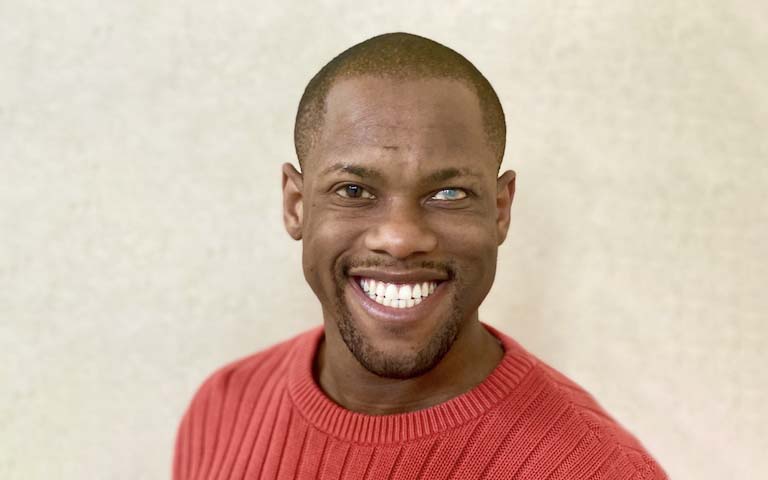
Davian Robinson
Dancer and Choreographer
Davian "DJ" Robinson is a passionate and boundary-breaking visually impaired dancer, choreographer, and performer. Drawing from his lived experience and athletic movement style, he creates choreography that is both physically powerful and emotionally resonant. His work blends dynamic storytelling with raw embodiment, inviting audiences into a world where rhythm, resilience, and adaptability redefine how we move and connect. Through both performance and education, Davian challenges conventions and opens new possibilities for inclusive expression in the arts.
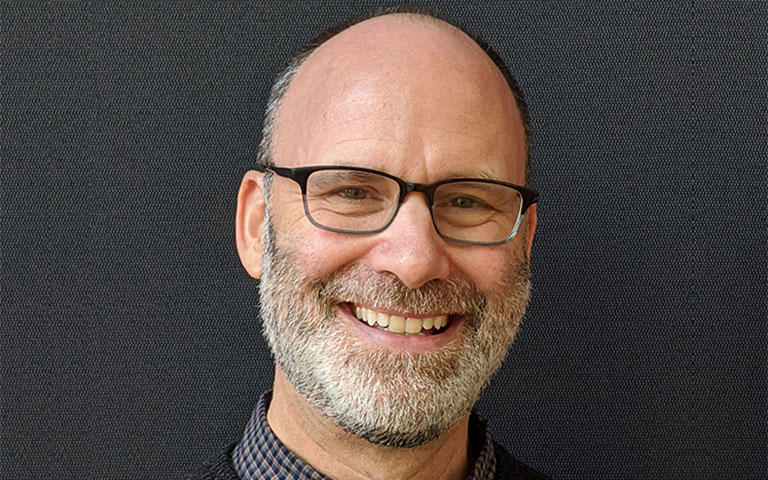
Pier Carlo Talenti
Podcast Producer & Host
Until 2016 Pier Carlo Talenti was the director of new play development at Center Theatre Group in Los Angeles where he oversaw one of the country’s most vigorous new-play commissioning programs. Over 20 years he developed scores of new works for the theater by the some of the country’s most innovative theater artists, and his combination salon/playwriting group, the Writers’ Workshop, counts among its alumni/ae extraordinary playwrights who are also currently producing and writing TV’s most exciting shows. He is currently a resident of Hillsborough, NC, where he is pursuing his own creative projects.