Free Art, Real Value: The Zero Art Fair Story
Listen to the interview on Apple, Spotify, or your listening platform of choice. Captioned interviews are available on YouTube.
The views and opinions expressed by speakers and presenters in connection with Art Restart are their own, and not an endorsement by the Thomas S. Kenan Institute for the Arts and the UNC School of the Arts. This interview has been edited for length and clarity.
For more than a decade, visual and conceptual artists Jennifer Dalton and William Powhida have collaborated on sharp, often darkly funny critiques of the art world’s economic and political machinery. One of their earliest projects together, a satirical telethon staged during the Great Recession, planted a seed they later returned to: What would happen if you ran an art fair where every work of art was free? That question eventually evolved into Zero Art Fair, a real, fully functioning event that uses a radically different contract to redistribute both artworks and power within the art market.
Zero Art Fair invites participating artists to place selected works into a five-year “store-to-own” agreement with collectors who take the work home at no cost. During those five years, ownership vests gradually; if a collector later decides to sell the work, the artist receives half of the sale price as well as a 10 percent resale royalty. The result is a system that clears storage, builds new relationships across class lines, and asserts one of the Fair’s core beliefs, namely that price does not equal value. So far, Dalton and Powhida have staged two editions — the first in a barn in the Hudson Valley as part of Upstate Art Weekend, the second this fall at the FLAG Art Foundation in Manhattan — together seeding more than 400 works of contemporary art into new homes.
In this interview, Dalton and Powhida explain how the Fair’s unconventional contract works, why prioritizing access for people who “need help to live with art” reshaped their second New York edition, and what kinds of unexpected relationships and ripple effects have emerged along the way.
Pier Carlo Talenti: What would I as an art lover and potential collector have experienced had I attended the Zero Art Fair?
Jennifer Dalton: Well, it depends on if it was the first fair or the second fair.
Pier Carlo: Let’s do the second fair because I’m going to talk to you later about different changes you made between the first two.
Jennifer: Bill, you want to talk through the second fair at FLAG?
William Powhida: We’ll cover this difference later, but for the second fair, not only did you have to know about Zero Art Fair, you had to know that there was a registration period ahead of the fair where you could go on our website, answer a few very simple questions about who you are, give us some contact info and put yourself in one of three buckets: whether you needed help to live with art, if you could normally afford to live with art, or if you could help others live with art. Based on those responses, we prioritized access for people who said they needed help to live with art.
Pier Carlo: Oh, that’s a big change between the two.
William: Yeah.
Pier Carlo: I imagine what happened in the first, since you were on the literal art map for Upstate Art Weekend, is that a lot of people of means probably showed up first.
William: We certainly had a few folks who would fit that category, particularly because The Wall Street Journal surprisingly wrote a very friendly preview of what the fair was. I think we had one couple that rolled in from Connecticut who claimed they had never really bought art before but clearly had found out about it from reading The Wall Street Journal. I think they said as much.
Just to continue with that process, once people registered and let us know they were interested in the fair, we kind of used a weighted randomizer to assign tickets and timed entry slots, because we had to balance how many people could physically come into the space with the available amount of artwork so there wouldn’t be nothing left in the last hours of the fair. And that definitely presented some challenges we can talk about.
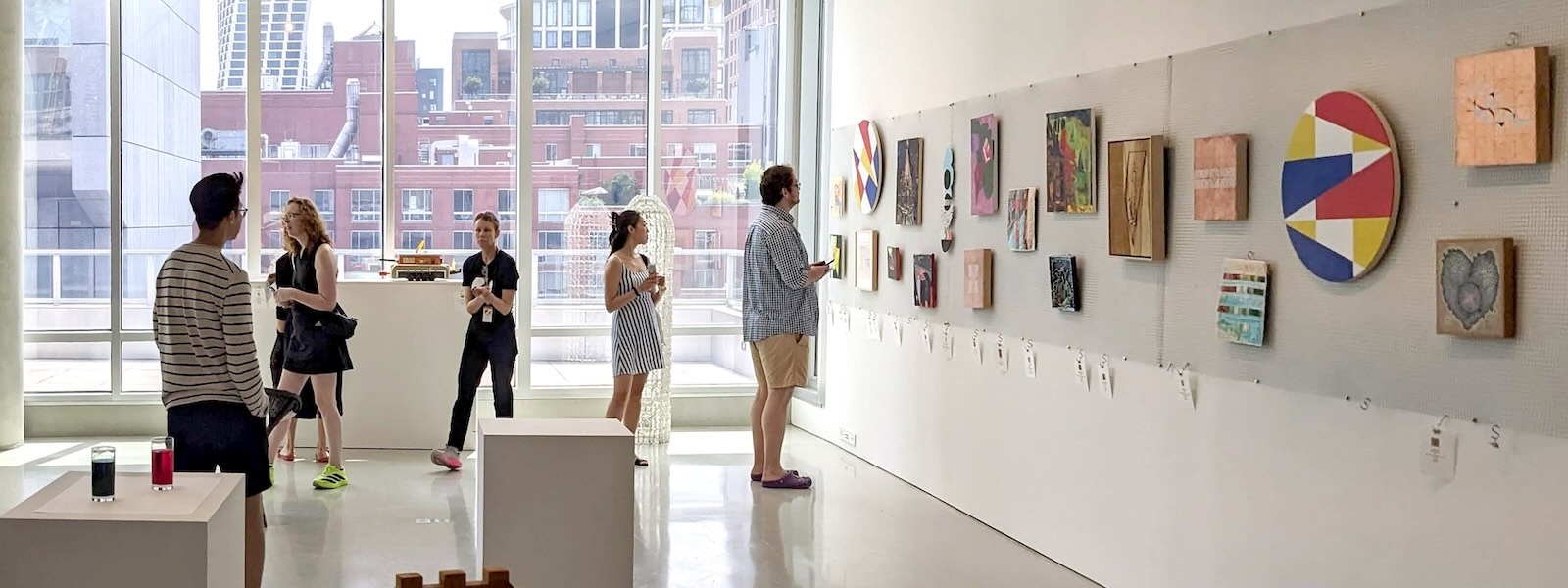
But once somebody had a ticket and assigned time slot and they came up the elevator to the ninth floor of FLAG Art Foundation, they could walk in. If they saw work that they were interested in taking home, if they had the means, they could buy the artwork outright, which happened in a few cases, or they could ask to sign the contract and take the work upstairs, have it packed up and take it home with them that day. That’s the basic process for how people would get work.
Inevitably in that equation, there was always somebody who would say, “When do I pay?” And we’re like, “You don’t, not yet.”
Pier Carlo: Unless you want it to buy it outright, like you said.
William: Yeah, unless you want to buy it outright, you don’t have to put any money down to take this work home. But if you were to sell the work after a period of five years, you would have to pay the artist 50 percent of that at-sale price.
Jennifer: And the artist never gives up copyright. So the new friend, the collector, takes immediate physical possession of the work.
Pier Carlo: I love that in the contract your collector is called friend.
Jennifer: Yeah. Well, as Amy Whitaker, who helped Bill with that original contract has mentioned, the contract just gets less. It started out extremely friendly, but as we’ve had to strengthen the language, it’s getting a little less friendly, but it still has some friendly aspects. [She laughs.]
The person who’s holding the work, who’s storing — Bill originally called the contract “Store to Own” —they’re storing the work for five years, and ownership is gradually vesting. Then after five years, they will, if nothing changes in the interim — there’s a couple of caveats — the new owner, the new storer completely owns the work outright.
Pier Carlo: But should the new owner, the new friend, sell the work thereafter, the artist gets a portion of proceeds from any future sales, is that correct?
Jennifer: Yes, 50 percent.
William: Yeah, this would be technically the first sale of the work, and the artist would also be granted subsequent resale royalties on future sales of the work, a 10 percent resale royalty that definitely borrows from European Droit de Suite and resale royalties that those artists get to enjoy.
Pier Carlo: Because here, should either of you sell a work of art to a collector, you have no more rights to that work of art.
Jennifer: No.
William: No economic or moral rights.
Jennifer: The collector can pretty much do whatever they want.
William: Yeah. So we asked Alfred Steiner to see if he could graft on some of the language from French moral rights for artists, including the ability to ask that a work not be necessarily exhibited in an exhibition that the artist didn’t want their work to be shown in. Things like that.
Pier Carlo: It seems to me, because I’m an idealist, that this should be par for the course. Is there a movement for this moral rights to happen here in America?
Jennifer: There have been intermittent movements, but I think that gallerists and art dealers will say it is already hard enough to sell art and that these resale and moral rights make it even more onerous. There are intermittent movements and we would love to be a part of that. Seeding the art ecosystem with these 400 or so works over the past two fairs, that is one effort that we’re trying to advance. It doesn’t seem to gather a lot of steam, at least not so far.
Pier Carlo: I want to make sure I understand the vesting system over those five years. It’s 20 percent each year, is that correct?
Jennifer: Yes. One of the things that could happen during the vesting period that changes the contract or that changes the trajectory is, let’s say, you have a work of mine and you’ve held it for two years and I’m approached by someone else who’d like to buy it. For easy math’s sake, let’s say they want to buy this work. They say, “Is this work available? I would buy this for $1,000.” I would go to you, you would get right of first refusal, and you would get a 40 percent discount off that price that I’m being offered because you have a 40 percent interest in the work at this point after two years.
Pier Carlo: Right, I see. And then I either get the 40% discount or I say, “No thanks,” and then your $1,000-buyer gets the work?
Jennifer: That’s right.
Pier Carlo: Has that happened yet?
Jennifer: No, it hasn’t happened. And Bill’s original bunch of work, 30-something works that he used the contract to transfer, those have all vested, right? It’s been more than five years too.
William: Yeah, all of those works have transferred, and I have not been approached by any collectors interested in buying that work. And no one has, to my knowledge, tried to sell the work after the period so far.
Pier Carlo: Because according to the contract, you would have to be notified?
William: That is one of the asks and collector responsibilities. We also tell artists to set up Google Alerts for your name or the titles of these works, because there are many regional auction houses throughout the United States where works come up for sale and they don’t have the same visibility as a Sotheby’s or Christie’s sale.
Pier Carlo: I can understand how this system benefits a collector of limited means who wants to get into the game or just loves art and would love to have art she loves in her house. How does it benefit participating artists?
Jennifer: There are a few ways. The first, most obvious one that we talk about is that most artists, especially when they get to a certain age, are storing a lot of work. Storage is expensive. It also kind of weighs you down; it’s also depressing. [She laughs.] It really isn’t sustainable for artists. It’s not like artists can give away all their work.
Pier Carlo: No, because if they did, in our system the value of their work would start to diminish, right?
Jennifer: Right. But many artists are storing a lot of work, and they could let go of a couple works. So in addition to clearing storage, which is one way it benefits artists, I think most artists really are sad to see that their work is not in a loving home, and they benefit from a new connection made with a person who would not normally be able to afford it. I know for many of us, it’s an awkward, uncomfortable situation for our work to be priced at an amount that people in our class cannot purchase, so to be able to make work available to “regular people” is a really beautiful thing.
Then a third thing, I would say, is that there is an activist component to this, where we’re trying to enlarge the community of people who feel that art is for them. We feel that if that community can be enlarged, if more people feel like fine art is something that is not just for the elite, that would increase art support in the general population. Bill and I have been saying for a long time, “Art needs to make friends.”
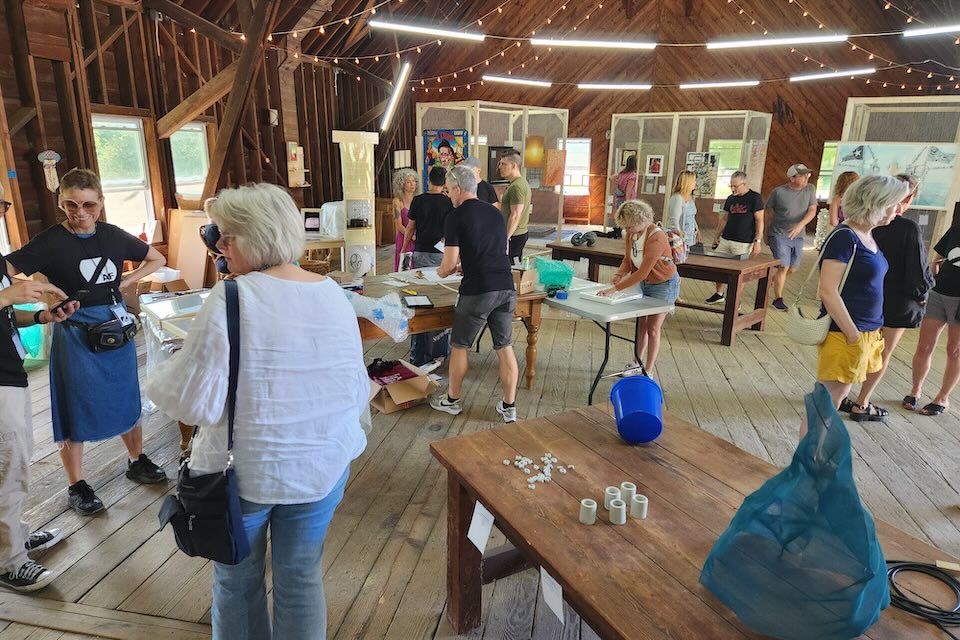
Zero Art Fair in Elizaville 2024; Photo credit: Zero Art Fair.
William: Yeah, I think if you’re trying to make an argument that there should be greater public funding for artists, this is an avenue in which art can get outside of the 1% and the upper classes to working class people. Right now it’s a lot of people who work in the arts but also can’t afford the thing that they have dedicated their lives to. And that condition applies to a lot of artists too. A lot of us can’t afford the things that we make or the things that our friends make.
In some ways, artists have long had a system to deal with this where they often trade with each other in works of sometimes very incommensurate economic value. We do talk about this with artists, that there may not be this kind of direct material benefit from the economic value of the work, but we don’t give up on that value. We’re not just giving the work away. There’s a kind of delay in the possibility of receiving economic compensation for the value of the work, and so it’s still possible.
We hope that seeding the idea that artists could retain equity in their work, that artists deserve or should receive resale royalties is something that benefits artists as a whole or a community. That’s part of the balance. An artist might be giving up a small fraction of inventory that they’ve made, that hopefully has been exhibited previously, that has had an opportunity to sell but maybe didn’t find a buyer. There’s this longer-term benefit for the whole, rather than just to focus on, “How does this benefit me directly?”
Pier Carlo: Have you gotten any unexpected pushback or reactions from any artists you’ve approached to take part?
Jennifer: I guess I wouldn’t say unexpected. I mean, we expected pushback.
Pier Carlo: What did that look like?
Jennifer: Just artists who don’t want to give their work away and would prefer to hold onto it in their studios in the hope that it would be sold. And we are just like, “Great, this idea isn’t for everyone.” But I would say I was surprised at how few people that was. We really did get a lot of positive response and people wanting to do it, a much greater percentage than I would’ve guessed.
Pier Carlo: I’d love to hear about some fun, wonderful surprises or stories you’ve heard or experienced in the two Zero Art Fairs.
William: One comes immediately to mind. We had a reception for the artists and their new collectors that took place after the fair this fall that was sponsored by FLAG.
Pier Carlo: That’s a great idea. I’m glad you did that.
William: That idea came directly from Glenn Fuhrman, who founded FLAG; it’s his collection. He thought it would be something really important to try to build these relationships, so we can thank Glenn for making that possible and coming up with that concept. While we were at that reception, one of the artists, Diana Shpungin, said that it turned out that the collector of her work was the curator of the Jack Whitten retrospective at MoMA and invited Diana to come to MoMA and gave her a three-hour tour of the show.
It was wonderful that she developed a new relationship with somebody who may be in a position to look at her work or make some connections for her. It’s one of these tricky things where we might think a curator at that level must have enormous wealth such that they could somehow afford to buy work. But we also know that many curators are not that well paid.
Pier Carlo: Right, she would be in the second bucket that you mentioned.
William: Yeah. Diana was so excited and just pleased with that outcome that I wish everyone could have that kind of same experience with their collector. We know it’s a really interesting range of people that came to the fair and were interested in taking the work home, but that one really just jumped out at me in that she had such a great outcome with placing some very large and difficult-to-place sculptures and paintings.
Jennifer: Another thing that comes to mind is that during the first fair that was part of Upstate Art Weekend — so people are running around from venue to venue to venue in the Hudson Valley — somebody came to Zero Art Fair and procured the first original art they’d ever owned. We later found out they went to another gallery, and they bought the first work that they’d ever purchased.
We kept thinking, “Well, I guess the first one’s free.” We’re starting a cycle of generosity. We are getting people to see that this is something that is within reach and encouraging people to see art that way. And we really do hope that anybody who can buy art does. Perhaps seeding them with an easy entry point can help spur that.
Pier Carlo: I wonder, because we touched on this, if either of you can remember a time when you realized, “Oh, I couldn’t actually afford a piece of my own art”?
Jennifer: Oh, I feel like artists talk about that all the time, and it creates this strange feeling to have a dollar value placed on your work out in the world that puts it out of reach of everyone you know. [She laughs.]
Pier Carlo: It’s also a mark of great success. It’s a double-edged sword, I guess.
William: I just had a very specific experience with that very question. Speaking of regional auctions, a collector of mine apparently had passed away, and the entire collection was put up for sale at a Midwestern auction house. I saw that the opening bid on a no-reserve auction was something like $200 for a piece that I believe sold for $5,000, and on social media, I was like, “Oh boy, I think I’m going to have to try to buy this one back because I might be able to afford it.” Spending anything over $500 would put a significant dent in our monthly budget; that would be the ceiling. And a few people responded on Bluesky that they would be interested. A couple of friends let me know that they were trying to maybe acquire the work for $1,000.
Ultimately, it sold for, I think, around $2,000, which is less than half of its retail value, but it does show [laughing] that my work does retain some value. But it’s a painful, embarrassing sort of thing to happen. And knowing that I certainly didn’t have the means to reinvest into my work or something.
Pier Carlo: And it’s public. There must be talk out in the world about, “So-and-so’s work sold for this amount.”
Jennifer: Oh, totally, right. One of the reasons that galleries dislike auction sales in general is that they’re public and not controllable.
William: Yeah. I think Jen mentioned that retail prices are something of a kind of phantasm or something. It’s not just a myth; myth is almost too neutral. It’s like a specter. You’re almost haunted by these prices because if works aren’t selling for their estimates or above their estimates, it’s like this work is broken or it doesn’t have the value that it claims.
So few works actually make it to auction. There’s a kind of institutional bias already that the main auction houses are taking works that they know they can sell, given that they already have an audience. Obviously, there’s some risk and they can’t predict the whole thing, but it’s very choreographed to give the appearance that art is this stable, lucrative investment vehicle. That is just not the experience that most of us have, whether it’s selling work in the primary market, achieving very, very high prices for the work, or having a second life in the secondary auction market and becoming a kind of commodity.
Jennifer: Right. The other thing about prices being some sort of, I don’t know, propagandistic phantasm or something is that they never publicly go down. So if I have a show where my 20 artworks are priced at $10,000 and none of them sell, at my next show in a few years, they will be priced at $15,000. [They both laugh.] What kind of so-called market is that? Because you can’t ever upset people who bought your work for the higher price by lowering your prices. But then it just means that your prices get further and further from reality.
William: It’s based on this notion that there’s a fairness standard in retail, but the art market doesn’t operate like a lot of other familiar markets. The pricing system is mono-directional upward. But in this idea of fairness, the question is, who is it fair to? Is it only fair to people with the means to buy the artwork? Or could we think about fairness progressively and think about price as being something that’s flexible for different audiences, different demographics within our market-based consumer society.
It’s a question that I think is still one of those very touchy or sore points around this idea of fairness in the art market.
Pier Carlo: And then there’s also the value of selling a work to a museum. We talked about storage. Most museums’ work ends up in storage, but there’s value added to your stored work when you can say in your bio that such and such museum has your piece in their permanent collection, correct?
Jennifer: Absolutely, right. And that’s why many times museums actually don’t purchase work; they receive donated work.
Pier Carlo: Oh, say more about that.
Jennifer: Art museums often either get a very steep discount on a sale price, or it will be arranged for a collector to purchase a work and then donate it to the museum and then the collector gets the write-off on that donation and a museum gets the work for free. Or in some cases, a donation is brokered directly from an artist, but museums, because of their storage needs, won’t necessarily take the work. Most work that would be offered to a museum, the museums won’t actually take.
But if you have, for instance, a large work that you’re having trouble storing and —
Pier Carlo: They will gladly accept it.
Jennifer: Exactly. If you can get a museum to accept that donation, it’s good for everyone.
Pier Carlo: This is a bit of an out-of-left-field question, but does each of you remember the first work of art you loved that you were able to afford?
William: Yeah. My wife and I were visiting Schroeder Romero, which was a gallery I ended up actually showing with a few years later. We were at a group show they had curated, and there was a small painting, part of a group of small works by this artist, Jaq Chartier, who was from Seattle. I had just become aware of their work because I was participating in a group show in Seattle.
It was a $400 painting, and my wife and I made a payment schedule with the gallery to pay it off over a period of four or five months. That was the first work we both agreed upon that we would purchase for our tiny apartment in Williamsburg at that point.
Pier Carlo: Well, you just taught me something. I didn’t know that you could make payment arrangements with some galleries.
William: It’s possible.
Jennifer: Yeah.
Pier Carlo: OK. What about you, Jen?
Jennifer: What’s funny is I still have this work hanging next to my bed in my bedroom. I’m not able to remember the artist’s name right now, so that is terrible. In the ’90s, I bought a piece at a small gallery in L.A. called Miller Durazo. I remember that they were these little drawings, and I think they were priced at $200 unframed and $300 framed. Some of them were unframed, and some were framed. And what I wanted was one of the framed ones, but I couldn’t afford to have it framed, and so I was like, “Can I get this one, but can I have it unframed?”
I was such a novice. I didn’t know that you can’t just pop the thing out of the frame, because the frames aren’t from Target. [She laughs.] And so I was really, really stuck when they said, “You can have that work, but actually, you’re going to have to take it framed. We’re not taking this out of the frame.” And so I had to go home and think about it.
Pier Carlo: For the extra $100.
Jennifer: Yes, the extra $100. And I came back, and I did it.
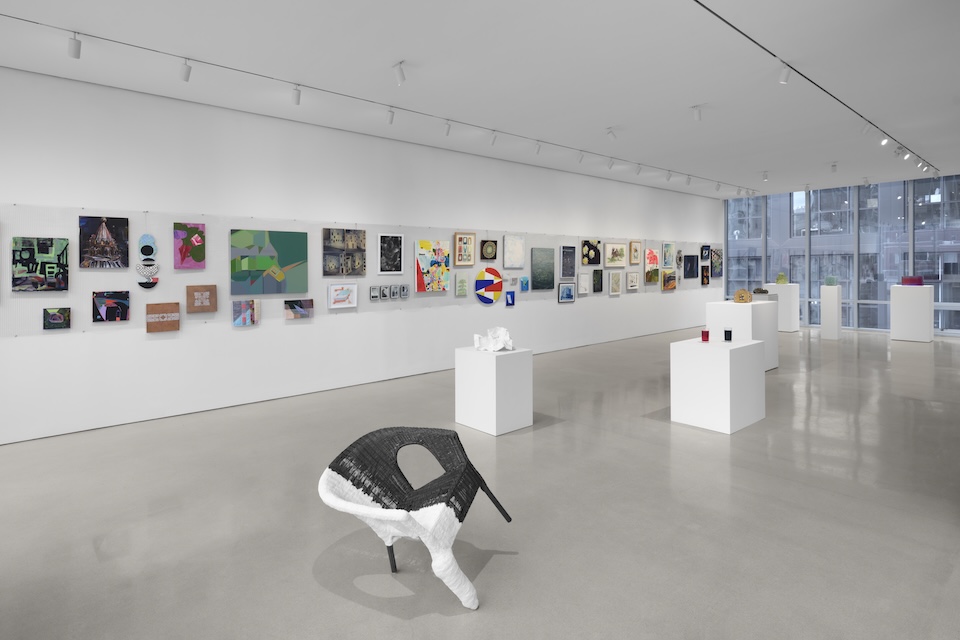
Zero Art Fair at FLAG Art Foundation 2025; Photo credit: Steven Probert.
Pier Carlo: Given the work that you’ve done critiquing the art world, has any part of Zero Art Fair felt like a work of art?
Jennifer: We’ve talked about this, and we don’t see it as a work of art, but it’s a lot of the same creative and satisfying problem-solving efforts. We both have conceptual practices, and I think it does feel sometimes like a big collaborative art project, even though I think neither one of us would call it our artwork.
William: Yeah, I don’t think it helps the fair to claim it as a work, even a collaborative work.
Pier Carlo: Yeah, it makes it a little more elite in a certain way.
Jennifer: And it makes it about us.
William: Yeah, we don’t have to center ourselves in this project. There is a hope that this project is a model, that it’s a template that other people with the right funding and interest in communicating with us could run this fair elsewhere, that it’s a little more open-source than the traditional art project. The side effect of a lot of art projects is they generate a lot of value for the artist and their career. That’s not something we’ve been so interested in pursuing.
The fair also had to be functional. A lot of people think that what makes art unique is that it doesn’t necessarily have to serve any particular function. It’s sort of autonomous. By keeping the fair art-adjacent, it allows us to think differently, to actually think pragmatically, “How does this work? No, we don’t want this to be ambiguous; we actually need to have a very clear process and method for making things happen.”
Yeah, I totally agree with Jen. It uses a lot of art thinking, it uses a lot of the same skills, and it pushes our ideas into a different part of the art world, and it really engages production and distribution of art at conceptual levels. But no, not like an artwork by Jen and Bill.
Pier Carlo: Let’s say somebody — because there are amazing artists working all over the country in big and small towns —wanted to replicate this model in their community. What would be your first words of advice to them?
William: Well, we have this question that we ask ourselves, that comes from Manon Slome: “Who pays for free?” The first piece of advice would probably have to do with how they’re going to pay themselves and how they’re going to potentially pay the artists an honorarium if there’s an exhibition component.
Pier Carlo: Your participating artists get an honorarium?
Jennifer: We were able to have that funded for the second fair.
Pier Carlo: It sounds like that’s one of your first lessons to somebody else who wants to replicate it, that there is startup cost.
Jennifer: Yeah. I mean, the venue. And really it’s quite a lot of time; it’s quite a lot of admin.
William: But I think what we hope too is that by creating a model, this kind of template, that if we’re able to really take what we’ve done internally, put together almost a kind of handbook for how you could do this, if another community or another institution sees the benefit of being able to tap a little bit of this vast inventory of work sitting nationally in storage spaces and studios, under people’s living rooms or [laughing] in barns all over the country, that that would be really a public good. Maybe it is worth putting a few thousand dollars or up to $50,000 together to get, in our case, up to half a million dollars of retail artwork out into homes.
I think that is a really interesting value proposition. Whether or not those retail prices are real, the work has this other set of values: aesthetic, conceptual, spiritual. Your question about the first artwork that we were able to buy or live with, that’s something we want other people to be able to experience, that interesting thing that happens when you have a unique object in your home over a long period of time. In some cases, maybe a child grows up with it and sees that art is something that’s in their home that’s accessible to them. That was a kind of motivating thing, I think.
I heard from another artist not too long ago that one reason to make physical objects after having a digital or less material practice is that their work could live in a home and be experienced outside of institutional settings.
Jennifer: And I would add one of the core tenets of Zero Art Fair is that price doesn’t equal value. It’s about decoupling those two ideas. Even if the people get the work for free and they have it in their home, I think that they can really feel viscerally, emotionally, spiritually, the value of having that work. And it has nothing to do with how much they paid for it.
Pier Carlo: Are you already planning fair number three?
Jennifer: We’re figuring it out. We’ve been taking it one year at a time.
Pier Carlo: Good for you.
Jennifer: But yeah, we’re figuring it out. I don’t think we’re done, though.
Pier Carlo: Oh, I’m glad to hear that.
I want to end with your own artmaking and hear from each of you what you’re working on now or if there’s something you’re about to start that you’re really excited about.
Jennifer: Do you want to go ahead, Bill?
William: Well, I think I’m happy to report that I just finished a cover for Art Review magazine. They do a kind of annual Power 100 list. It’s kind of absurd on its face that [laughing] there is this kind of strict hierarchy of power in an art world when so many people would love to make things less hierarchical. So many of the artists and people on the list are working to change this model that somehow we all seem to reproduce constantly. So it was a tricky, fun challenge to make work responding to something that I would rather not see continue.
But it got me back into the studio and making work in a way that I haven’t, between teaching, doing Zero Art Fair and just kind of contending with the world at this moment. It felt good to make that work. I think I’m more likely to maybe start a new body of work soon.
Jennifer: Similarly, I got back in this studio. Actually, I spent October at Yaddo, the artist residency in upstate New York, which was amazing. Yeah, it is hard to juggle all of the things, but I’ve been working on a project called “Skin in the Game,” which is a 20-year project. I mean, it’s not the only thing I’ve worked on over 20 years. I tend to go back and revisit and reinvent and reimagine projects at intervals, so it’s something I’ve worked on off and on for 20 years.
It’s chronicling the post-industrial evolution of the neighborhood I live in, Williamsburg, Brooklyn. It has a very toxic recent past, in the past 20 years. I started chronicling all these buildings and all these sites that were designated by the EPA as potentially hazardous to the community in 2004. Then over the last 20 years, countless of the almost 400 sites are now residential and boutique —
William: [He laughs.] Luxury residences.
Pier Carlo: And were not cleaned up?
Jennifer: Actually, it’s really hard to find out if any mitigation was done. The sites all have sort of different trajectories and it’s buried in bureaucratic ... . I need a degree in journalistic research practices to try to find out.
There are 394 sites. I photographed them all in 2004 and 2014 and then again in the fall of 2024. And I’m building a big installation out of them and trying to research what was done on the various sites so that I can include that in the installation.
January 07, 2026
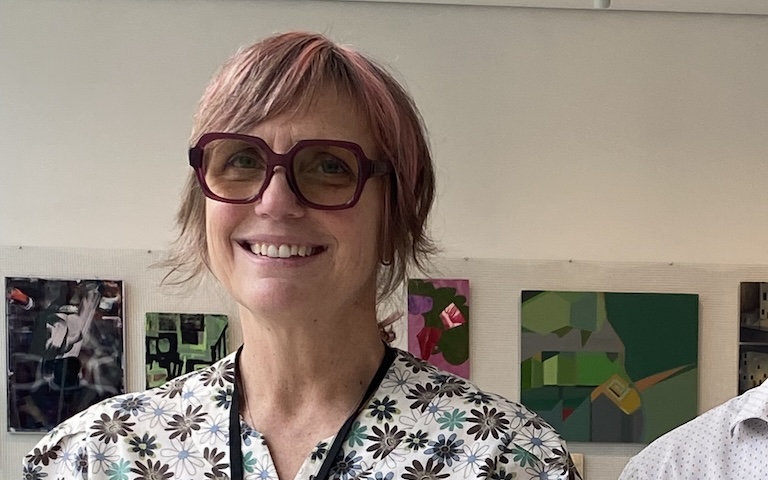
Jennifer Dalton
Interdisciplinary Artist
Jennifer Dalton is a Brooklyn-based interdisciplinary artist. In her research-based installations, she collects and evaluates cultural information, often choosing a subject to test a hypothesis. She frequently invites viewers to assess themselves and each other through interacting with her works. Since 2008 she has collaborated with William Powhida on art interventions addressing problems of access, hierarchies and power imbalances, among them #class in 2010; Month2Month, in conjunction with More Art, in 2016; and Zero Art Fair. Photo credit: Amy Whitaker.
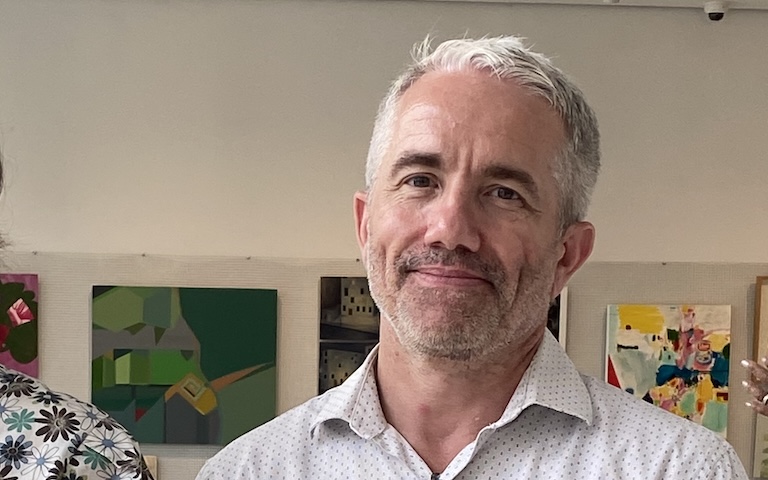
William Powhida
Artist and Critic
William Powhida is a Brooklyn-based artist-critic whose work examines the paradoxes and ironies of the social, economic, and political infrastructure that produces the ‘art world.’ His work relies on research, participation, and collaboration to diagram, list, perform, and critique the forces that shape perceptions of value. His self-reflexive method often involves looking at his own practice including his inventory of accumulated work. Zero Art Fair represents another collaboration with Jennifer Dalton informed by their work with FIPCA, a loose-knit collective that produced the Telethon for the 1%. Photo credit: Amy Whitaker.
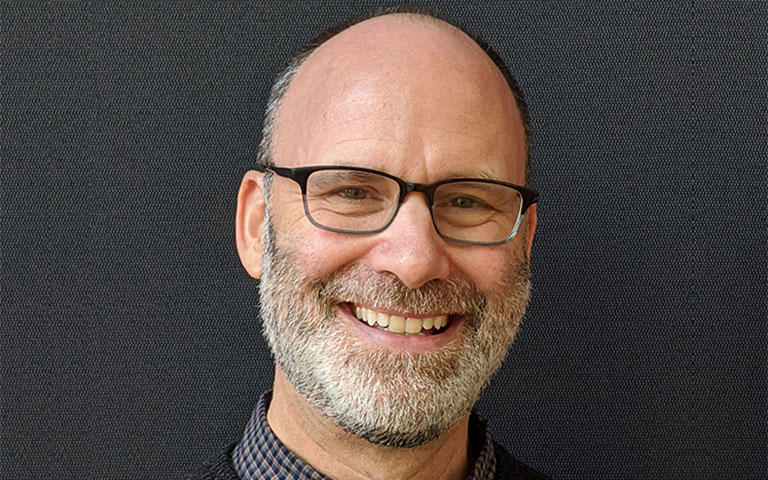
Pier Carlo Talenti
Podcast Producer & Host
Until 2016 Pier Carlo Talenti was the director of new play development at Center Theatre Group in Los Angeles where he oversaw one of the country’s most vigorous new-play commissioning programs. Over 20 years he developed scores of new works for the theater by the some of the country’s most innovative theater artists, and his combination salon/playwriting group, the Writers’ Workshop, counts among its alumni/ae extraordinary playwrights who are also currently producing and writing TV’s most exciting shows. He is currently a resident of Hillsborough, NC, where he is pursuing his own creative projects.