

Turning point: Community Innovation Lab primed for action
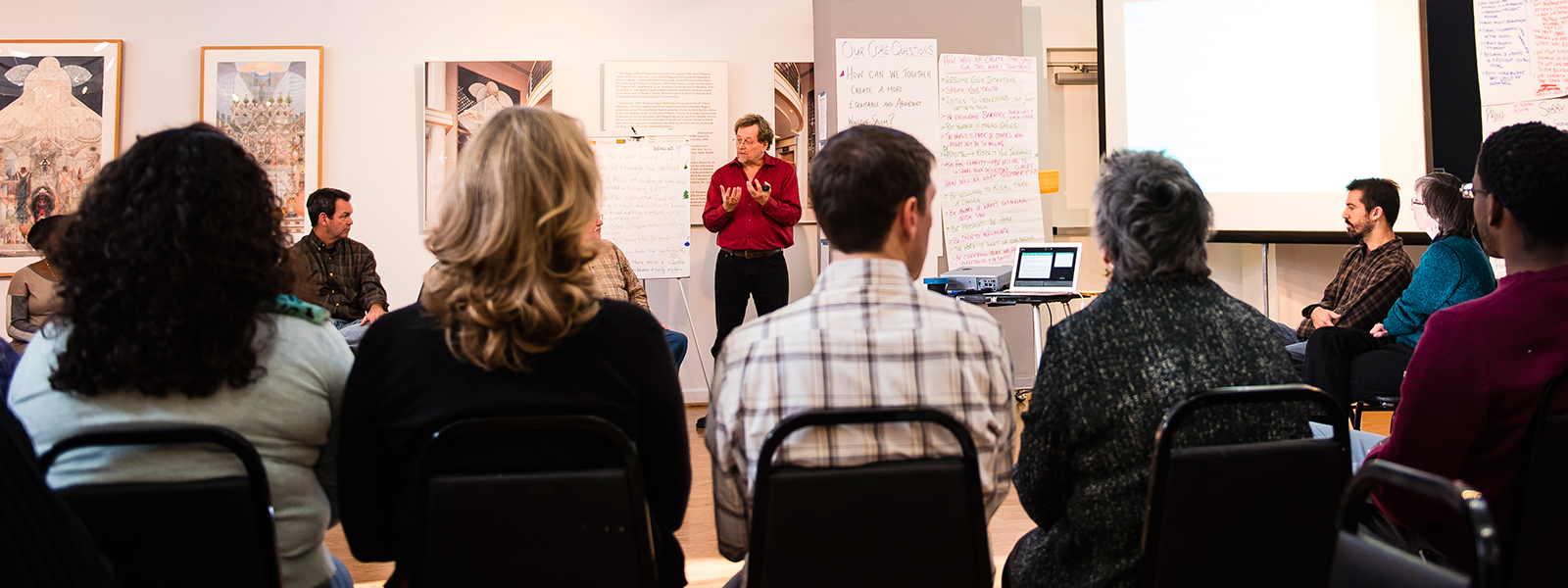
Members of Winston-Salem’s Community Innovation Lab have reached a turning point in their journey, deciding at a recent workshop to focus on specific interventions they believe could help transform the city into a more equitable and abundant place for all its residents.
“This is the pivot moment,” said Richard Evans, President of EmcArts, a nationally known service organization based in New York City that is designing and facilitating the Lab with primary funding from the Kresge Foundation.
“We really are moving from understanding the dynamics of the system, and what needs to change, toward developing some significant interventions that will be tested,” Evans said during a Lab workshop Feb. 26-27. “So for those who have been waiting for the action to begin, this is the time.”
The Winston-Salem Lab has brought together a diverse group of stakeholders, including city agencies, community organizers, business leaders, artists, cultural organizations, faith-based organizations, nonprofit service providers as well as those affected by poverty, to address inequities in employment, income and wealth in the city. The Lab was convened last fall by the Thomas S. Kenan Institute for the Arts at the University of North Carolina School of the Arts, The Arts Council of Winston-Salem and Forsyth County, and The Winston-Salem Foundation.
After a break of several months, during which teams of Lab members worked on “small experiments with radical intent,” the full group gathered recently at El Buen Pastor Latino Community Services.
Representatives from each team described the experiments, which ranged from simply reading books about poverty to better understand the issue to conducting “listening conversations” with residents of a low-income apartment complex to find out what barriers they face to living healthier and fuller lives.
One such experiment, a mentoring group for female entrepreneurs, really took off, said Mary Haglund, a chef and owner of Mary’s Gourmet Diner.
“I have a burden for women in my community that also want to be entrepreneurs,” she said. “There are systems that I feel like need to be interrupted. We are treated like a minority when we are a majority.”
Haglund was moved to tears when she talked about creating the group “Mary’s Mavens” on Facebook and quickly attracting nearly 300 members. Sixty women came to the first meeting.
“I knew there was a need,” she told fellow Lab members. “The energy was palpable. These women were like sponges — everybody started feeding each other. It was an amazing experience. We are now doing workshops on life coaching, finance, startup businesses.
“I am not a joiner by nature. I’ve never been a part of anything remotely like this. Then you gave me something to do. And it has been astounding.”
After discussing their experiments, Lab members spent the rest of their time together examining a dozen proposed strategies for systemic change that grew out of their work last fall and deciding which of the interventions they wanted to pursue further. They considered whether the interventions could play out over time on a broad scale; could clearly disrupt ingrained mindsets and structures that drive the way things now work in Winston-Salem; and could incorporate opportunities for artists and cultural organizations to play central roles moving forward.
The group voted to focus on four system interventions, or “clusters,” in the coming months:
- The Art of Dialogue: Create arts-based forums for the community to share ideas, information, experiences and assumptions about race, class and power for the purpose of personal and collective learning.
- An Inclusive Economy: Build radical new structures of mutual support for entrepreneurs and small business owners who traditionally have been excluded from access to capital, such as people of color, women, artists and low-income residents.
- One-Stop Shops for Social Services/Wraparound Justice: Find inventive new ways to integrate and simplify the experience of accessing social services, focusing on a personal and holistic approach, such as community centers or mobile delivery. Lab members also expressed interest in developing peer-to-peer support networks and wrap-around services for people currently in the justice system and those re-entering the community.
- Equitable Schools/21st Century Skills: Activate a network of unusual community partners to accelerate work toward equity in public education, advancing issues of school segregation, funding disparity, biased discipline, culturally relevant curriculum and staff diversity. Create new pathways for young people to develop the 21st century skills they’ll need to adapt to a changing economic landscape in Winston-Salem by curating robust new partnerships between students, parents, educators, businesses, creative industries, training institutions and workforce development.
Evans asked Lab members to brainstorm the names of others in the community they need to invite to further explore these system interventions at the group’s next workshop, planned for April 22-23.
“If these clusters are to be successful, to be leveraged so that you get a big bang for your buck, which agencies, organizations and individuals really need to be involved?” he asked.
The core questions driving the Lab’s work include: How can we create a more equitable and abundant Winston-Salem? How can we move systems of race, class and power to do so? How can we, as a community, build enough trust to enable transformative change to happen?
EmcArts recently received a grant of $1.5 million from the Kresge Foundation to support completion of its two pilot Community Innovation Labs, launched in 2015 in Winston-Salem and in Providence, Rhode Island, and the launch of two additional Labs in communities across the United States. With the grant from Kresge, along with local funders and conveners, EmcArts has committed to a two-year investment in the Winston-Salem community totaling $1 million.
Karina Mangu-Ward, a lead facilitator for EmcArts, said the Kresge funding can support the work of up to three clusters through April of 2017 with a grant of up to $60,000 for each.
Lab members collectively expressed a desire to move forward.
“The fact is, the federal government and state government don’t care about us,” said Ralph Womble, Vice Chairman of the Downtown Winston-Salem Partnership. “If we don’t fix it, nobody will.”
Rebeccah Byer, an artist entrepreneur who owns The Olio glass-blowing studio, said the issues the Lab is grappling with are the kind that keep her up at night.
“And this is the work that wakes me up in the morning,” Byer said. “Knowing that there is a room full of people who are all committed to doing the hard work and asking the difficult questions is really important to me.”
More Information:
March 23, 2016