

The difficult — and rewarding — work of systems change
Nobody promised the work would be easy. Or the solutions simple.
But the rewards? That’s what members of Winston-Salem’s Community Innovation Lab tried to focus on when plowing through some of their most difficult work to date: more deeply defining interventions that could help transform the city into an equitable and abundant place for all residents.
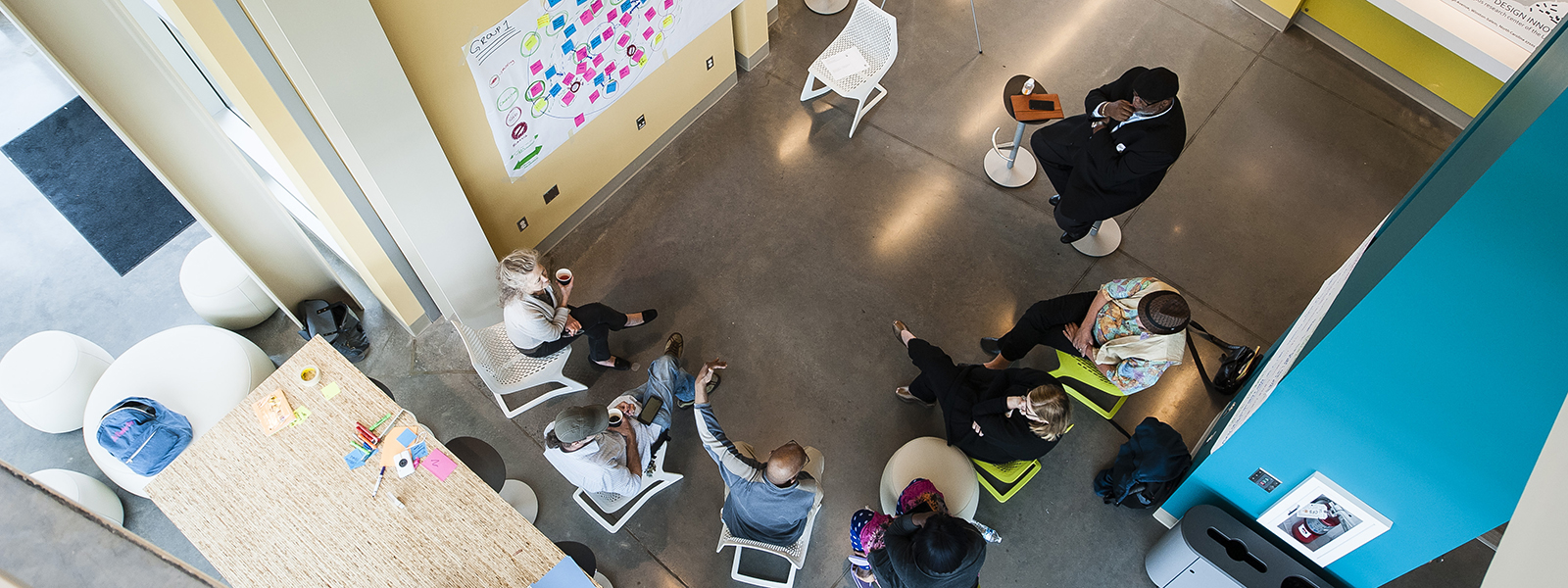
Lab members gathered for a two-day workshop April 22-23 at the Center for Design Innovation. Since beginning work last fall, the group has moved from understanding the dynamics of the system — one in which inequities in employment, income and wealth persist — toward developing significant interventions that could change the system. The interventions are designed to disrupt ingrained mindsets and structures that drive the way things now work in Winston-Salem while incorporating opportunities for artists and cultural organizations to play central roles in moving forward.
On the first day of their workshop, Lab members divided into four working groups — or “clusters” — and talked with guests they had invited from the community to gather more information and feedback on their proposed interventions. The guests were stakeholders in the areas of education, social services, entrepreneurship and the arts.
While some of the groups jelled quickly and refined their work with relative ease, others struggled to find common ground.
“The Art of Dialogue” working group, for example, made significant strides on its strategy to create a citywide dialogue about race, class and power in Winston-Salem.
The group decided to explore the creation of a decentralized, autonomous organization that would make grants to organizations or residents interested in hosting arts-based forums, such as a screening of the film “Honky.” In return, the hosts agree to “pay it forward” with a portion of the grant money, such as providing food for the needy or establishing a community garden.
Tommy Priest, the owner and operator of Coffee Park at Hanesbrands Theatre, said a showing of the film he organized last winter sparked a lively conversation about issues of race in the community. “And you are creating the potential for people to do more good with the money than just showing the film,” he said.
Corey Madden, Executive Director of the Kenan Institute for the Arts at the University of North Carolina School of the Arts, liked the idea of breaking new ground.
You are asking the world, ‘Do you want to see Winston-Salem become a more diverse place?’ Trying to break the boundaries down is really what we are talking about.
Corey Madden
“It’s the idea of contribution vs. donation, investment vs. sponsorship. You are developing a following that believes in you and in your cause. You are literally developing your own community.”
Another of the Lab’s working groups struggled to find a focus for its work. While members of the “Holistic Social Services” cluster talked about how difficult the current system can be for families to access, their guests stressed the complex state and federal regulations their agencies have to deal with on a day-to-day basis.
“There are pieces of this (intervention) I cannot do anything about,” one guest said. “There are restraints that are put on us by government statutes. I think that’s why you should focus on nonprofits who have a lot of flexibility. I don’t have flexibility.”
Jacinta White, a local poet and facilitator working with the Lab, tried to keep the group on track yet give its members space to speak their minds. At times the conversation grew tense.
“Anything new, innovative, creative, powerful, significant requires messiness and conversation that gets to a collective purpose,” White said after the workshop. “We experienced that in our group — lots of questions, digging, circling around, clarification, ‘what-if’s. All of this can be heavy and taxing but each member carried the weight collectively.”
In the end, White said, the team “was able to rest with the direction of the intervention. For now."
The Lab is just that — a place where these bright, creative, deeply committed and concerned individuals can think through and practice the change they hope to initiate in the community at large.
Jacinta White
Richard Evans, President of EmcArts, told the guests at day’s end that inviting them into the process to test the Lab’s emerging ideas inevitably would create a disruption. “You were questioning the premise of what the groups are doing,” he said. “We wanted to ask you to come in to get your feedback and input, but not to make that the end of the journey.”
One guest described the experience as “uncomfortable,” another said she can’t wait to see how the Lab’s plans take shape. Yet another acknowledged, “When there is no struggle, there is no progress.”
Madden, who worked as a director and producer for 30 years before joining the Kenan Institute, likened the process to being in the rehearsal room.
“It’s essential to get feedback at a certain point in the process, especially when you are working on things that are new. Inviting people in from the outside to give commentary can be disruptive in ways that feel exciting and deflating, but in general that deflation is temporary,” she said. “One of the great lessons of being an artist is the ability to take feedback, reframe and gain new perspective.”
The following morning, Lab members began to do just that. They heard from two speakers who specialize in the arts and systems change: Stephanie V. McKee, Artistic Director of Junebug Productions, and George Scheer, Co-founder and Director of Elsewhere, a living museum and artist residency set in a former thrift store in downtown Greensboro.
Born out of the Civil Rights Movement, Junebug is a leader in the progressive arts movement and has worked in more than 500 communities across the United States. Central to Junebug’s art-making and community engagement work is a process called the “story circle,” a gathering to collect personal stories from people significantly influenced by the movement.
McKee said the process has helped her facilitate some difficult community discussions.
“The idea of casting in the circle to do the work, there is a value attached to that,” she explained. “The circle is a representation of what we would like democracy to look like for us — the idea of equality in the space, not a hierarchy.
“You can share a story from your own perspective, your personal story. It allows us to gain insight into what the problem is from a much deeper place of humanity.”
People today are hard-wired to react rather than to listen, McKee added.
“I am locked and loaded, and wishing that someone would say something to offend me, because I have the perfect comeback,” she said. “This isn’t about the perfect comeback. This is about actually sitting and listening. It is a deep artistic tradition that can connect people deeply.”
Scheer said socially and politically engaged artists can be system changers.
Artists can see what is there and what is present. Artists can say things to people that others cannot. They can call people out in a way that is constructive and challenging.
George Scheer
EmcArts has received a grant of $1.5 million from the Kresge Foundation to support completion of its two pilot Community Innovation Labs, launched in 2015 in Winston-Salem and in Providence, Rhode Island, and the launch of two additional Labs in communities across the United States. With the grant from Kresge, along with local funders and conveners, EmcArts has committed to a two-year investment in the Winston-Salem community totaling $1 million.
The Kresge funding can support the work of up to four clusters, which will develop and test prototypes of their interventions. Madden invited the groups to continue their work at the Kenan Institute’s new Creative Community Lab in the historic Railroad Building on South Liberty Street.
Lab members left the two-day workshop on a hopeful note.
“These labs, sometimes, have been exhausting, but I always leave energized,” said Jonathan Halsey, Director of Community Engagement for The Winston-Salem Foundation. “It’s funny how that works. I left yesterday wondering what is going to come of all this. But we pulled together today.”
Madden agreed, adding that most everyone involved found new clarity about how to design change that is truly innovative and systemic.
“It’s meant to be experimental… .Whether it’s 100 percent successful is not the point,” Madden said. “The point is that you have moved the conversation forward and are contributing to the success of the future. Progress is a shared experience.”
Origins and Design of EmcArts Labs Existing Pilot Sites for EmcArts Labs
The Conveners
- The Thomas S. Kenan Institute for the Arts at the University of North Carolina School of the Arts
- The Arts Council of Winston-Salem and Forsyth County
- The Winston-Salem Foundation
The Core Questions
- How can we create a more equitable and abundant Winston-Salem?
- How can we move systems of race, class and power to do so?
- How can we, as a community, build enough trust to enable transformative change to happen?
The Clusters
Lab members are working in “clusters” to develop strategies for four system interventions:
- The Art of Dialogue: Connect and recognize arts-based forums for our community to share ideas, information, experiences and assumptions about race, class and power for the purpose of personal and collective learning.
- An Inclusive Economy: Engage with existing structures and build radical new structures of mutual support for entrepreneurs and small-business owners who traditionally have been excluded from access to capital, such as people of color, women, artists, creative enterprises, Eastside residents and low-income residents.
- Holistic Social Services: Create a prototype to help identify community residents’ needs, assets/knowledge and desire for community art; integrate community and social services; and develop a long-term strategy and a shared database system by neighborhood.
- Equitable Education:Activate a network of dynamic community partners to foster a learning environment that is culturally humble and respecting by addressing the root causes that lead to race-based bias and barriers to literacy.
May 16, 2016