Kenan fellowship frees UNCSA professor to pursue “dream project”
Before Norman Coates and Corey Madden crossed paths, the former was cruising through the twilight years of a distinguished career at the University of North Carolina School of the Arts.
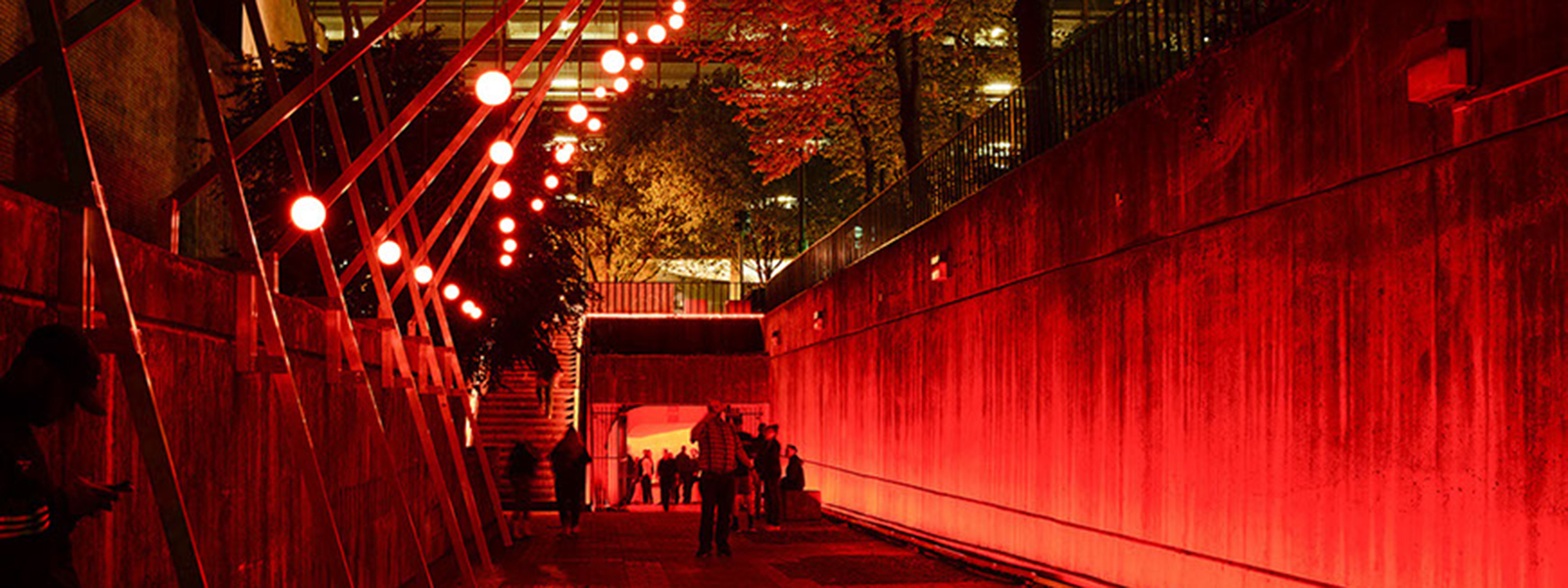
In fact, the Director of Lighting for UNCSA’s School of Design & Production had made a name for himself far beyond the confines of any classroom or stage. Each year since founding the Winston-Salem Light Project in 2008, Coates and his lighting design students have transformed an ordinary landscape in the city into an inspiring work of public art, delighting tens of thousands of people.
It was Coates’ project along the Winston-Salem Strollway in 2014 that first captured the attention of Madden, then the new Executive Director of the Thomas S. Kenan Institute for the Arts at UNCSA. Aptly titled “Artery,” the multimedia installation transformed a half-mile section from downtown to the Southeast Gateway into a series of arches that mirrored the movement of pedestrians in and out of the city center.
“I’ve heard people say that the School of the Arts was invisible in this town. One of the most vivid examples of how that isn’t true is the Light Project,” Madden says.
“On a simple level, I just thought it was beautiful. On a strategic level, I realized it was a very visible example of how artists make a difference, how they improve our quality of life. I saw Norman as an innovator.”
When Madden actually met Coates, she asked him a question she frequently poses to fellow artists: What is your dream project?
“He said, ‘Well, if I could start my own business and light buildings all over the world, that would be wonderful,’ ” Madden recalls. “I’m not sure he thought that was a reasonable thing to dream at the time.”
Ah, but it was. When the Institute decided to establish a Kenan Arts Research Fellowship in the fall of 2016, Madden remembered Coates and his dream project.
“Corey coerced me, gently, into considering it,” says Coates, one of two inaugural Fellows. “It seemed a great path to take to fulfill several needs — mine, UNCSA’s and the Kenan Institute’s.”
These days, Coates has added the title “entrepreneur” to his long list of credits, spending two days a week in his other office at the Creative Community Lab, which the Kenan Institute opened last year in the historic Railroad Building on South Liberty Street in Winston-Salem.
His work is becoming more well-known, and he and his students have even had the opportunity to illuminate one of the most prestigious buildings in the country – the White House.
The year-long fellowship has allowed Coates to cut back his teaching schedule and focus on two major endeavors: launching the Light Project into a commercial venture that specializes in architectural lighting and researching a possible new graduate program in the field at UNCSA.
“Since we started the Winston-Salem Light Project, I get endless calls from people who are interested in doing this somewhere else. And the fact is, my students can’t take on the extra work,” he says. Until now, the project has been limited to one installation a year supported entirely with grants, corporate gifts and private donations.
“I had been thinking about it for a while, but I had held back because of time and energy and how much time I spend at school.”
Over the summer, Coates formed Light Project LLC. Currently he has two projects in the works, one for the city of Chapel Hill and another in downtown Winston-Salem.
His biggest challenge thus far?
“For so long, I’ve never needed other people to help me fulfill what I need, other than a producer. Now I need expertise outside of my expertise to actually be able to accomplish my ideas,” he says. “It’s become far too complicated to do alone. I can’t be a lawyer. I can’t be an accountant. I can’t be all those things. It’s defining and finding how I need help and how to pursue that help.”
Coates also is conducting research on a graduate program in lighting architecture and entertainment — “architainment,” he calls it.
“It would be a combination of lighting architecture in an artful way and as an entertainment vehicle,” he explains. “You would put students of varied backgrounds together to explore ideas and perhaps even products once we get to creating pieces of art.”
For Madden, the new fellowship fulfills the Kenan Institute’s mission to build the creative community at UNCSA and in Winston-Salem.
“Our faculty are among the most talented practitioners in their field and, unfortunately, they don’t get regular sabbatical opportunities. When I came here I saw that one need for senior faculty was to be able to step back from their teaching and create important connections between their university life and their field,” she says.
“Norman is a great example of freeing a very important teacher to be entrepreneurial, to think in a visionary way, to be a leader.”
Coates, who has taught at UNCSA for more than 25 years, is extremely grateful for the opportunity to transform his career at this stage in his life.
“The Kenan Institute and Corey recognized the value of the Winston-Salem Light Project, he says. “It’s been eight years of work, and to get that recognition and be given the opportunity to move that forward as a project is invaluable and remarkable.”
February 3, 2017