Percussionist uses Kenan faculty grant to help cancer patients heal
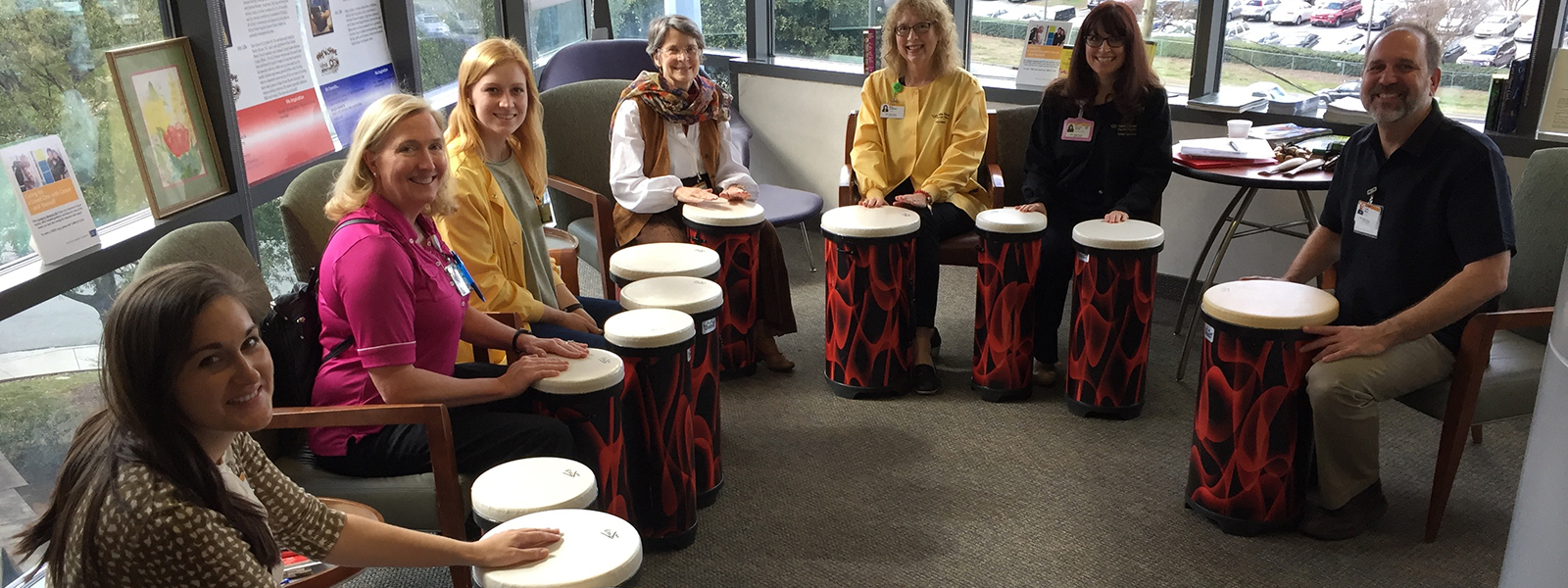
It was that grab-your-heart kind of moment when percussionist John Beck knew that his outreach work in therapeutic music truly could make a difference.
One day, a cancer patient taking part in Beck’s interactive community drumming circle at Wake Forest Baptist Medical Center asked to speak to the group. “I have been in and out of lots of hospitals, and this is the best I have ever felt,” the young man said. “Thank you.”
That patient is now a regular: Whenever he returns to the Comprehensive Cancer Center for treatments, he also returns to the drum circle. “What he said confirmed everything we were seeing,” says Beck, who volunteers at the hospital every week.
“When we are done, everybody feels good and everybody is smiling. That is rewarding for me. I can’t say that all my students smile at the end of their lessons,” Beck jokes.
A music professor and chair of the Brass and Percussion Department at the University of North Carolina School of the Arts, Beck is a recipient of a Faculty Leadership Grant from the Thomas S. Kenan Institute for the Arts for his project titled “Community Drumming in Cancer.” The grants are designed to give UNCSA faculty opportunities to lead, engage diverse stakeholders, and explore creative strategies and initiatives for further study or implementation.
The Kenan Institute grant has allowed Beck to visit seven universities that offer degree programs in music therapy to learn more about how to train students for careers in the field.
“We are not currently in a position to start a degree program in music therapy, but we can certainly help direct students better. A music therapy degree and a music performance degree are very different, and music therapy in the medical community is still very much a fringe discipline,” explains Beck, who began group drumming in hospitals as community outreach in Indianapolis in 2013, when he was president of the Percussive Arts Society.
“It’s been educational for me to talk with these music therapists and learn about their struggle in convincing the medical community that music can be a viable, non-pharmacological treatment. I’ve learned a lot about how I can do it better, but also about the landscape of music in medicine.”
Resources like the Kenan Institute’s Faculty Leadership Grant are essential to artists such as Beck, who says the creative community must continually adapt to stay relevant in today’s marketplace.
Going to the concert hall to listen to the orchestra is no longer an important social thing to do. ... Seed money to explore different ways that the arts can intersect with society or education is critical to our continued success as creative artists. We have to reinvent ourselves.
John Beck
“Going to the concert hall to listen to the orchestra is no longer an important social thing to do. What is considered entertainment today is much different,” he says. “Seed money to explore different ways that the arts can intersect with society or education is critical to our continued success as creative artists. We have to reinvent ourselves.”
One goal of Beck’s project is to document how community drumming can be used as an adjunct therapy for patients undergoing chemotherapy. His qualitative exploratory research at Wake Forest Baptist will support applications for grants from the Grammy Foundation and National Institutes of Health for a multi-year quantitative study with neuroscientists and state-of-the-art brain mapping instruments. Therapeutic Harpist Ruth Moskop is partnering with him on the project.
Previous studies suggest that improvised music-making and movement not only improve mood, cognition and overall quality of life, but also boost immune system response and relieve neuropathy.
For Beck, the work is quite personal. His first wife, a fellow musician, died after a struggle with cervical cancer in the mid-1990s.
“It is why I have a passion for it — because I have lived the cancer experience from the primary caregiver’s perspective and I know how helpless it feels,” he says.
That passion shines through, according to those who have watched the musician at work. In fact, Beck’s visits attract more than patients to the hospital’s activities room.
“My interns are in the room and the nursing staff will be in the room. Even our medical students have asked to sit in,” says recreation therapist Suzanne Thompson, who works in Wake Forest Baptist’s behavioral health unit for children.
Beck’s connection with teenagers is magnetic, Thompson says. “It is neat to see a patient who has been sad or deflated or withdrawn during the day start to open up and blossom. His energy and the vibrations of the drums and the enjoyment are contagious. We don’t like things to be contagious at a hospital — except this.”
In the classroom, Beck’s students learn about broader opportunities for careers in music-making. He offers an elective class in community drumming, and some of those students attend his drum circles at the hospital.
One of Beck’s high school percussion students recently wrapped up auditions for music therapy programs at East Carolina University, Appalachian State University and Queens College.
“I think that music therapy is such an unappreciated way to reach out to others with music, not only on a physical level but an emotional level — you connect with people,” says 17-year-old Katie Spade of Jacksonville, North Carolina. “I really want to make music therapy part of my life because it helps others and keeps me involved in music.”
Another of Beck’s primary goals for the cancer project is to broaden the definition of “community music” at UNCSA.
“For those of us who are doing interactive community drumming, the definition of community is the people who engage in the music-making together — it’s the group that is performing, not the teacher teaching the student,” says Beck, who also is principal percussionist with the Winston-Salem Symphony.
If we can think of community as making music with people, as opposed to just for people, that broadens the definition.
John Beck
“If we can think of community as making music with people, as opposed to just for people, that broadens the definition.”
In his perfect world, Beck says, UNCSA would have a music therapy program partnering with Winston-Salem State and Wake Forest universities, the hospital would have full-time music therapists and collaboration would thrive.
“We call this the city of the arts and innovation. It seems to me this is the ideal place for this kind of partnership. But I am also mindful that right now I am just a percussion teacher here,” he says with a laugh.
March 2, 2017