

Kenan Fellows experience defining moments at Aspen Music Festival and School
As Zoe Johnson remembers it, playing the role of Laurey in her middle school’s presentation of the popular musical “Oklahoma” became a defining moment in her life.
“I was 14 and it was the most incredible, life-changing moment in my performance career,” recalls Johnson, a soprano who later would become a Fletcher Opera Institute Fellow at the University of North Carolina School of the Arts.
“You know when it feels right,” she says. “I knew I wanted to pursue a career in it.”
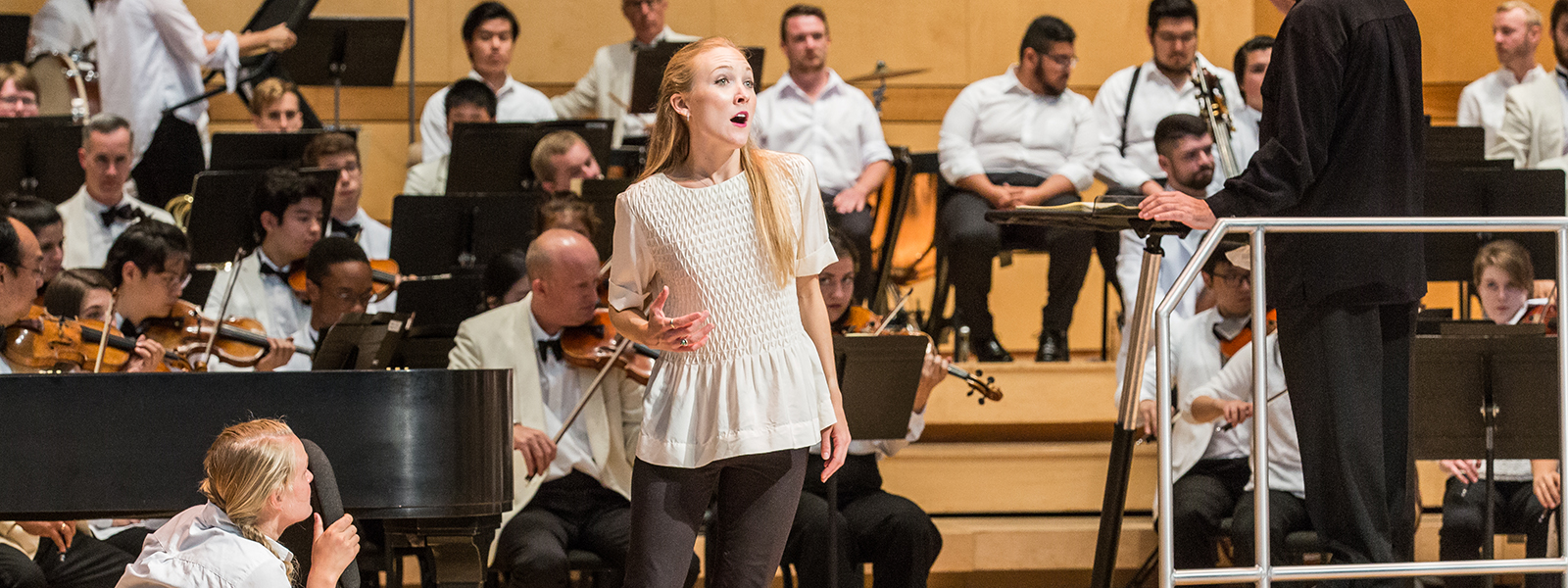
A close second in the defining-moments category happened this past summer when Johnson, a Kenan Fellow at the Aspen Music Festival and School (AMFS), performed several primary roles in the festival’s production of Maurice Ravel’s opera “L’enfant et les sortileges.”
The setting: the Benedict Music Tent with the Rocky Mountains as the backdrop. With seating for 2,050, the venue boasts the acoustics of a concert hall, yet the freshness of an open-air tent.
It was a very immersive experience and very different from any other opera I had done. The Kenan Fellowship allowed me to go and do that. It was totally magical for me.
Zoe Johnson
“The tent is a gorgeous venue with the orchestra on the stage. We were acting within the orchestra, using it as the set. It was a very immersive experience and very different from any other opera I had done,” says Johnson, who also had the opportunity in Aspen to study with Renee Fleming, one of the world’s most revered opera stars.
“The Kenan Fellowship allowed me to go and do that. It was totally magical for me.”
The country’s premier summer music festival, AMFS offers emerging artists like Johnson eight weeks of intensive one-on-one instruction and professional performance experience of unparalleled depth and breadth. The Thomas S. Kenan Institute for the Arts at UNCSA provides support for music students to attend the program in Colorado, which draws more than 600 young artists from 40 countries. The majority are orchestral students, others are singers, conductors, composers and pianists.
Johnson, who grew up in Los Angeles and got involved with community theatre as a child, didn’t begin formal opera training until graduate school. She earned a bachelor’s degree in theatre studies at Barnard College and holds a master’s of music in vocal performance from Bard College Conservatory of Music. (At Bard she met Nic Muni, the artistic director of UNCSA’s Fletcher Opera Institute.)
“The discipline of the art form really drew me to it,” says Johnson, now 27 and living in New York City. “I love the rigor and complexity of opera. I love how highly technical it is and how thoughtful you can be about how you present it. You study the languages, you look for the meaning behind each word.”
Edward Berkeley, the director of the Aspen Opera Center, worked closely with Johnson on “L’enfant" and was impressed by her performances.
“She had an amazing beauty of sound and compelling dramatic presence,” says Berkeley, also director of undergraduate opera studies at The Juilliard School. “Her growth over the past several years has been remarkable; Zoe is now ready to step into the professional world.”
Cellist Benjamin Maxwell, who graduated from UNCSA’s high school program last May and recently began studies at the New England Conservatory in Boston, also attended AMFS on a Kenan Fellowship. While there, he studied with Juilliard professors Darrett Adkins and Richard Aaron and played in several orchestras, tackling new repertoire at a frenetic pace to prepare for weekly performances.
... playing in the orchestra was pretty amazing, just being able to collaborate with all these interesting musicians from different countries. I enjoyed it so much. I feel like I grew a lot as a musician, and I would love to go back.
Benjajmin Maxwell
“I was able to learn a lot from both of them,” says Maxwell, 18. “And playing in the orchestra was pretty amazing, just being able to collaborate with all these interesting musicians from different countries.”
For a young man from Durham who first picked up a cello in sixth grade, Maxwell made great strides as a musician. He also played in a chamber group coached by members of two world-renowned ensembles: the Pacifica Quartet and the American String Quartet.
“I enjoyed it so much,” he says. “I feel like I grew a lot as a musician, and I would love to go back.”
Jennifer Johnston, vice president and dean of students at AMFS, believes young musicians like Maxwell can gain as much in one summer at Aspen as they can in a full year of study at a traditional conservatory.
“The competitive level is high and students are pushed above and beyond. However, there is an air here that is nurturing and supportive,” Johnston says.
“It’s the kind of healthy pressure that comes with being coached by a member of the Pacifica Quartet — it just raises your level to a degree that most students come out feeling surprised at their own progress.”
Johnston describes the relationship between AMFS and the Kenan Institute for the Arts as “the perfect partnership.”
“Our work with the Kenan Institute has really been transformative in the way that we interact with other institutions today,” she says. “In fact, the Kenan Fellowship has been rolled out to other organizations as the model.”
Such opportunities are critical to the success of emerging artists in competitive fields, Zoe Johnson says.
“It is hard as a young singer, there are not a lot of job opportunities. Especially in opera, it is very competitive,” she says.
“When you are given an opportunity to make music and at such a high level, I feel honored and free to pursue what I love to do in life. The Kenan Fellowship really gave me the support and encouragement that I needed. I am excited about what the future holds.”
October 5, 2017