Fellowship at Mixxer Makerspace brings local artist full circle within his community
A Creative Catalyst Fellowship in Community Engagement at Mixxer Makerspace hit close to home for artist Yosimar Gutierrez — much of his outreach work took place in Winston-Salem's Boston-Thurmond neighborhood where he grew up.
A makerspace, by design, Mixxer aims to increase access to expensive tools used for creating — 3D printers, laser cutters, welding equipment, even premier software. Mixxer founder Alan Shelton has doubled down on that mission, aiming to provide "equitable access to tech, tools and community," he says, particularly to underserved communities like Boston-Thurmond. It's a goal and project that has been ever-evolving.
Gutierrez was immediately drawn to Mixxer's mission when he heard about the fellowship, which is supported in partnership with the Thomas S. Kenan Institute for the Arts and the Emily Hall Tremaine Foundation. "When I was younger, the idea of a place housing all of the tools you needed to create whatever it was you desired was just that, an idea," he says. "Once I heard it was a reality and also local to me, I had to take part in it!"
His work consisted of outreach to the local community to increase awareness of Mixxer and its offerings and projects like the organization's first-ever Community Playbox at Kimberly Park Elementary School. The Playbox houses outdoor toys and equipment for kids in the Boston-Thurmond neighborhood to use.
For Shelton, Gutierrez's work is part of an ongoing strategy to raise familiarity with Mixxer within local communities. "For people that are already familiar with makerspaces (only about 30 percent of the public), we only need to open our doors and they have all the access they need," Shelton says. "But Mixxer is about equitable access. That requires creating more entry points and spending time meeting people where they are.
"Yosi’s work as a Creative Catalyst Fellow meets people where they live and introduces them to the Mixxer community in an engaging way. He is giving his neighbors a chance to do something fun in decorating the Playbox, and then it will stay there and be a place for sports equipment to be in a dry location and available when his neighbors need it."
We’ve learned over the years that community engagement requires a sustained effort. It usually takes continually reaching out to people and consistently being there when they reach back. ... Using art as a tool for connecting with people is a tried and true way, but it is something that we continue to learn from.
Alan Shelton, Mixxer
Gutierrez's work marks the second iteration of the Creative Catalyst Fellowship at Mixxer and Shelton says each partnership is an opportunity to continue to grow. "We’ve learned over the years that community engagement requires a sustained effort. It usually takes continually reaching out to people and consistently being there when they reach back," Shelton says. "There is a lot of noise out there to cut through. The fellowship gives Mixxer a unique and engaging way to reach out to people that we may not be able to connect with otherwise. Using art as a tool for connecting with people is a tried and true way, but it is something that we continue to learn from."
Below, Gutierrez reflects on his fellowship at Mixxer and the opportunity to give back to the community where he lives.
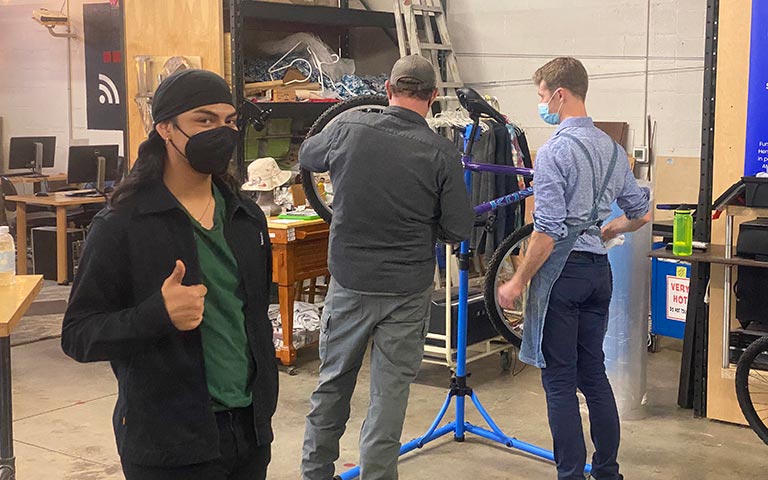
Gutierrez at Mixxer
Can you describe some of the work you did as a fellow at Mixxer?
As a fellow, I got to represent Mixxer at places like Kaleidium, represent it to a Spanish-speaking audience and visit Kimberly Park Elementary School, which is down the street from me! This is probably the most exciting part of my fellowship, having the full circle moment of growing up in the Boston-Thurmond Neighborhood and now being in a position to give back. As kids, my friends and I wanted the opportunities some children now get with Mixxer summer camps, as well as being able to go outside and be a child and have fun without worrying about the poverty and reality of other issues in our community.
How has the fellowship helped meet your goals professionally?
As a younger artist, I was not as involved in Winston-Salem and did not have a lot of experience making connections with organizations and businesses — so this fellowship definitely opened those doors. I also got to manage a really great project, the Community Playbox, that I could not have done on my own and that ultimately benefits my community. I had never done anything this big, so to finally take something on like this taught me a lot.
Can you tell us about your own art? How has your work at Mixxer influenced you as an artist?
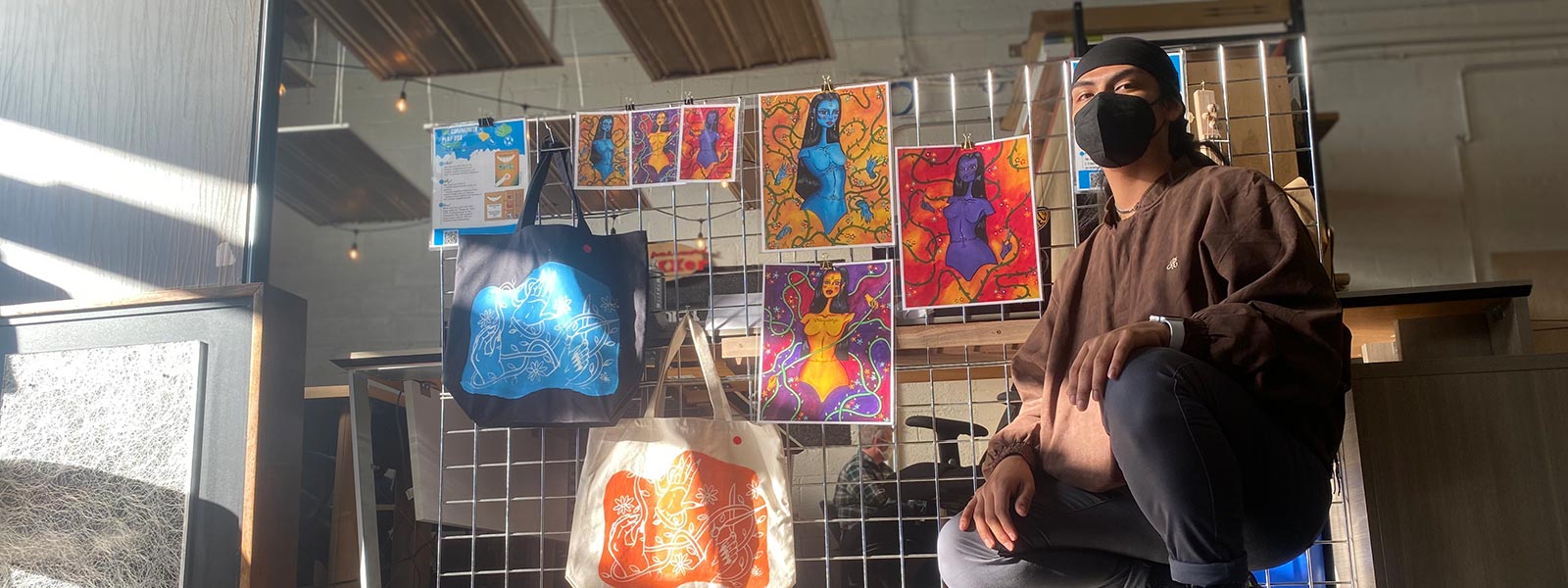
My art comes from the representation of my Mexican culture and the communities which I am part of, as well as touching on subjects that may be seen as taboo or even looked over by society.
I think it’s important that we have conversations that are difficult so that we can start to make a change.
Yosimar Gutierrez, Creative Catalyst Fellow
I think it’s important that we have conversations that are difficult so that we can start to make a change. I will always try my best to represent where I come from in a really good light — whether that be through fully-researched themes in my paintings or very bright color palettes that evoke feelings.
The work I’ve done at Mixxer is an extension of that. A lot of times people don’t acknowledge the effects of under-serving communities and what that does. After realizing that, it made me not only want to make pieces that mean something to people and peers, but also include them in the process, just like with the Playbox project.
March 23, 2022