Tim Miller residency inspires creative liberation
The five-day residency in September, which culminated in a presentation for the UNCSA community, gave participants inspiration and a fresh perspective on their craft.
In this post-2020 era in which technology both connects and separates us, it is well established that the intimate connection between audience and performer has become particularly special. The performance that grew out of theater artist Tim Miller’s work last semester with students and faculty at the University of North Carolina School of the Arts (UNCSA), a residency made possible in part by support from the Thomas S. Kenan Institute for the Arts, offers a poignant example of that phenomenon.
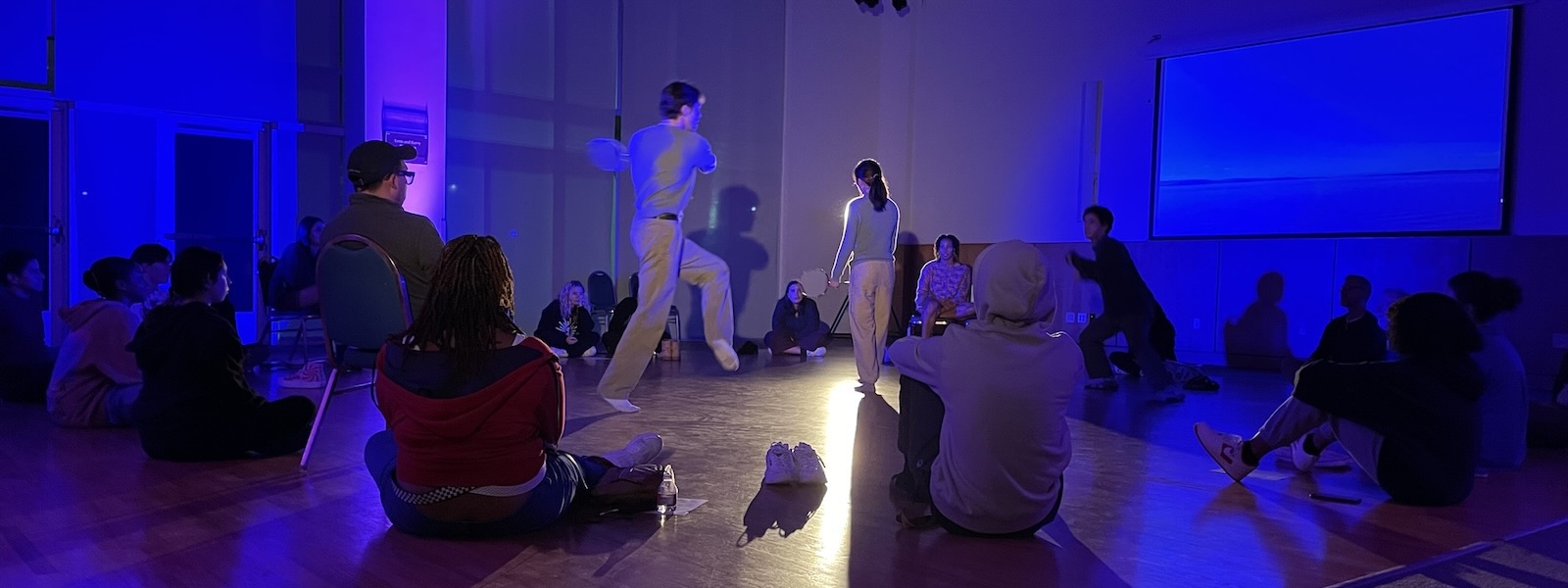
The final group of nine presented a series of original solo pieces that were deeply personal, amplifying the intimacy of the uniquely intimate art form of theater. That performance, titled “These are the shoes . . .,” featured eight students, half from UNCSA’s School of Drama (including one guest student from Wake Forest University) and half from the School of Dance, plus Drama faculty member Michael Alvarez. The dance students were Madison Wilson, Noah Braun, Jayla Thacker and Abi Gooch; the drama students were Hannah Szemereta, Matías Kruse, Liwen Zhang (of Wake Forest) and Jake Bryant.
Tim Miller residency
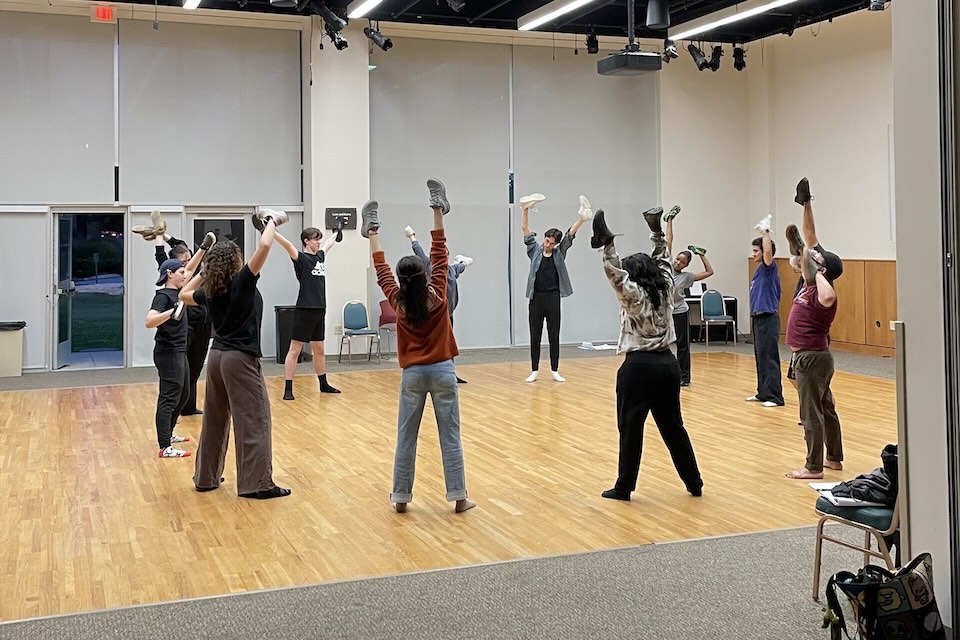
Dean Wilcox, professor of Theatre History, Dramatic Literature and Humanities in UNCSA’s Division of Liberal Arts, praises Tim Miller’s talent for inspiring workshop participants to create pieces at an astonishingly quick pace: “I’ve seen Tim get a group of basically strangers to do remarkably deep, intimate material in an hour.” Wilcox continues, “His skill set is fantastic, and his ability to get people to dive really deeply into issues that they feel passionate about very quickly produces work on a really compressed timeframe.” Wilcox says the fall 2023 workshop was a manifestation of this phenomenon. “By the end of that five-day period, they were able to share it publicly — it’s pretty amazing,” Wilcox enthuses. “They went from nothing to a finished work in five days.”
Wilcox participated in Miller’s first UNCSA residency in the early 2000s and has coordinated Miller’s subsequent work at UNCSA. At the time of the first official workshop in 2010, Wilcox notes, the School of Drama took a more traditional conservatory approach, and Miller inspired the school to offer students a broader range of opportunities. “For so many of our students, who have never had an opportunity to create their own material,” Wilcox says, that first 2010 workshop “was their first time to do that. Since then, the School of Drama has begun to work on devising more specifically.”
For so many of our students who have never had an opportunity to create their own material, this was their first time to do that.
Dean Wilcox, Division of Liberal Arts professor
For this residency, Miller was on the UNCSA campus for five days this past September, dedicating time to speak about his work with all first-year seminar classes in addition to leading the devising process that culminated in the intimate presentation for members of the campus community. Participants in the workshop described the experience as revelatory and inspiring. Jayla Thacker, one of the four student performers from the School of Dance, explains that the workshop marked her first time working with text or dialogue. Thacker says that Miller’s thoughtful, careful approach to the process made her comfortable trying out that new mode of expression and also enabled her to delve into personal material in her piece. She observes that she hadn’t expected the workshop “to be that emotional, but I think that was also one of the best things to come out of it because it was very, very raw and very real.”
Jake Bryant, one of the four students from the School of Drama, also celebrated the opportunity to explore personal topics through their pieces — noting that the opportunity was appealing in part because Bryant and Miller are both members of the queer community — and says it was particularly enlightening for the Drama and Dance students to work side by side. “It was really interesting just on a general level,” Bryant says, “to see people whose discipline is really movement-heavy and all the interesting things that they were able to bring, storytelling-wise, and just in their own capabilities as dancers.” Even more powerful for Bryant was the experience of sharing with peers and others from the UNCSA community his original piece: “That was a personally transformative moment for me,” they note. “Considering A, you know, having a forum to share your devised work is a unique opportunity that I haven’t had that often, and especially work that was, like, really based in my own experience and a story from my life that I wanted to tell.”
Michael Alvarez, who teaches Interdisciplinary Approaches to Performance in the School of Drama, is primarily a director, and with this workshop, he returned to performing for the first time since completing his undergraduate degree in performance art. Like Thacker and Bryant, Alvarez speaks to Miller’s unique ability to quickly foster an environment in which the group felt safe with each other and comfortable with creating deeply personal pieces: “Tim created a really safe space for people to talk about these things and to feel.”
The participants quoted here were unanimous in their enthusiasm for the cathartic nature of the five days working with Miller. Thacker points out how the experience heightened her ability to be vulnerable in performance, saying the process gave her “confidence in learning how to tell my story without holding certain parts back.” Alvarez adds, in discussing the opportunity to work through his grief publicly, “I always believe that art should cost you something. Like it should mean something to go out there and to stand on that stage.” And, he says, that sacrifice was worth it: “Being able to say the words, and to say the words in front of people,” he says, “was really transformative and healing.”
By Russell M. Dembin
Get the best news, performance and alumni stories from UNCSA.
SUBSCRIBE TO OUR NEWSLETTERS(OPENS IN NEW TAB)(OPENS IN NEW TAB)
May 7, 2024