

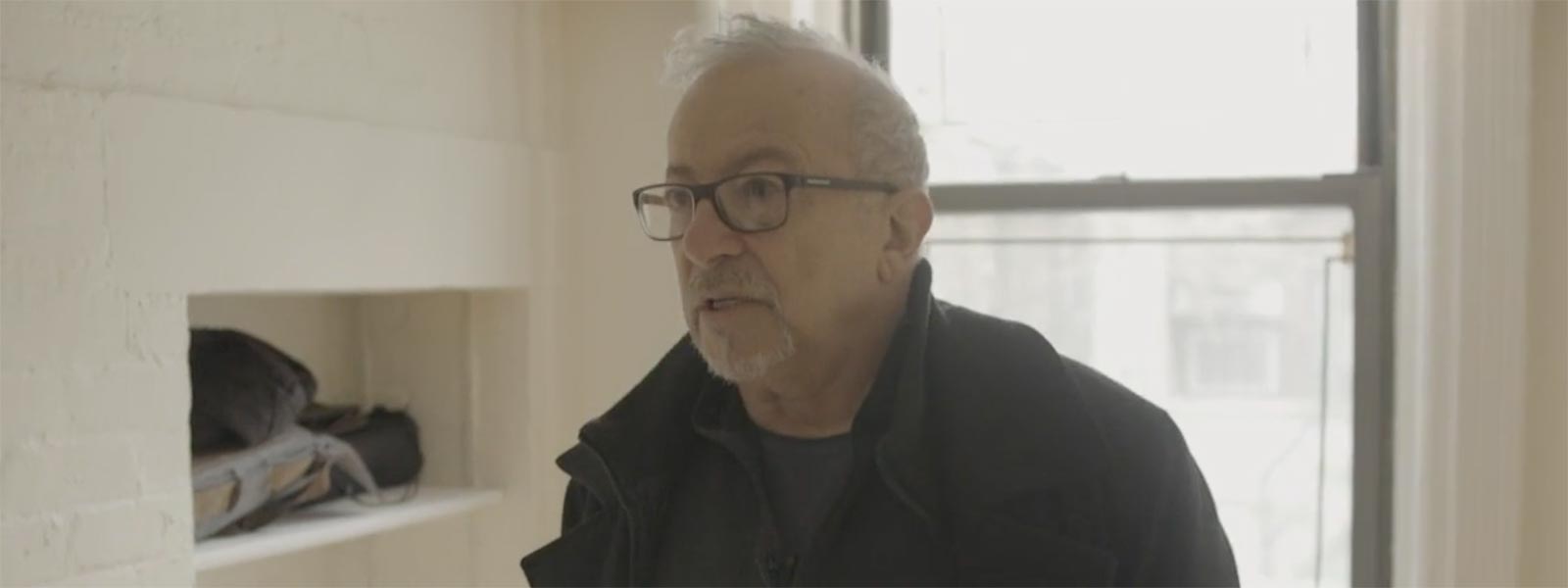
Faculty Leadership Grant helps Julian Semilian realize a long-held filmmaking dream
After decades as a film editor, Julian Semilian decided to try his hand at something new — becoming a documentary filmmaker. The process has proven enlightening for Semilian, both as a seasoned artist and as an instructor of budding filmmakers in the UNCSA School of Filmmaking. After many years in the business, it has also proven that there is always something more to learn.
Semilian is currently working on his second documentary, "Fish Have No Psychiatrists," a film about novelist, poet and NPR commentator Andrei Codrescu ("All Things Considered"), supported in part by a Faculty Leadership Grant from the Thomas S. Kenan Institute for the Arts. Faculty Leadership Grants are awarded semi-annually to UNCSA faculty to explore new approaches to creative learning challenges; impact student learning outcomes; and produce creative ideas, among other goals.
Semilian's pursuit of documentary filmmaking has met many of those aims. He's certainly produced new and creative ideas in the forms of his films, but he's been able to impact student learning by applying his contemporary experiences directly to lectures and assignments in his classes and beyond.
A story to be told
Semilian's interest in documentary filmmaking was sparked in 2016 by Ted Fujioka, a friend who lived in a Japanese American internment camp during World War 2. The desire to tell that story led to the creation of his first documentary film, "The Unrestricted Life of Ted Fujioka" (also supported in part by a Faculty Leadership Grant from the Kenan Institute for the Arts).
"I had never really done a conventional documentary before, but I really wanted to tell this story," Semilian says. Undaunted by the unknown, he dove into the genre with enthusiasm and openness. "I have been a film editor for many years. But I didn't take into account all of the things I didn't know," he laughs.
His experience with that first film taught him a lot — and revealed opportunities for further development. For instance, he realized he still needed to hone his deep listening skills when conducting interviews. That's certainly something he's had ample opportunity to refine with his extensive interviews for his Codrescu film.
Now in post-production, the film is part biography, part homage, part ecological and social commentary — all centered around its subject, Codrescu, a man Semilian has known since the earliest days of his immigration from Romania to the United States (they met on the plane as it left their home country).
The broad-ranging documentary will feature footage of Semilian's interview with Codrescu, combined with more than a dozen interviews from those who've known and worked with Codrescu, including Art Silverman (executive producer at NPR), Jacques Serverin (documentary filmmaker and activist), former students, poets, writers, friends and others whose lives he's touched.
It will also include Codrescu's musings and commentary on social norms and at least one social experiment, filmed in New York's Union Square. Along with several UNCSA alumni recruited for the experiment, Codrescu drops unexpectedly to all fours in the crowded social space as an exploration of the bipedal nature of the human species and its effects on human existence.
"Andrei is always saying something profound," Semilian says. "I found it to be an illuminating and freeing experience to see and hear Andrei speak: his freedom and humorous ease, his openness, inclusivity and imagination, not only in his speech but also in his demeanor and interaction with others, is what this film captures."
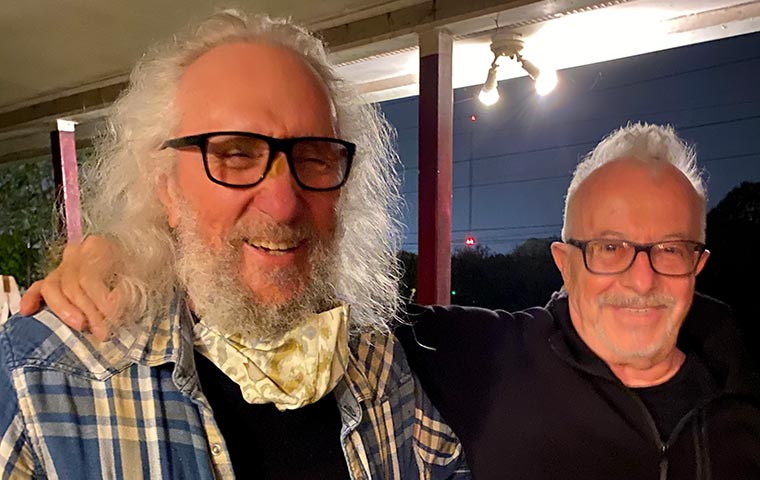
Semilian with Codrescu (right)
From learning to teaching
His foray into documentaries has been personally fulfilling for Semilian, but it's the ripple effects from those experiences that he is particularly grateful for.
His successes (and failures) in creating "The Unrestricted Life of Ted Fujioka" turned out to be the perfect material for a new course, "Introduction to Documentary Filmmaking," that Semilian launched in 2017.
"For about a year, I was in complete agony over everything I did wrong during that first film," he says. "I kept a journal and eventually worked out a whole series of everything I would recommend knowing before making a documentary." That served as the basis for his course, which interweaves practical information about topics like interview techniques and the use of archival footage, with less tangible lessons, like making sure the subject is something that one's passionate about.
After multiple iterations of the class, Semilian can see some of the insight he's shared taking hold. The course has also given students the space to explore their own stories. For example, an assignment to create a short documentary about an ordinary object in their lives has become particularly meaningful. Short 3-4 minute films about everything from sunglasses to coffee mugs to mopeds have helped foster a salon-like atmosphere in his classes where students exchange ideas and stories.
That ability to explore documentaries in the School of Filmmaking has also followed several alumni into their careers. One former student, Fer MacFarlane (B.F.A. '21), received funding this year to turn a short documentary he created about a homeless encampment in New Orleans into a longer feature.
I worked in Hollywood for 24 years on narrative, dramatic films. I felt a regret from not going into documentaries from the beginning but figured it wouldn't happen in this lifetime. The support from the Kenan Institute helped me to realize that I can still expand myself and continue to develop as an artist.
Julian Semilian
One other thing Semilian's been able to share with his students? That you can always continue developing your artistry — and it's never too late to pursue a passion.
"I worked in Hollywood for 24 years on narrative, dramatic films," he says. "I felt a regret from not going into documentaries from the beginning but figured it wouldn't happen in this lifetime. The support from the Kenan Institute helped me to realize that I can still expand myself and continue to develop as an artist."
April 4, 2022