

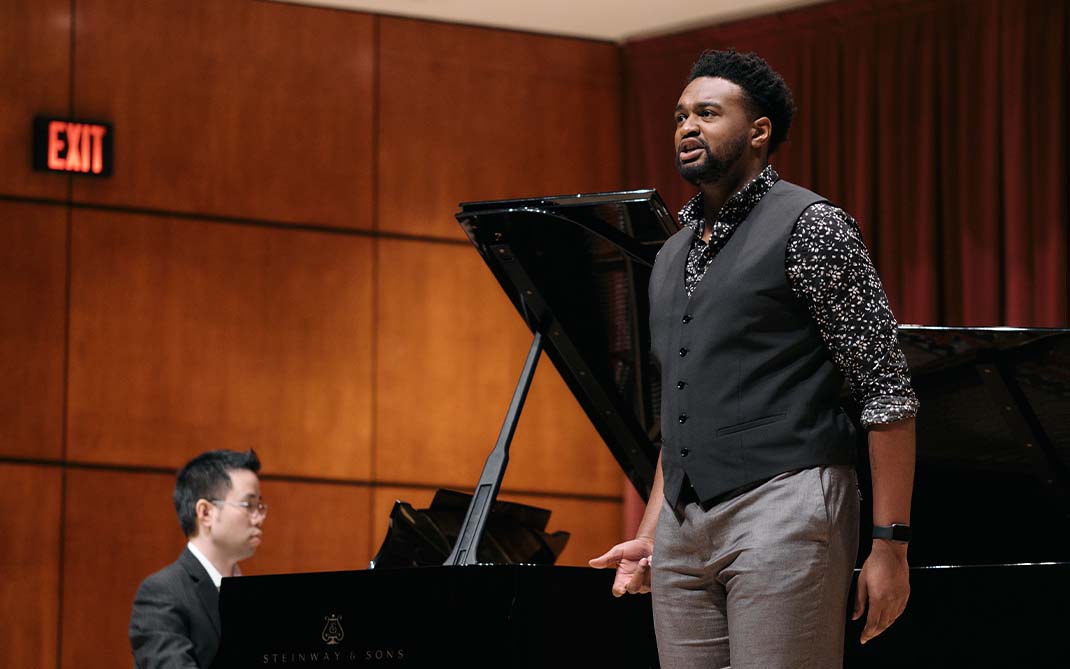




Drama alumnus Chris Grace learned to trust the long game
For actor and comedian Chris Grace, success did not arrive overnight. It came through persistence, curiosity, collaboration and a willingness to keep showing up long after many others might have given up.
The School of Drama alumnus, known to many audiences for his roles in NBC’s "Superstore,” Netflix’s “The Residence” and “All the Bright Places” directed by alumnus Brett Haley, has built a career that spans theater, television, film, improv and stand-up comedy. Looking back, Grace credits much of his foundation to his time at UNCSA.
Finding a creative home
"It was a really important laboratory," Grace reflects on his School of Drama training. "I was with a bunch of other people who wanted to do the same thing."
Growing up in Texas, Grace discovered acting through school theater programs. Between junior high and high school, he found himself drawn to performing and began to imagine it as a possible career.
When it came time to choose a college, an article in Rolling Stone helped point him toward UNCSA (then-NCSA). The article highlighted a group of elite theater training programs, including Carnegie Mellon, Juilliard, Yale and UNCSA, whose graduating seniors participated in major New York showcase auditions. "That was enough for me to think, 'This must be one of the good schools,'" Grace recalls.

Chris Grace / Photo by CX Xie, courtesy of Chris Grace
Once on campus, he quickly found himself immersed in an environment unlike any he had experienced before. "There’s a value in being in a bubble where people care about the arts and live performance in a way that’s not as common in other places," he says.
At many universities, students pursuing theater are part of a much larger campus culture with competing priorities. At UNCSA, Grace found something different. "People really cared about getting better as artists," Grace says. "Everybody's priorities were flowing in the same direction."
That shared commitment pushed students to challenge themselves. Grace believes the intensity of the environment created a culture where simply doing the minimum was never enough. "If you do the minimum in an arts degree, you're really going to be stuck when you leave," he says. "There needs to be an element of passion there."
Among the faculty members who left the strongest impression on him was Bob Francesconi, whose teaching helped unlock Grace's creativity and shape the way he still approaches character work today.
"The people who really believed in you matter," Grace says. "Between Bob Francesconi and Leslie Hunt, those are the people who really stuck out to me." He also credits former Liberal Arts professor Richard "Dick" Miller with helping him develop another skill that would prove valuable throughout his career: writing.
Like many arts students, Grace initially viewed general studies courses as a requirement to get through rather than embrace. Miller changed that perspective. "He really pushed me to write deeper essays about art and taste," Grace says. "I got a lot out of it."
Grace also remembers the encouragement he received from former Drama Dean Gerald Freedman. During Grace's senior year, Freedman told him, "I don't know what path you'll find in this business, but if I had to buy stock in you, I would." It's a vote of confidence Grace has carried with him throughout his career.
When the training finally clicked
Some of Grace's favorite memories at UNCSA came through Intensive Arts, a time at the end of the Fall semester when student-driven projects encouraged collaboration and independent creative work.
Those experiences, he says, offered an early glimpse of life as a working artist. Students were responsible for developing ideas, creating original projects and presenting them to audiences without being told exactly what to make. Looking back, Grace sees those experiences as remarkably similar to the realities of a professional career. "It actually bears a lot of resemblance to the real world," he says.
Even so, Grace admits it took time for his conservatory training to fully take hold. He recalls hearing an alumnus tell students that everything they learned might not click until years after graduation. At the time, he didn't believe it. It turned out to be true.
About 18 months after graduating, Grace was helping run an independent theater company in New York. While producing one of the company's shows, he was also juggling financial pressures, organizational responsibilities and a leading role onstage. It was during that production that his training finally came into focus.

Chris Grace / Photo by Jill Petracek, courtesy of Chris Grace
"That performance was one of the best experiences where a lot of the training unlocked for me," he says. The learning hasn't stopped. "I think it continues to click for you in the decades after," Grace says. "You get put into different situations where you need the training."
As his career expanded into comedy, improv and television, Grace found that his conservatory training gave him an edge in spaces where formal actor training isn't always the norm. "To have voice and speech and movement training in spaces that aren't training-heavy is definitely an advantage," he says.
Building a career through persistence and collaboration
Like many working actors, Grace's career path was anything but straightforward. "I mostly found my footing through survival and hanging around," he says with a laugh.
For years, he balanced artistic pursuits with other jobs while taking on projects that genuinely interested him, even when they paid little—or nothing at all. Those opportunities often led to valuable creative partnerships and lasting professional relationships.
"I always took projects I was interested in and worked with people I wanted to work with," he says. One particularly meaningful experience was performing at the Edinburgh Festival Fringe, where connections made during the production opened doors to future opportunities.
Grace's breakthrough came when he was cast as Jerry on "Superstore." "That's been the biggest one for sure," he says. Years after the sitcom ended, fans still recognize him from the role. One of the show's defining moments came during Jerry and Sandra's wedding storyline.
"It was like a network event," Grace recalls. "My face was on the advertising, and that was really strange."
Other milestones, including a role on "Broad City," helped reinforce his confidence as a performer. "There are moments when you're not sure if you belong," Grace says. "Television and film can feel very surreal."

Chris Grace in NBC's sitcom "Superstore"
More recently, his work with the comedy platform Dropout has become another defining chapter in his career. What began as guest appearances evolved into an ongoing creative partnership, culminating in the release of his comedy special on the platform.
Grace credits part of that success to learning to advocate for himself. "I've become way more direct about asking people," he says. "'Hey, I'd love to work with you guys. I'd love to be on that show.'"
Many artists assume opportunities will come once they've established themselves. Grace has learned otherwise. "A lot of people just forget," he says. "It's not malice. They just have a lot going on."
Whether performing comedy or drama, Grace still relies on the character-building approach he developed in the School of Drama. Rather than constructing characters from external traits, he begins by understanding who they are from the inside out.
His portrayal of Jerry reflected that philosophy. "Jerry is very similar to a certain aspect of me," Grace says. "I approached him as simply and straightforwardly as possible." The result was a character that felt genuine, allowing audiences to connect with him without the performance ever feeling forced.
Playing the long game
Today, Grace often shares a different kind of advice with current students and recent graduates. Many young actors, he believes, underestimate how much time they actually have. "I think they have more time than they think," he says.
While it's natural to compare yourself to classmates who book jobs immediately after graduation, Grace encourages young artists to focus on the long game. "The people who seem successful right away are going to face challenges too," he says. "It's going to be hard for everybody."

Chris Grace for his show "SARDINES (a comedy about death)" / Photo by Eric Michaud, courtesy of Chris Grace
His practical advice is equally direct: keep your expenses low, stay flexible and create opportunities to remain close to the communities where art is being made. "I would say get scrappy," he says.
That mindset continues to guide his own work. This year, Grace developed a new show, "88%," and performed his acclaimed show "Sardines: A Comedy About Death" at New York Theatre Workshop before returning to the Edinburgh Festival Fringe.
For Grace, the path from drama student to working artist has rarely been linear. But after decades in the profession, his advice remains remarkably simple.
"As long as you don't quit," he says, "you'll find a place."
Get the best news, performance and alumni stories from UNCSA.
SUBSCRIBE TO OUR NEWSLETTERS(OPENS IN NEW TAB)(opens in new tab)(opens in new tab)
September 24, 2026