


"Still Life with Rocket" brings devised theater to Winston-Salem
The School of Drama and the School of Design & Production at UNCSA will present Mollye Maxner’s Helen Hayes Award-winning “Still Life with Rocket,” an immersive theater event unlike anything previously seen in the area, for seven performances beginning April 4.
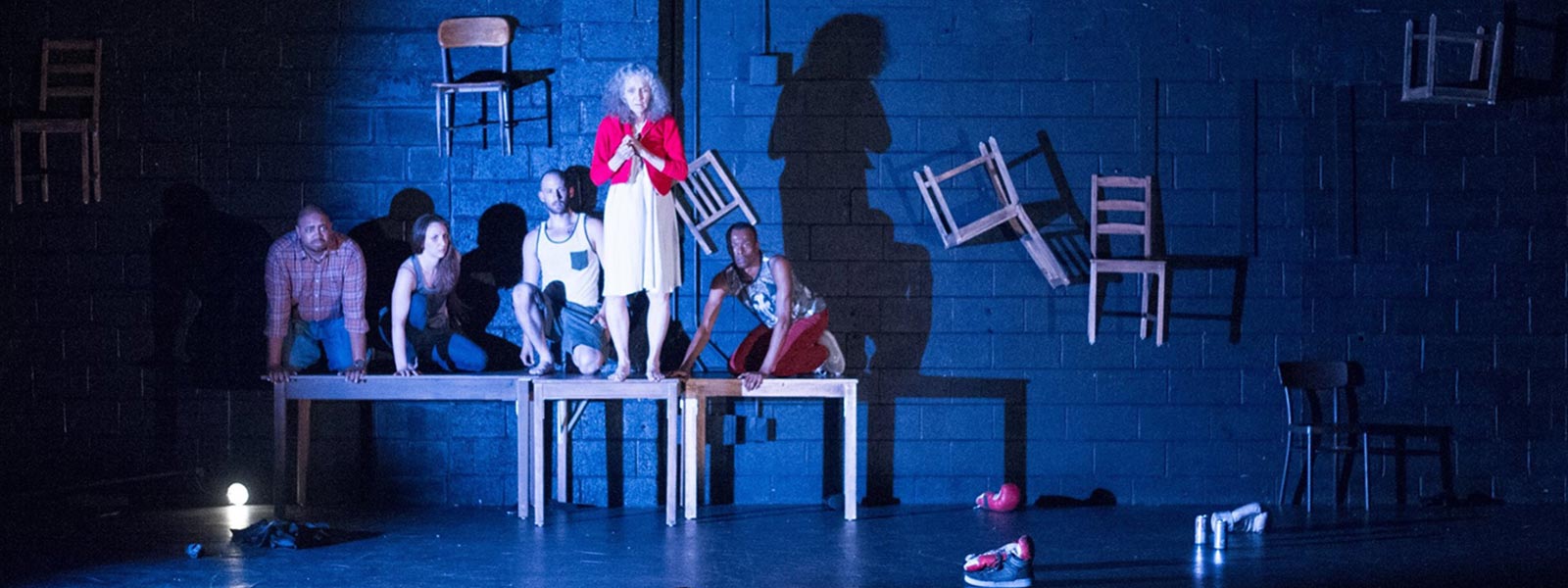
“Still Life with Rocket” will take audiences on a journey through an abandoned warehouse in Whitaker Park once owned by R.J. Reynolds Tobacco Co. that will be transformed into a space that allows for immersive storytelling. Audiences will walk through the warehouse during portions of the evening as the play unfolds around them. “Still Life,” UNCSA’s first public performance of devised theater, is at its heart a story of a family dealing with their mother’s worsening dementia. As the matriarch’s grown children all return home, family secrets are revealed through a unique combination of theater, dance and art.
Shows will be at 7:30 p.m. Thursdays through Saturdays, April 4-6 and April 11-13, with a 2 p.m. matinee on Sunday, April 7. Tickets are $20, $15 for students with an ID. Order tickets online, or call 336-721-1945. Note: Patrons are urged to arrive 30 minutes before each show begins, as there will be no late seating. Greeters will direct patrons to the warehouse where the performance will take place.

Mollye Maxner directs "Still Life with Rocket," UNCSA's first public performance of devised theater.
“Still Life,” which won the 2018 Helen Hayes Awards for Outstanding Production and Choreography, was originally commissioned by Theater Alliance of Washington D.C. and was directed and conceived of by Maxner, a UNCSA alumna who teaches part time in the School of Drama. Maxner will direct the UNCSA production of “Still Life,” which she describes as a largely new “second iteration” of the Washington show.
“Still Life” is a complex, layered journey that works on the audience emotionally, visually and sonically, Maxner said. “We are exploring not only the content but the form in which that content is expressed. We’ve created a world where the audience can walk into the set, where dialogue at times comes through headsets worn by the audience, where the power of the students’ creative efforts is visible at every turn.”
Devised theater is a practice rooted not in a pre-existing script but in the multidisciplinary creative efforts of a performing ensemble and the technical personnel who support them. Because of its collaborative nature, each staging of the work is unique.
Actors must be trained to meet the demands of the new theater and media landscape. There are many new opportunities, and often they require an additional set of skills.
Dean of Drama Scott Zigler
Eleven School of Drama actors, a contemporary dancer from the School of Dance, and more than 30 School of Design & Production students have contributed material to the UNCSA production, derived from a research trip to West Virginia and from several “pillars of content.” These pillars have inspired improvisation and idea generation that formed the basis of what Winston-Salem audiences will see. They include dementia, boxing, and the “Golden” phonograph records included in the Voyager spacecraft that launched in 1977.
Devised theater is a new focus in the School of Drama, as led by Dean Scott Zigler. “At UNCSA, we are exploring the role of the arts conservatory in the 21st century,” Zigler said. “Actors must be trained to meet the demands of the new theater and media landscape. There are many new opportunities, and often they require an additional set of skills.”
The School of Drama recently welcomed Emmy Award-nominated actor Andy Paris, co-creator of “The Laramie Project,” who will teach the practice. As a founding member of Tectonic Theater Project, he helped develop Moment Work, a technique for theatrical exploration and interdisciplinary collaboration. Using the Moment Work technique, he co-created “The Laramie Project,” one of the most-frequently produced plays over the last 25 years.
Michael Kelley, dean of the School of Design & Production, said the devised theatre emphasis provides welcome opportunities for designers. “Students are falling over themselves to work in the maker’s space of devising,” he said. “They want to work in a way that is more personal and engaged, and they want to leave with ownership of the product, to be able to say ‘we developed this together.’ It will enable our designers to be better storytellers.”
March 4, 2019