
Alumna Liz Sargent turns a dancer’s instinct into a filmmaker’s vision
UNCSA School of Dance alumna Liz Sargent (Contemporary Dance ‘02) grew up in a Chicago suburb she describes as “where all the John Hughes movies were filmed.” Unable to choose just one artistic language, she immersed herself in dance, theater, musicals, painting and violin at New Trier Township High School.
Still, she wasn’t sure what came next until her dance teacher, Andrea Johnson, nudged her toward a handful of arts conservatories, including what was then the North Carolina School of the Arts. “You should look at these colleges,” she remembers Johnson saying. Sargent followed the instinct that the arts were where she felt most at home and applied.
At UNCSA, she majored in contemporary dance and found herself transformed not only by the training, but by the community. Living in the small brick dorms, she landed on a hall full of filmmakers who became her first friends and, unknowingly, her first collaborators. “I had no idea that I was even interested in film,” Sargent recalls, “but I was drawn to the way of working and thinking.” Those conversations planted a seed she wouldn’t recognize until years later.
Becoming a filmmaker
While dance remained her primary focus, Sargent was always searching for a way to integrate all the art forms she loved. “There’s just a certain way of thinking and seeing the world that I learned through dance,” she says. That embodied awareness now shapes her directing — her sensitivity to gesture, breath and the unspoken communication between people.
After graduating from UNCSA, Sargent danced in New York and worked at Dance Theater Workshop (now NYLA), gaining exposure to the city’s experimental arts scene. But as the middle child of eleven siblings — several with disabilities — she began feeling the weight of caregiving and family realities. That shift opened a new creative door: Sargent started imagining stories that felt more intimate, more human and uniquely suited to the camera. Film became the medium that could hold the aliveness of performance while preserving it beyond the moment.
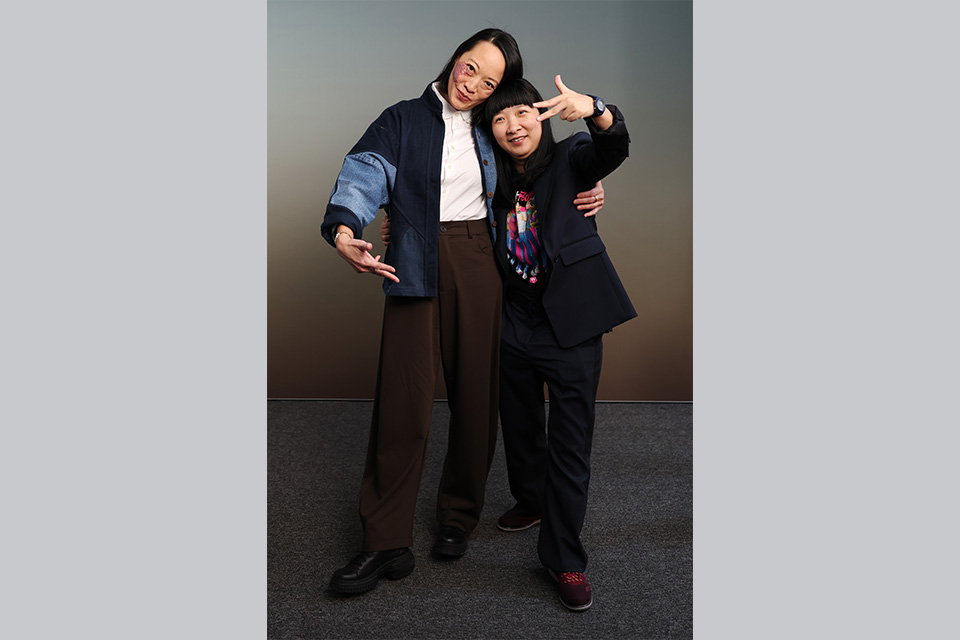
Anna Sargent and Liz Sargent at an event for Take Me Home (2026) / Photo: Mat Hayward
Her transition into filmmaking was characteristically hands-on. Through her husband, an indie filmmaker, she learned production design, costuming and producing, absorbing the scrappy, problem-solving ethos that dancers know well. “Modern dancers have a certain work ethic,” she explains, “finding creativity in problem solving.” That instinctive, improvisational training would later become essential to her directing style.
Sargent’s storytelling is deeply personal, rooted in lived experience, family, identity, disability and adoption. She doesn’t begin with representation as a goal, though she carries its weight. Instead, she starts with the story she feels hasn’t been told.
Her first film, “Strangers Reunion,” emerged from a prompt to create a two-hander set in a hotel anywhere in the world. At the time, she had just made contact with her biological mother. She wrote a script about an American adoptee meeting her Korean mother for the first time without a translator — an emotional landscape shaped by silence, body language and longing. The film was shot on the 100th floor of the Ritz-Carlton Hong Kong and she won the competition that funded it.
That early success foreshadowed a remarkable ascent.
A breakthrough in independent film
Sargent’s debut feature, “Take Me Home,” premiered in U.S. Competition at the 2026 Sundance Film Festival, where she received the Waldo Salt Screenwriting Award, one of the festival’s most prestigious honors. The film went on to screen internationally in the Perspectives Competition at the Berlin International Film Festival, cementing her as a bold new voice in global cinema.
The feature was developed with Caring Across Generations, River Road Entertainment, Cinereach, Cyprian Films New York, and ALLCAPS. It received the SFFILM Rainin Grant and later won $1 million through AT&T Untold Stories at the Tribeca Film Festival, a career defining moment that propelled the project forward.
“Take Me Home” is particularly notable for casting Sargent’s cognitively disabled sister in the lead role, an approach she wrote about in a guest column for The Hollywood Reporter during the film’s FYC Oscar campaign. The production adapted entirely to her sister’s needs, embracing improvisation, on-the-spot adjustments and a flexible process that mirrored the work of filmmakers like Sean Baker and Chloé Zhao. The result was a performance widely praised for its honesty and emotional clarity.
The feature grew from her proof of concept short of the same name, which premiered at Sundance 2023, won the Grand Jury Prize at the American Cinematheque PROOF Film Festival, screened at over 50 festivals including SXSW, and was featured at the White House for the 25th Anniversary of the Olmstead Act. It also appeared on Delta Airlines and toured theatrically with Sundance Shorts.
Her growing list of honors includes the Lighthouse Award, the Impact Award from the Adoptee Film Festival, multiple New York Emmys, NBCU Launch Director and recognition from Film Fatales, Humanitas, the Academy Gold Fellowship and the Ryan Murphy Half Initiative.
A voice rooted in community
Despite her accolades, Sargent remains grounded in the values she learned at UNCSA. Her advice to emerging artists is simple and generous: build your community horizontally. “The friendships and the community that you make are the most important,” she says. “Too many people wait around for industry permission and think that’s the thing that’s going to change things, but it’s not. It’s your ingenuity that creates the path.”
Her career reflects that ethos. She continues to engage with audiences and communities through panels, workshops, and screenings, from Sundance to the White House to public schools and disability advocacy organizations.
Liz Sargent’s path — from a modern dancer to an award-winning filmmaker — embodies the heart of UNCSA: interdisciplinary curiosity, creative resilience and the courage to follow a story wherever it leads. Her work is intimate, deeply human and unmistakably her own. And as her films continue to reach wider audiences, she remains guided by the same instinct that led her to UNCSA, a belief in the power of art to connect, to reveal and to transform.
Get the best news, performance and alumni stories from UNCSA.
SUBSCRIBE TO OUR NEWSLETTERS
May 01, 2026