

How Nate McGaha became North Carolina's voice for the arts
From community theater in West Virginia to leading statewide arts advocacy, alumnus Nate McGaha’s (B.F.A. Lighting ’95) has spent his career shining a light on the transformative power of the arts. What began with a love for lighting design has evolved into a career as the executive director of Arts North Carolina, where McGaha leads initiatives furthering the arts and arts education in the state and beyond.
But to get there, McGaha first had to take a few unexpected steps.
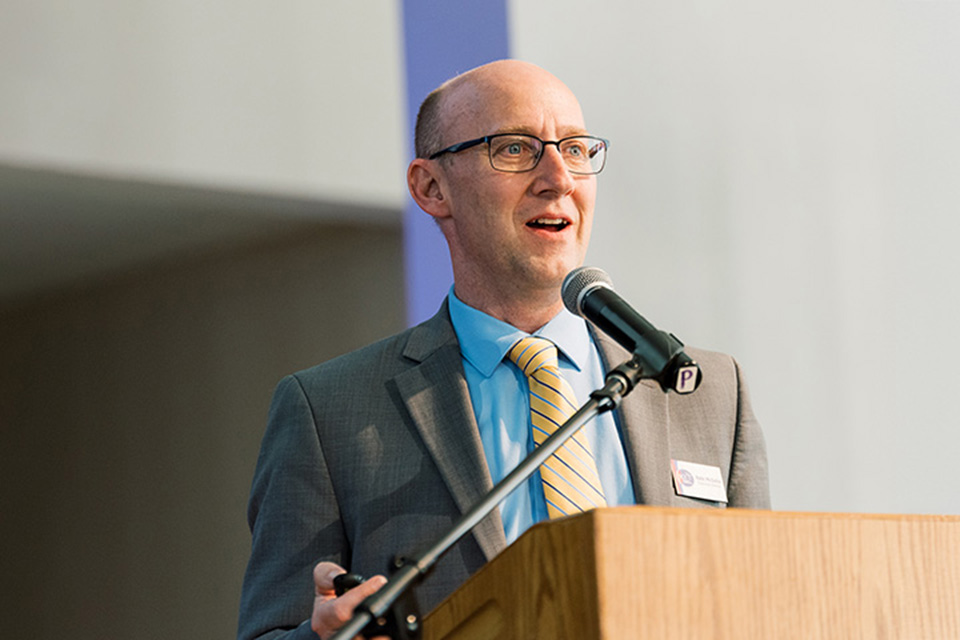
Nate McGaha speaking at an event / Photo courtesy of Nate McGaha
A spark ignited early
Toward the end of McGaha’s sophomore year in Martinsburg, West Virginia, he received a flyer asking, “Are you bored with high school?” Simon’s Rock — a college in western Massachusetts affiliated with Bard College — was offering students the chance to skip their junior and senior years to begin college early. McGaha applied, was accepted, and took the leap.
At Simon’s Rock, he met a theater professor with Broadway experience in lighting design, directing and acting. McGaha had already been involved in community theatre since age 11 — running follow spots, working the hemp fly system, and designing lights for local productions, often in exchange for pizza and Boy Scout merit badges.
Recognizing McGaha’s early experience, the professor invited him to explore lighting design more seriously. He handed him a drafting table, a ground plan of the theatre, a lighting template and an interview in “Lighting Dimensions” magazine with renowned designer Jennifer Tipton. That moment marked a turning point. McGaha was soon designing shows and exploring lighting programs — and while Tisch was on his radar, UNCSA's School of Design & Production stood out as the perfect fit.
Finding his place at UNCSA
McGaha’s roots run deep in Winston-Salem — his grandparents met at Gray High School, the very building he studied in when he transferred to UNCSA at age 17. He thrived at UNCSA, designing junior and senior shows, and spent a formative summer at Stagedoor Manor theater camp in the Catskills, working with budding young stars such as Bryce Howard and Natalie Portman.
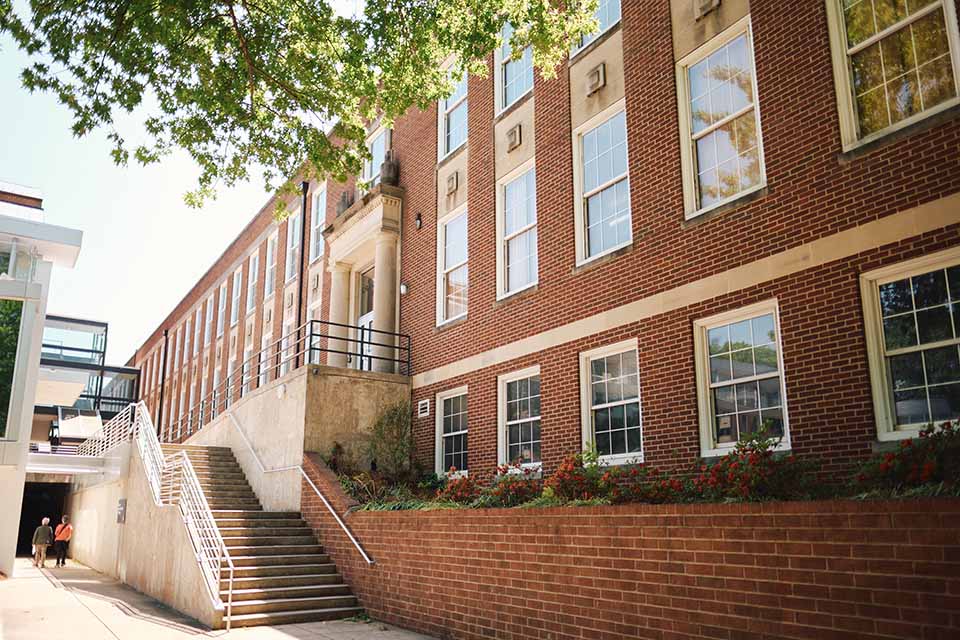
The Gray Building at UNCSA.
After graduating, McGaha moved to Charleston, South Carolina, to work for the College of Charleston — first as an assistant lighting designer for a student production, then later in the scene shop and lighting department. He quickly made a name for himself.
When Charleston alumnus Doug Singleton became production manager for what is now Charlotte Ballet, he turned to his alma mater looking for promising lighting designers. But instead of a College of Charleston student, it was McGaha who was recommended. “There’s this kid from School of the Arts …,” Singleton remembers being told. McGaha got the job, and Singleton — now Charlotte Ballet’s executive director — became his mentor.
From backstage to the boardroom
McGaha spent 16 years at Charlotte Ballet, starting as lighting designer and supervisor before being promoted to director of operations. He later transitioned to Carolina Ballet in Raleigh as production manager. Then, when Carolina Ballet’s executive director left six months later, McGaha was offered the position.
“For the first time in my life, I started walking in the front door instead of the back door,” he remembers. His entry into arts administration was unconventional — one moment he was loading in for “The Nutcracker,” and the next he was meeting with donors.
With a strong grasp of production and budgeting, he quickly adapted to development and leadership and ran the $5+ million ballet company for five years..
The final step
As an executive director for a dance company, McGaha found himself at the heart of changing laws — like those affecting unemployment compensation for dancers and sales tax for performance tickets. He became invested in arts policy work, led regular legislative engagement sessions, and joined the board of Arts North Carolina, the statewide advocacy organization for the arts and arts education.
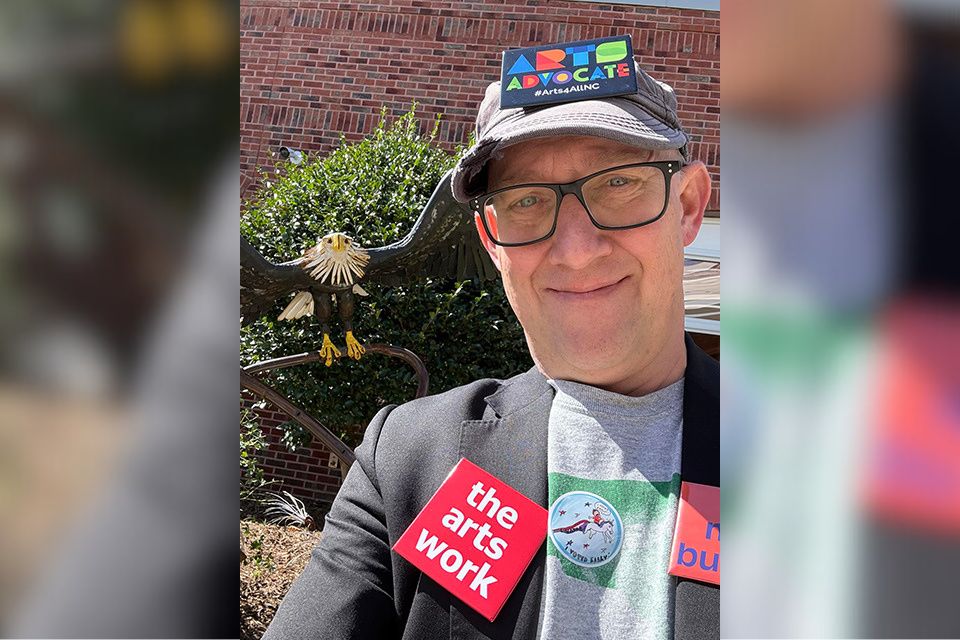
A selfie of Nate McGaha / Photo from Arts North Carolina
Soon, McGaha was board chair for Arts North Carolina, and was encouraged to take it one step further.
“I figured I’d be executive director of another ballet company or a symphony next,” McGaha says. “I just didn’t figure I’d run an advocacy organization.” But in November 2016, as the political landscape shifted, he saw an opportunity and stepped forward — becoming executive director of Arts North Carolina.
Arts advocacy in action
At the federal level, McGaha now serves as North Carolina’s lead arts advocate, using his contract negotiation background to interpret legislation and guide others through policy. He’s helped champion Arts North Carolina’s flagship work of securing public funding for North Carolina Arts Council grants, supporting organizations in all 100 counties. The group has also led the campaign for North Carolina’s first arts graduation requirement and is now advocating for universal K–5 arts instruction.
Locally, McGaha collaborates with North Carolina’s extensive network of county arts councils — the most comprehensive in the country — providing training, data and legislative support. He also partners with the NC Arts Council and groups such as02 the North Carolina Presenters Consortium to address issues like ticketing fraud and arts access. In a shifting policy landscape, his role is to provide clear, actionable information that helps the arts sector adapt.
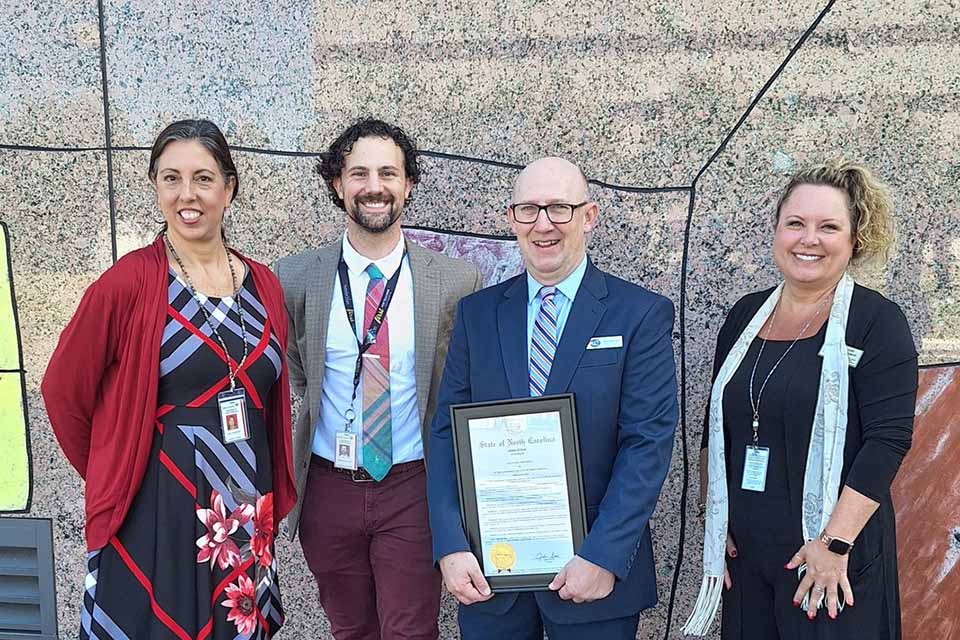
Nate McGaha with colleagues during the Arts in Education Week / Photo from Arts North Carolina
In 2021, amid shifts within Americans for the Arts, McGaha helped form the Creative States Coalition, now representing over 40 states and 75 organizations. Recently elected co-chair, he supports peer-led professional development and national advocacy while working to secure sustainable funding.
He also helped launch the bipartisan Joint Caucus on the Arts and Arts Education, organizing meetings and legislative discussions about the arts and arts education with state representatives. With support from both parties, the caucus helped expand the Grassroots Arts Program grants from $2.8 million to $6.3 million statewide in just two years.
Advice for the next generation
When asked if he misses performance mode, McGaha said, “Yes and no. I miss the regular adrenaline. There’s adrenaline in this, but it’s different. It’s more like ‘West Wing’ instead of ‘Noises Off.’” He finds deep fulfillment in advocating for the arts statewide, without the pressure of opening night.
His advice for students is simple: “Your School of the Arts education gets you your first job,” he says. “That first job teaches you what you need for the second, and the second prepares you for the third. You’re just getting your foot in the door to take your next step.”
And — maybe most importantly — he urges students not to fear where those steps might lead.
February 25, 2026