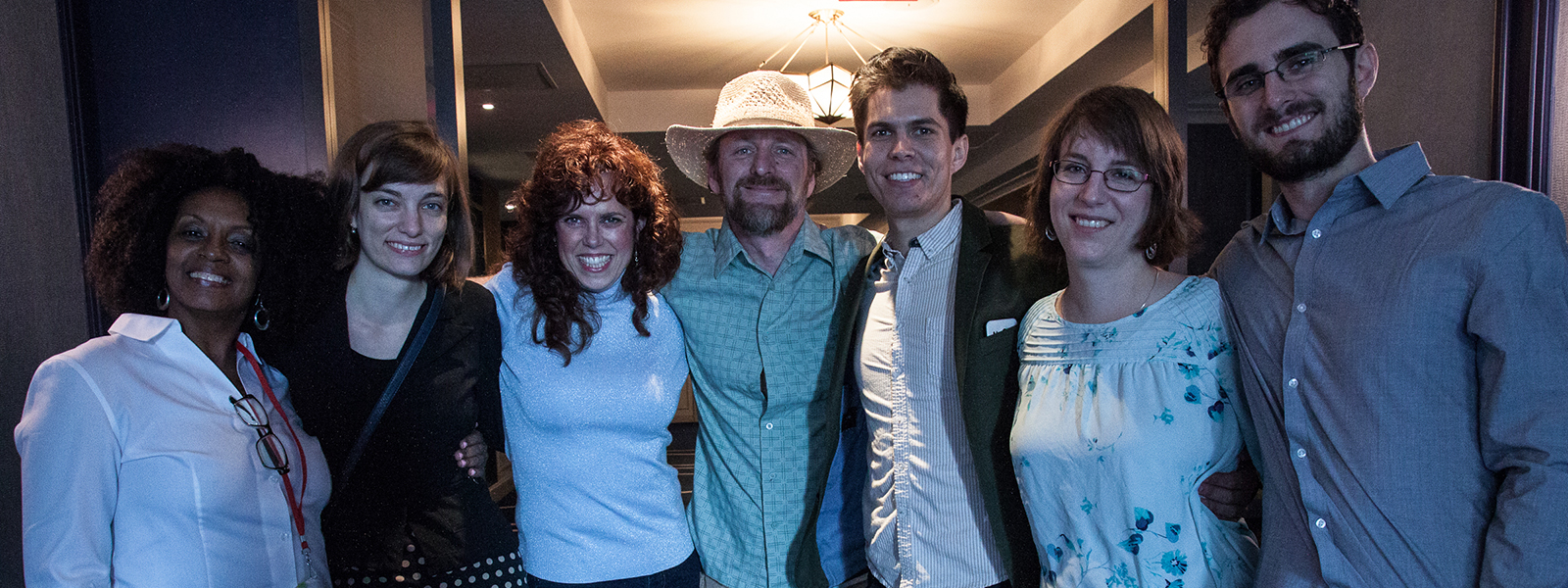
Second place, and $15,000, went to The Feeling Friends, founded by Winston-Salem native Karen Cuthrell to help parents, caregivers, educators
and clinicians teach children how to express their feelings. Muddy Creek Cafe & Music
Hall, a venue in historic Bethania that emphasizes hearty food, great conversation
and live music, took third place and $10,000.
Cuthrell, inspired to create a line of plush toys and books about managing feelings
because her daughter battled depression at a young age, described her experience with
Creative Startups as “life changing.”
I have spent thousands and thousands of dollars on training, and I’ve never walked
away with something as valuable as Creative Startups ... Our creativity was celebrated.
Karen Cuthrell, founder of The Feeling Friends
“I have spent thousands and thousands of dollars on training, and I’ve never walked
away with something as valuable as Creative Startups,” says Cuthrell, who plans to
use her prize money to buy prototypes and conduct focus groups. “The mentors, the
one-on-one conversations, the personal interest that people gave you, understanding
that you were a creative company. For the first time, we were smiled upon instead
of being frowned upon. Our creativity was celebrated.”
Shana Whitehead, who owns and operates Muddy Creek Cafe & Music Hall with partner Bill Heath, plans to enlarge and weatherize the cafe’s front patio for
use as a music venue, as well as invest in outdoor sound equipment. Muddy Creek currently
moves concerts indoors during cold weather and has to turn people away because of
space restrictions.
“The mentoring really helped us define our business model and helped us realize what
areas we need to focus some attention on,” says Whitehead, who learned about the accelerator
through her participation in the Kenan Institute’s Arts Enterprise Lab.
“We just learned so much from people who are experts in their field who helped us
in all aspects of business — finance, design, accounting, marketing and legal. We
are still trying to digest everything we learned.”
Organizers say that Winston-Salem was the perfect venue for an accelerator focused
on creatives.
“Creative enterprise is part of our DNA and the business community is recognizing
that now,” says Margaret Collins, Executive Director of CCE. “Creative enterprises
are not just solo artists — painters, potters and songwriters. We are enterprises
that are solving problems for customers, have value to society and have business models
that can earn revenue and scale.”
J.D. Wilson, Chairman and Chief Executive Officer of Excalibur Enterprises Inc. and
a member of Kenan Institute’s Board of Advisors, served as both sponsor and mentor
for Deep Dive week.
“We are the City of Arts and Innovation, and to be a brand, you can’t just say you
are something. It has to be authentic,” Wilson says. “There are all sorts of examples
of how innovative we are. Look at the Innovation Quarter. Look over on Waughtown and
Main streets — the School of the Arts is unique in the world. And it is in Winston-Salem,
North Carolina.”
Likewise, serving as a primary sponsor for the program was a perfect fit for the Kenan
Institute and UNCSA. That’s because building creative community is among the Institute’s
primary missions, says Executive Director Corey Madden.
“Being in community with each other is one dimension of that mission; another is to
build a more sustainable arts ecosystem in Winston-Salem and nationally by example,”
says Madden, who also served as a mentor for Creative Startups Winston-Salem.
“We are in the middle of a city-wide conversation to grow our creative economy,” Madden
explains. “Here in Winston-Salem, we have made a huge step forward, because there
is a greater understanding that creative industries are a economic sector that we
can grow. Beyond the arts themselves, digital media, design and communication are
integral to every workplace, and all of these are led by creative workers.”
Dalton Grein, Fund Executive for Piedmont Angel Network, believes that investors who
fail to embrace the creative industry will miss out on unique opportunities.
“We have 26 portfolios, including a couple in the creative space but not that many.
That is one reason I wanted to be a part of this,” says Grein, another mentor for
Creative Startups.
“Look at the growth that is taking place in the creative industry — it’s huge — and
the demographic shift, the fact that millennials are flocking to that space,” Grein
notes. “We tend to disregard it, but I think that is wrong going forward. The landscape
is changing.”
Grein says he and others involved with Creative Startups Winston-Salem already are
talking about next steps.
We are trying to do all we can with physical space, connectivity, startup money and
mentorship to get the word out to folks around the country that if you want to start
up a business, Winston-Salem is one of the places you should go for all of those reasons.
J.D. Wilson, Excalibur Enterprises Inc.
“Let’s be honest, without the Kenan Institute we wouldn’t have the action and the
momentum that we now have to become a ‘best in class’ place to go for creative startups,”
he says. “This wasn’t a one-and-done thing. There is a bigger movement happening here
and that was just the first step.”
Wilson agrees. “We are trying to do all we can with physical space, connectivity,
startup money and mentorship to get the word out to folks around the country that
if you want to start up a business, Winston-Salem is one of the places you should
go for all of those reasons.”
Ultimately, Madden hopes the work of Creative Startups will broaden the mindset of
the city’s business community.
“I’m hoping a year from now that senior businessmen and women in our community say,
‘I’d really like to have a creative person on our team when I start something’ — someone
who is deeply educated as a creative entrepreneur to ask questions, to help people
go further, to imagine more creative problem-solving,” she says.
“It’s what businesses are really looking for.”
October 20, 2016