“A story completely my own”
Soundscapes allowed Cuthbertson to focus completely on her craft for the first time.
“In the arts, most things have been done before,” she says. “Even if the content is
different, it's still a play, a musical, an opera. I was presented with a completely
open-ended design opportunity ̶̶̶ no talent, no script, no visual elements, just
the capability to create sound.”
Cuthbertson’s inaugural segment, “Migratory Journeys,” follows the seasonal movements
of different species, including those from North Carolina’s Pisgah Forest, Antarctica’s
volcanic isles, the grasslands of the Serengeti and the deserts of Northwest India.
“You can feel the wildebeest move past you from the middle of the pack,” Wilson says.
“You find yourself flying in the flock of birds, with no visual stimulation. It’s
all sound.”
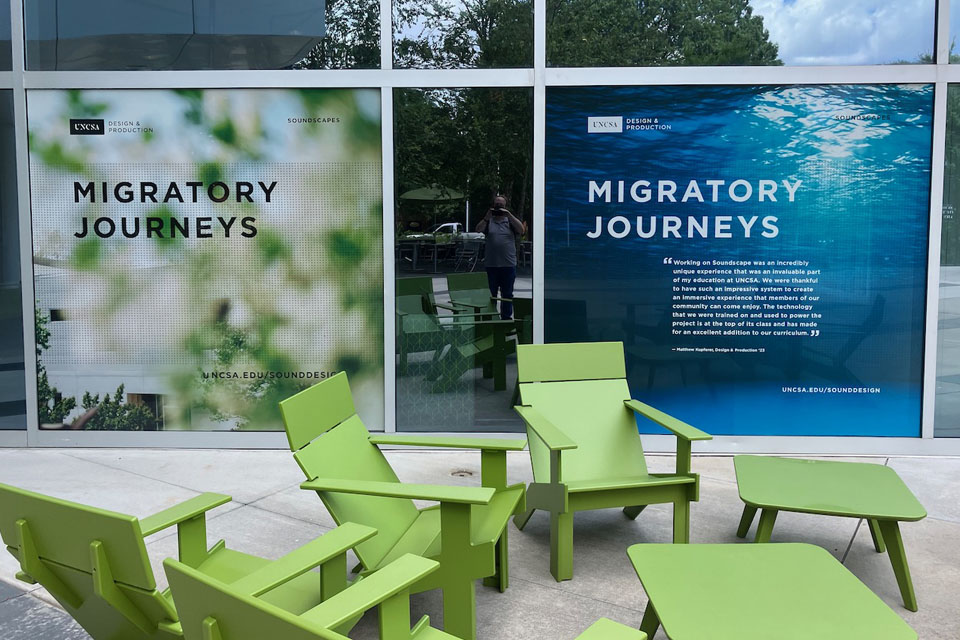
Soundscape signs at the UNCSA Library Learning Commons.
The second segment of Soundscapes, designed by Sam Hayes in the fall of 2022, places
listeners in the driver’s seat of a race car for the final lap. “Formula One: In the
Hot Seat” incorporates voiceovers by actors in the School of Drama, who performed
as the driver, pit crew, announcer and fans. “You feel the cars passing you in the
pack,” Wilson says.
Camille Everett’s third segment which premiered in April 2023, “Into the Depths,”
is a fantasy-horror experience that transports listeners to the world’s deepest oceantic
trench. The story follows a diver as they launch off of a ship in the Mariana Trench
and encounter a malevolent sea creature. “This project is completely different from
any other sound designs I have done or experienced,” Everett says. “I am usually designingto
support someone else’s story, but with Soundscapes it is a story that is completely
my own.”
“A sensory experience like no other”
Soundscapes is installed in the first-floor lobby of the UNCSA Library & Learning Commons, where University Librarian Sarah Falls feels it is a perfect fit. “The library promotes all kinds of research,” she says.”
A sound system like this necessarily must be installed in a public space, where students
have to adjust the size and scope of the project to meet the space it occupies–that’s
research.”
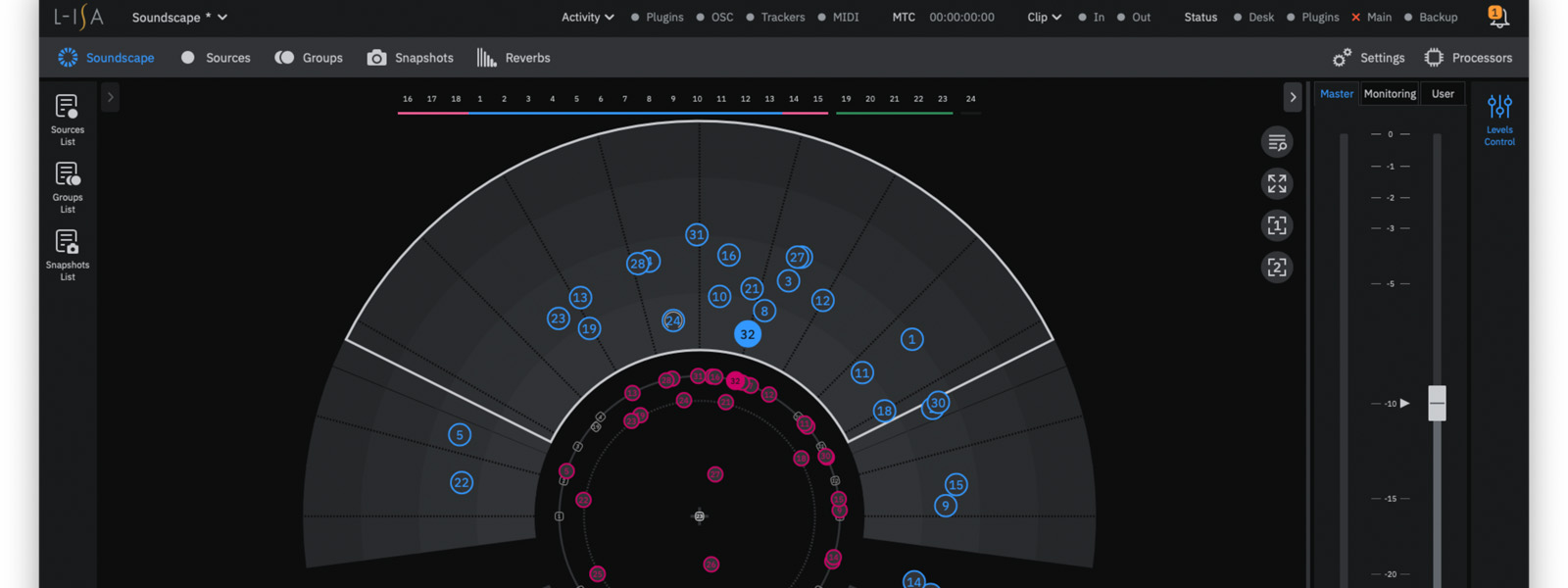
In a corner of the library lobby, a small bench is surrounded by 24 speakers connected
by hundreds of feet of cable. Jason Romney, head of the sound design program, added a final touch underneath the bench – minature
subwoofers known as ButtKickers that deliver low frequency vibrations. In the middle,
a mounted tablet allows listeners to select which two- to three-minute segment to
experience and colorful fliers on a nearby table explain each. “They can listen to
all three or just one,” Wilson says. “I imagine someday there will be many choices.”
Falls is thrilled with the response to the installation. “The overall reaction is
typically delight,” she says. “To step into the installation really provides a sensory
experience like no other. It makes you think about all the sound components of a space
that you might not ever inhabit. Perceptually, we often hear sound as a whole, but
don’t take the time to break it down. This environment helps you do that.”
Wilson says the library location is also good exposure for the Sound Design program
and for all of D&P. “Original concepts in design and technology, storytelling and
interdisciplinary collaboration are all exploding right here,” he says.
“The sky is the limit”
Each semester the sound design faculty (Wilson, Romney, Lindsay Putnam and Lindsay Jones) choose a three-person Soundscapes team – a designer, an assistant designer and an
audio engineer. The designer pitches a story concept to the faculty, who offer guidance.
“The concepts come completely from the student’s imagination,” Wilson says. “They
can choose something they are passionate about and develop it into a story. It is
very much student-driven.”
Soundscapes is a premium production assignment that involves more than working with
cutting-edge technology and pushing creativity to its limits. Led by the designer,
the teams also write scripts, engage with actors and musicians, and collaborate with
Strategic Communications staff to create marketing materials. “I learned how to be
a team leader,” Hayes says, “and I figured out how to be a leader and a designer at
the same time. The project is redefining what we are capable of as sound designers.”
Along with new skills, Soundscapes designers have gained self-assurance and a deeper
appreciation for their craft. “As I’m transitioning into my career in sound design,
Soundscapes has exponentially grown my confidence in myself and as a designer,” Everett
says. “I’m always incredibly hard on the work I do, because I always think there’s
room to improve; with Soundscapes I’ve learned that the ability I have to create and
tell a story is one I cherish very much, and I hope to continue designing for a long
time.”
Hayes offers advice to future Soundscapes designers. “Don’t be afraid to step outside
your comfort zone. Try radical ideas. Utilize the resources and the support you have.
Try whatever you want and see what the outcome will be,” he says.
For Wilson, the outcome is a win-win: an enhanced learning environment for sound designers
and a unique listening experience for library patrons. He thinks Soundscapes will
endure and potentially even grow. “The sky's the limit,” he says. “What can you imagine?”
by Lauren Whitaker
Get the best news, performance and alumni stories from UNCSA.
SUBSCRIBE TO OUR NEWSLETTERS(OPENS IN NEW TAB)(OPENS IN NEW TAB)(OPENS IN NEW TAB)(OPENS IN NEW TAB)(OPENS IN NEW TAB)(OPENS IN NEW TAB)(OPENS IN NEW TAB)(OPENS IN NEW TAB)(OPENS IN NEW TAB)(OPENS IN NEW TAB)(OPENS IN NEW TAB)(OPENS IN NEW TAB)(OPENS IN NEW TAB)(OPENS IN NEW TAB)