Emile Rizzo-Banks documents recovery in Asheville’s River Arts District
When Hurricane Helene sent more than 30 feet of floodwater through Asheville’s River Arts District, the devastation was staggering. Studios and homes were destroyed, and artists lost not only their work but also their spaces to create.
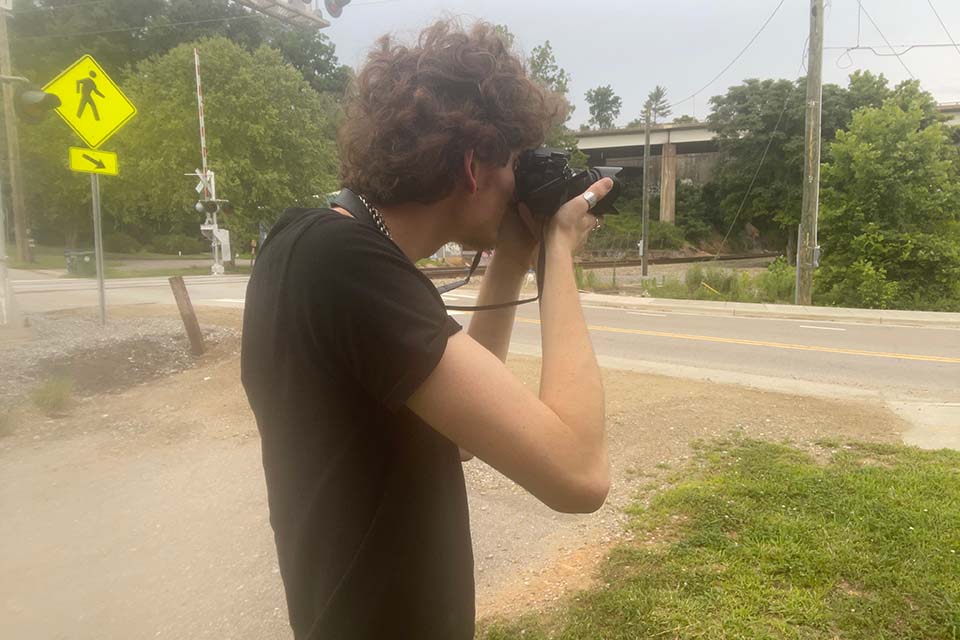
Emile Rizzo-Banks photographing Asheville's River Arts District / Photo courtesy of Rizzo-Banks
School of Filmmaking student Emile Rizzo-Banks spent his summer on the ground in the district, documenting both the destruction and the recovery as a SECU Public Fellows Intern with the Rada Foundation. Through conversations, photos and an interactive map project, he captured the resilience of a community determined to keep creating against the odds.
Discover Rizzo-Banks' experience in his own words:
Tell us about what you did this summer!
This summer, I did the SECU Public Fellows Internship through UNCSA. I chose to work with the Rada Foundation, a non-profit and the largest arts organization in my hometown of Asheville, with almost 1,000 members.
Of course, Asheville was recently hit by Hurricane Helene, and the River Arts District (where this organization is based) was flooded with over 30 feet of water. The damage here was unparalleled; artists lost studios and almost all their work, and people lost homes. However, looking around now at the number of fundraising events and construction projects, the efforts for recovery have also been unparalleled.
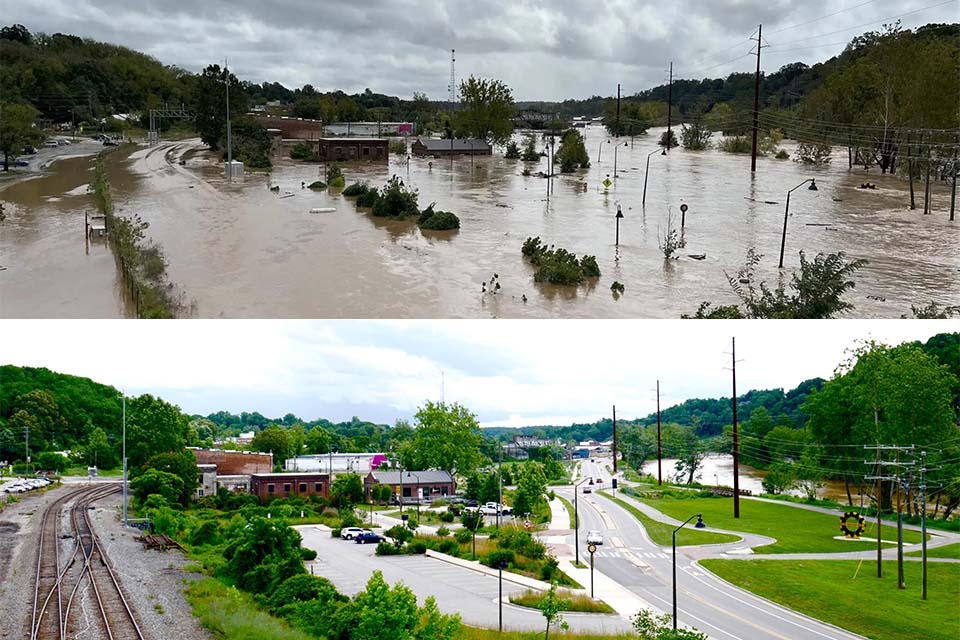
Before and after photos of part of Asheville's River Arts District / Photo courtesy of Emile Rizzo-Banks
My task was to build a photo library that would document all of this — both the damage and recovery. Every day, I would roam around the district, trying to meet everyone I possibly could — artists, tourists, business owners — asking about their story and if they had any photos that I could use as part of this archive. Throughout my time in the district, I received over 500 submissions, while also taking many photos of the surrounding events and recovery efforts. I also developed an interactive map of the River Arts District, containing points of all studios with photos and a brief report on each of their recovery efforts.
What was the best part or biggest lesson learned?
It took weeks to establish myself in the area. Although I’m from Asheville, I knew no one in this district. Every day was essentially trying to discover the complex network of people and studios. Afterwards, I used Dropbox for the archive and the free software Storymap.js (I have to thank Division of Liberal Arts professor Andrew Britt for introducing me to this) for the map. They took mere hours to learn and were easy to use.
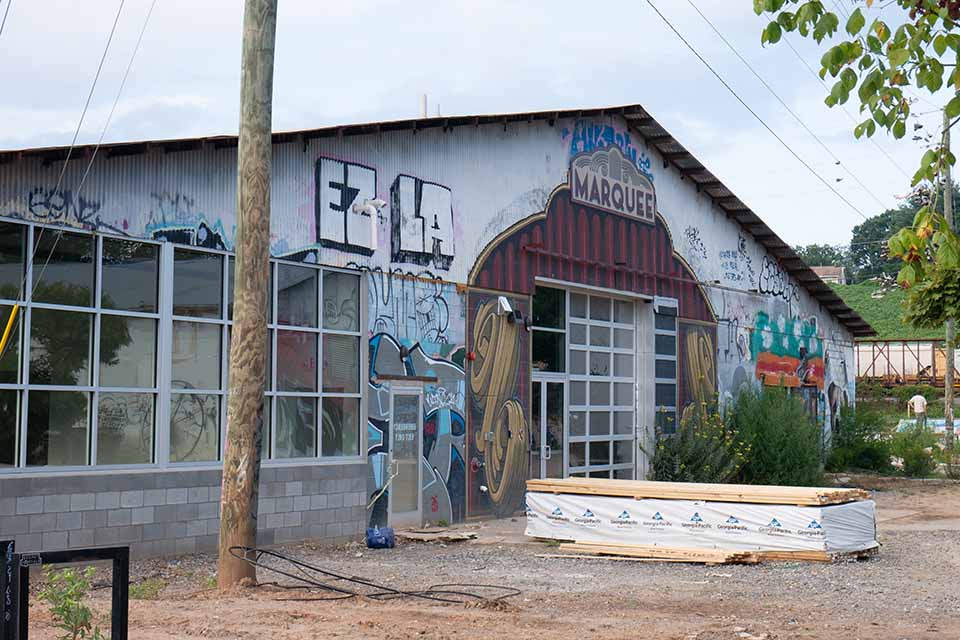
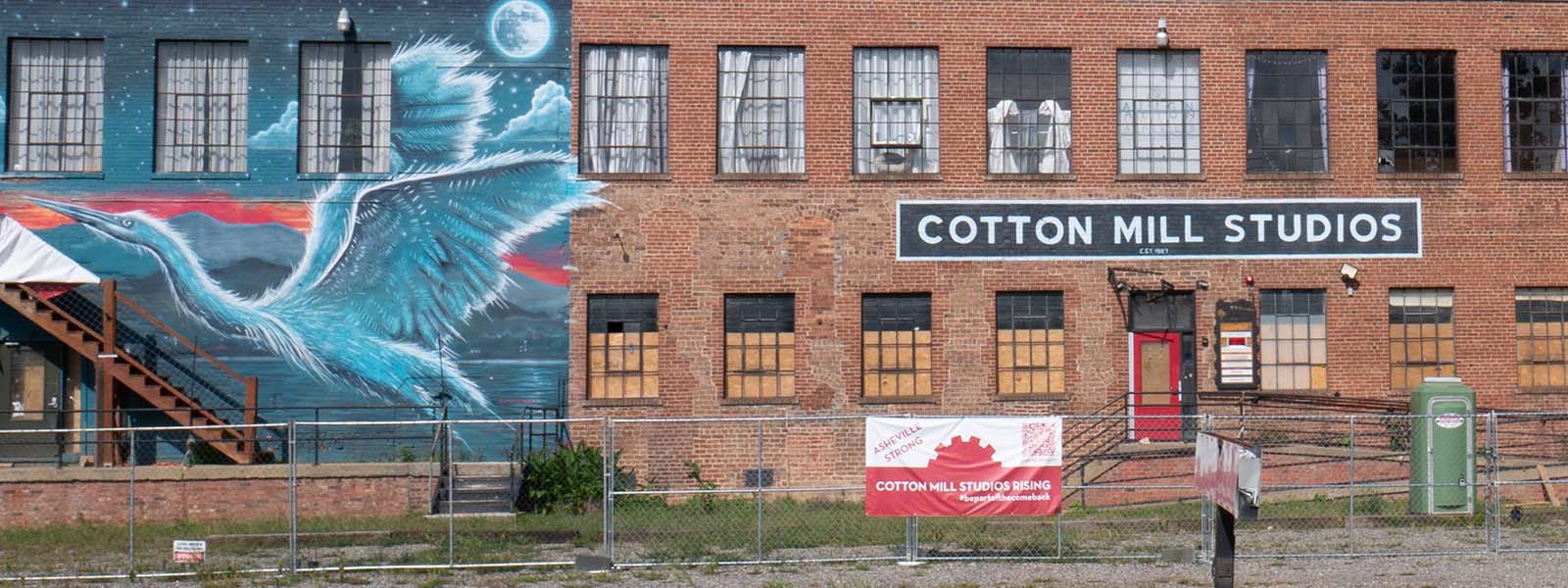
Asheville's River Arts District / Photo courtesy of Emile Rizzo-Banks
My point here is that the work is done not in the digital realm, but in the physical one. This is the biggest thing I learned. In this age of hyper-technology, anyone (or anything at this point) can learn the software and plug in the photos and text. But approaching people face-to-face, trying to communicate your project and vision daily, is the real skill. This dynamic also works because everyone — especially those going through a crisis — just wants to be heard. So I urge everyone to be a listening ear; it’s that simple.
How did you get this opportunity and make it happen?
I really have to thank Kate Miller for even telling me it existed. I applied on the UNCSA website and got accepted. Then it was Kathy Baker who made the connection with RADA’s executive director, Kimberly Self Hundertmark. I just showed up to the meetings and everything else went from there.
Who were the people who were instrumental in making this possible?
I'm very thankful for everyone mentioned above, they were really the ones to set this up. Then I’d have to thank Rebecca Naussbaum, who mentored all of the interns through the summer.
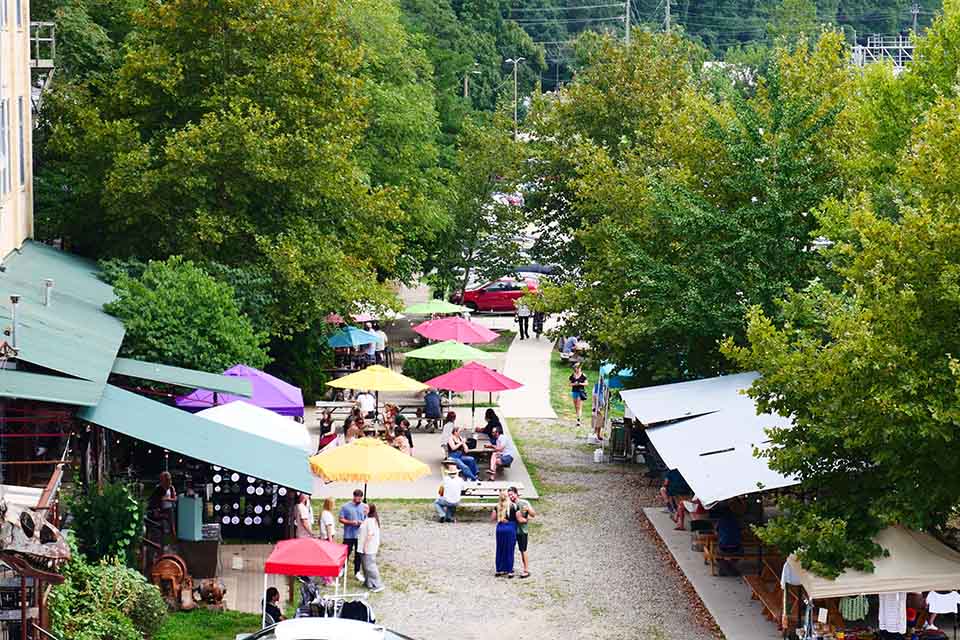
Asheville's River Arts District / Photo courtesy of Emile Rizzo-Banks
I would also have to thank RADA’s president Jefferey Burroughs (also an alumni of UNCSA!) for welcoming me into the community; Paige Houghton, the true historian of the district and someone who immediately believed in me; Christine VanCott, whose photos I used for the map (she was literally there taking pictures of the area as the hurricane hit); and then all of the artists in the district who helped me, either from donating their own photos or just hanging out and telling me all the lore of the area. Not only did they help me, but they made me feel a part of the community I'd been away from for so long again.
Was the experience what you expected or something more? How did it shape your artistry?
I really wasn’t sure what to expect, and I wasn’t even sure what Kim and the foundation meant by "photo archive" initially. Still, I learned the area and slowly understood what I needed to do. Now looking back, it will always be the people that I’ll remember and think about. The artists. The ones facing so many obstacles.
A true artist believes in what they do so far above any personal or political obstacle. People will find a way.
Emile Rizzo-Banks
The question lodged in my mind throughout these conversations was always the obvious one: how can you still keep creating? Hurricane Helene was by no means the only obstacle, either. The RADA Foundation itself was about to receive thousands of dollars in a grant from the NEA, which was, of course, entirely cut by our current federal government. But now I see that the answer to that question was also obvious. A true artist believes in what they do so far above any personal or political obstacle. Painting, sculpture, filmmaking, etc, will all continue. People will find a way. The photos, map and hopefully my own words here can prove this.
What’s next? What are you looking forward to most this year?
I could say I’m most excited for the classes or projects, but my honest answer is just seeing all my friends again. I think in our final year at UNCSA, we must all really examine how art can affect our world. Looking around, there’s certainly a lot that we wish was better. We’re going to be making big moves next year — movies, documentaries, very exciting things in the works!
August 17, 2025