David Hoffman on acting, improv and the road to LiMu Emu
On his first day in the School of Drama at UNCSA, David Hoffman (H.S. Drama ’95) learned a lesson he still laughs about decades later. His teacher, Bob Moyer — tall and serious, with his hair in a bun and memorable socks — asked the class to write down what he considered the most important rule they would ever learn as actors: “Never. Ever. Turn down free food.”
Moments later, Moyer and the Drama students drove to a gallery opening at a local university to partake in the reception snacks.
It was absurd, generous and unforgettable — the kind of moment that becomes part of an artist’s DNA. For Hoffman, it marked the beginning of a transformative chapter he had spent his entire childhood unknowingly preparing for.
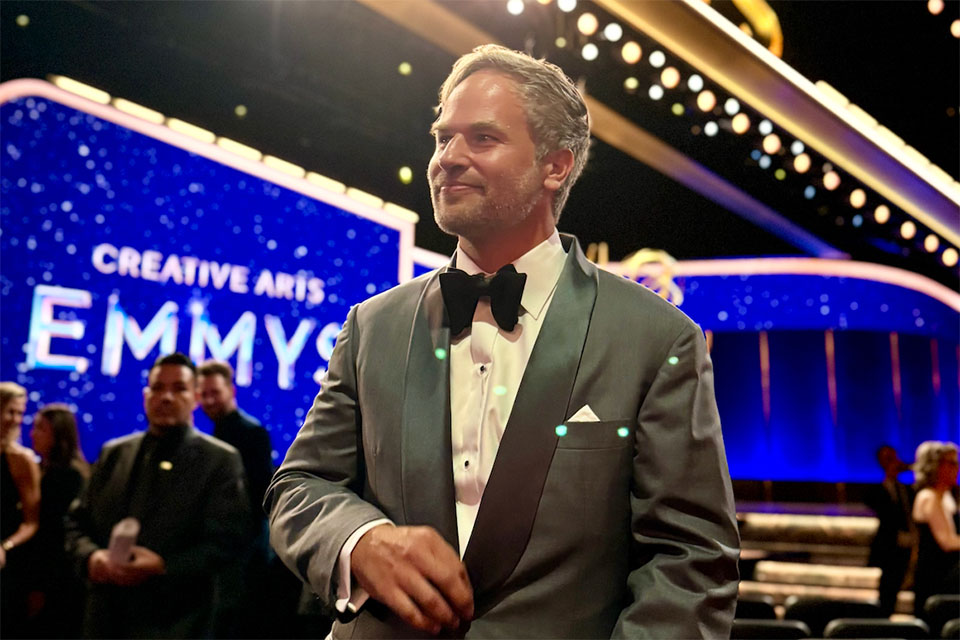
David Hoffman at the Creative Arts Emmy Awards / Photo courtesy of David Hoffman
How acting gave David Hoffman a place to stay still
Hoffman was born in Philadelphia, but after his mother remarried a soldier in the U.S. Army, moves became frequent. The rhythm of military life — with new kids arriving weekly and others moving on just as quickly — taught him how to adapt, bond quickly and let go.
“It conditioned me for the actor’s life,” he says. “You’re always the new person. You make friends, you say goodbye and you move on to the next job.” That sense of impermanence shaped him. But acting gave him something he had never had before: a place to stay still.
Acting became real for Hoffman at age 15, when his high school staged “Flowers for Algernon.” He did not initially intend to audition for the lead role of Charlie Gordon, but his drama teacher insisted, and he landed the part.
They rehearsed for months without a performance date, simply because the work brought them joy. When the teacher finally set a date, Hoffman spent long Saturdays rehearsing, eating pizza with the cast and discovering a sense of belonging he had never felt before. “I just had a moment where I realized this is the happiest I’ve ever been,” he says.
Around the same time, his grandmother died, and his grandfather, usually the playful one, became serious with him. “He told me not to choose a career for money, but to choose what made me happiest,” Hoffman remembers. When Hoffman told him acting was it, his grandfather immediately began researching programs and mailing him lists of schools. From that moment, Hoffman’s focus never wavered.
Finding exceptional actor training at UNCSA
In 11th grade, Hoffman’s family moved to Fort Bragg, North Carolina. He began attending school off base, where he felt like an outsider. Then he saw a tiny blurb in Parade magazine about what was then the North Carolina School of the Arts, and he applied without telling his parents. “Can’t tell the wardens the escape plan,” he jokes. When he finally told them, they supported him without hesitation, and his mother drove him two hours to the audition.
Hoffman prepared Mercutio’s Queen Mab monologue from “Romeo and Juliet,” drilling it for hours, as well as a monologue from David Mamet’s “Glengarry Glen Ross.” The faculty members conducting the audition were welcoming, and although Hoffman was nervous when asked to sing — he chose “The Star-Spangled Banner” — he will never forget receiving the letter announcing that he had been accepted.
UNCSA felt like a bubble in the best way. In the pre-internet library, students could check out films and watch them in a dark room filled with tiny televisions. Hoffman estimates that he watched 100 movies, catching up on the classics. Weekends were filled with movies, dances and time with friends. “It was like being away at camp,” he says.
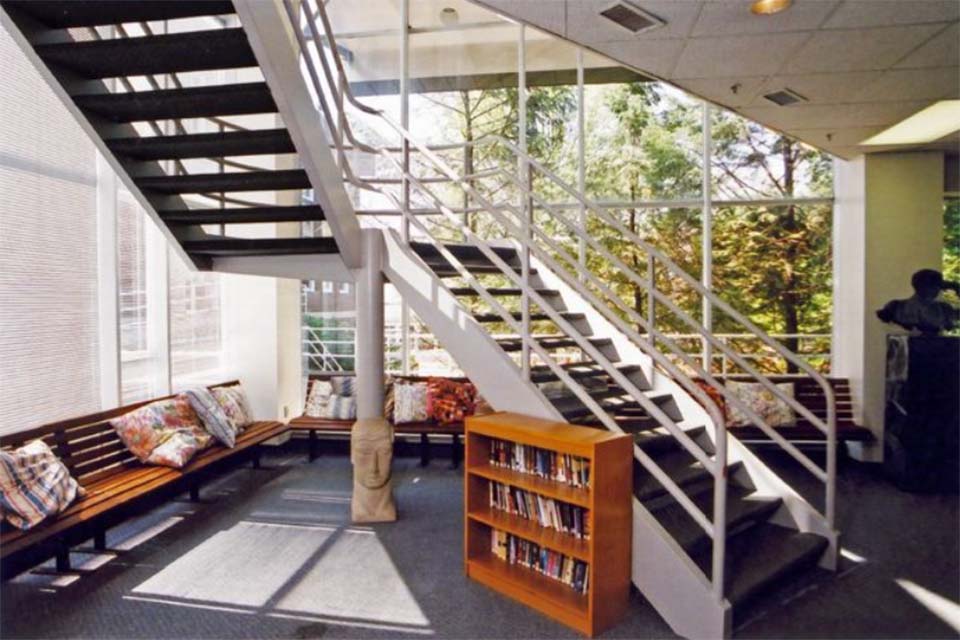
The Semans Library at UNCSA in the late 1990s and early 2000s / Photo: UNCSA Archives
Guest artists visited regularly. Some were alumni, and all were doing work that inspired him. He recalls a performer from the Big Apple Circus teaching students juggling techniques that Hoffman still uses today. He also remembers Gerald Freedman, then dean of the School of Drama, dropping in to watch monologues and treating the students’ work seriously. Even as a high school senior, Hoffman knew the training at UNCSA was exceptional.
Groundlings training and the early years of an acting career
After graduating high school at UNCSA, Hoffman earned his B.F.A. in acting at Boston University. He was finally ready to move to New York and become a star. But after hustling for seven months without a single audition, it was time to follow the lead of some friends who had made the move to Los Angeles instead.
Once in California, Hoffman immediately booked a two-man show and commercial work trickled in, though inconsistently. That’s when he knew he wanted more training and enrolled at the world-famous Groundlings School for improv and sketch. After climbing the ranks for four years, he was invited to join the prestigious Sunday Company in 2006.
The experience was incredibly intense: 100 hours a week, no pay and weekly original shows. During this time, Hoffman wrote and performed hundreds of sketches and improvs. After two years, he was voted into the main company and became a Groundling. “It was exhausting but exhilarating,” he remembers.
To survive financially, he worked a string of odd jobs: telemarketing, restaurant work, a 4 a.m. job monitoring brand mentions on radio shows, a call center where people asked him to look up things on the internet for them, and many more. His favorite of these was at TreePeople, a non-profit in the Santa Monica Mountains, where he taught kids how to protect and enjoy nature. Every day was a new audience, and he got to play characters and be funny while hiking kids through the mountains.
Eventually, the acting jobs added up, and he could finally let go of the odd jobs and act full time.
From “Bridesmaids” to LiMu Emu and Doug
As Hoffman's improv career grew, he began appearing more on film and TV, including several Super Bowl ads, one line in “Bridesmaids” that didn't make the cut (but you can still see him handing out puppies at the bridal shower), guest starring roles on “2 Broke Girls" and "Victorious," and the improvised Western series “Quick Draw," in which he was a series regular.
In 2014, he was cast in the lead role of the British sitcom “I Live with Models," playing Tommy, a hand model living with “real” models. The series ran for two seasons and expanded his international fan base. He followed that with guest appearances on “Modern Family,” “Bones” and “Castle,” and in 2017, he played a volatile writer for Johnny Carson in the series “There’s… Johnny!”
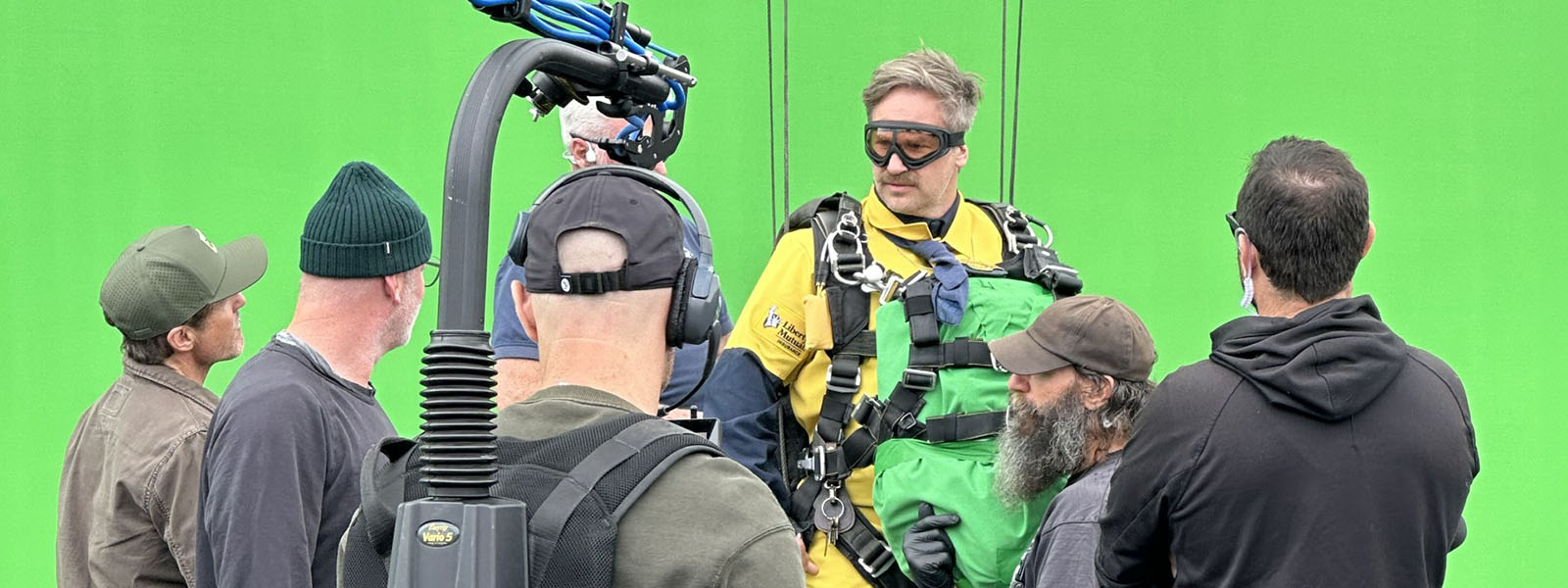
Then, in 2018, everything changed when Hoffman landed the title role in the Liberty Mutual “Limu Emu & Doug” campaign. Nearly eight years later, the campaign is still going strong, and he’s enjoying every minute of it. “One of my favorite things about this job is that I get to improvise and put my stamp on the character every time we shoot,” he says.
Describing his role as Doug and relationship with the crew, Hoffman says, “We’re a little family. We come back together, pick up where we left off. It’s a dream come true.”
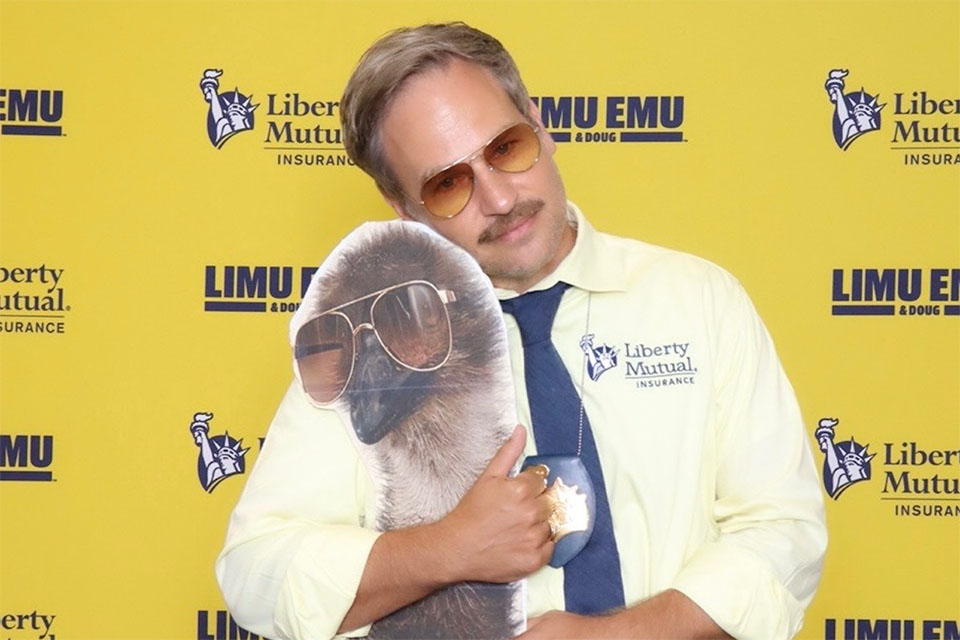
David Hoffman with a cutout of the Limu Emu / Photo courtesy of David Hoffman
And for those who wonder: Yes, the emu is real.
There are three trained emus — one good at running, one good at sitting still, and one who is a wild card. The first day of shooting, the trainer warned him that one kick could kill a person. “If I say run,” the trainer told him quietly, “just run.”
Honing his writing skills one scene at a time
In addition to his acting work, Hoffman has honed his writing skills throughout the years. He wrote multiple episodes of “Mike Tyson Mysteries” and created a forty-episode web series, “George Washington Is Here to Help," in which he plays George Washington attempting to guide America through the pandemic. He also developed an animated series about his childhood, titled “Army Brat," and is always working on scripts for pilots and full-length features.
Although he enjoys playing characters as an actor, writing is where his creativity feels most unbounded. “I only want to do things I find funny or interesting,” he explains.
His Groundlings training taught him to keep things loose, and those instincts shape his entire approach to storytelling. He describes his writing process as intuitive rather than structured. He doesn’t outline; instead, scenes simply appear in his mind, shaped by ideas he’s carried for years.
After completing a scene, Hoffman sets it aside and returns to it the next day. Reading it with fresh eyes naturally leads him to whatever comes next, almost as if the story reveals itself in sequence, following the momentum of the characters.
Hoffman says this ease in writing comes from years of absorbing performance and from training rooted deeply in character work — the kind of training that teaches an artist to trust instinct, rhythm and emotional truth.
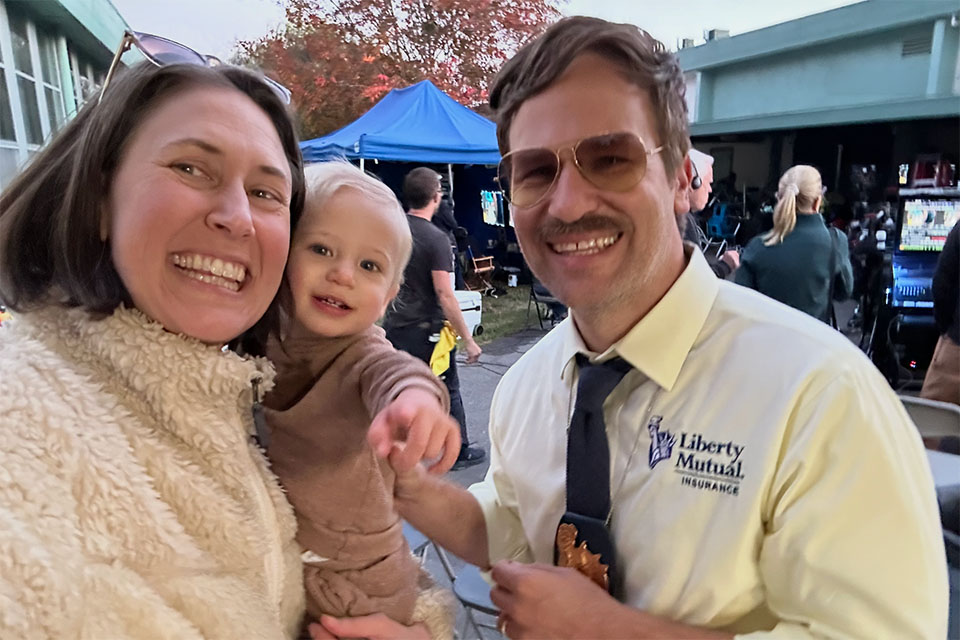
David Hoffman and his family on set / Photo courtesy of David Hoffman
A career built on endurance, curiosity and joy
Hoffman is looking forward to returning to Winston-Salem and meeting with current Drama students to offer the kind of grounded, practical advice he once craved as a young artist. He remembers the questions he and his peers asked guest artists: What do you actually do the day after graduation? What does the working life of an artist look like?
Today, he’d emphasize staying present, collaborating generously and focusing on getting better every day.
Hoffman and his wife, Jaime, a photographer and designer, live in Santa Barbara with their young son, Sonny. After decades of persistence, odd jobs, improvisation and creative reinvention, Hoffman has built a career defined not by overnight success but by endurance, curiosity and joy.
And somewhere in the background, Bob Moyer’s voice still echoes: Never. Ever. Turn down free food.
For more on David, visit his website www.thedavidhoffman.com.
Get the best news, performance and alumni stories from UNCSA.
SUBSCRIBE TO OUR NEWSLETTERS(OPENS IN NEW TAB)(opens in new tab)(opens in new tab)(opens in new tab)
August 04, 2026