
Fellowship at ACT connects dots for UNCSA alum
Alex Bodine left his heart in Seattle when he completed his Kenan Fellowship in Directing at ACT Theatre in August.
The actor, director and stage combat choreographer says he hopes to return to the Pacific Northwest. But for now, Bodine is content putting into practice all that he learned during his six-month stint with ACT — A Contemporary Theatre.
“If this opportunity for teaching hadn’t come through the way it did, I would have stayed in Seattle,” says Bodine, an alumnus of the University of North Carolina School of the Arts who returned to campus this fall to teach for a year at the request of mentor and Interim Associate Dean of Drama Dale Girard.
“I loved the city and the work being done there.”
The Thomas S. Kenan Institute for the Arts created the fellowship at ACT as part of its Career Pathways Initiative to provide practical knowledge and experience to recent graduates of UNCSA’s School of Drama. Bodine, a 24-year-old native of upstate New York, earned a BFA in Acting in 2015.
Bodine took advantage of wide-ranging opportunities at ACT, one of Seattle's largest and most established playhouses with five theatres under one roof and an annual budget of $6 million. He worked alongside director David Bennett on “The Legend of Georgia McBride.” Then he assisted acclaimed ACT Artistic Director John Langs on the world premiere of "Alex & Aris,” a new play by Moby Pomerance about Alexander the Great and Aristotle.
“I got to watch this epic, ‘War and Peace’-scaled piece of theatre being built from the ground up,” Bodine says. “We were getting dozens of pages thrown away each day with new pages replaced in. It was amazing to watch the actors deal with that much work and then completely do a 180 the next day. I learned more about my own acting craft and how to work with actors as a director.”
The Kenan fellowship culminated in early August with a three-day run of “Fool for Love,” a twisted tale of incestuous love penned by American playwright and actor Sam Shepard. As director, Bodine had the rare opportunity to reimagine the show, which played to sold-out crowds on the heels of Shepard’s death at age 73.
“It was really kind of special to be able to honor Sam Shepard’s life by doing a work right after his passing. It lent an energy to the performance of the actors,” Bodine recalls.
“Rather than just doing a play by Sam Shepard because it is an American classic, I learned more about the responsibility of a director to make the conversation more active, more with the times. I tried to make the play more about the head games than the physical attraction, because that always stood out in the play for me.”
“Fools for Love” also presented the biggest challenge Bodine would face during his fellowship: casting. Langs stepped in and asked him to go back to the drawing board.
“If you do it right, casting is about 80 percent of the production,” Langs explains. “There is a learning curve around the kind of actors you want in the room to make a show successful.
“I asked him to put on the breaks and think about what diversity and inclusion and representation meant to this project. I am an artistic director who believes that what is represented on stage should really reflect the world around us.”
Langs, who is also an alumnus of UNCSA, considers it a privilege to mentor the future leaders of theatre because he remembers the mentors who helped facilitate his professional own journey.
“Gerald Freedman took me under his wings when he was artistic director of the Great Lakes Theater Festival in Cleveland. I got to spend time with a gentlemen who had met the challenges of theatre for decades,” Langs says of Freedman, the beloved Dean of the School of Drama for two decades. “I can trace a direct line from my work assisting Gerald when he was an artistic director to where I am sitting now as an artistic director. It is huge to me.”
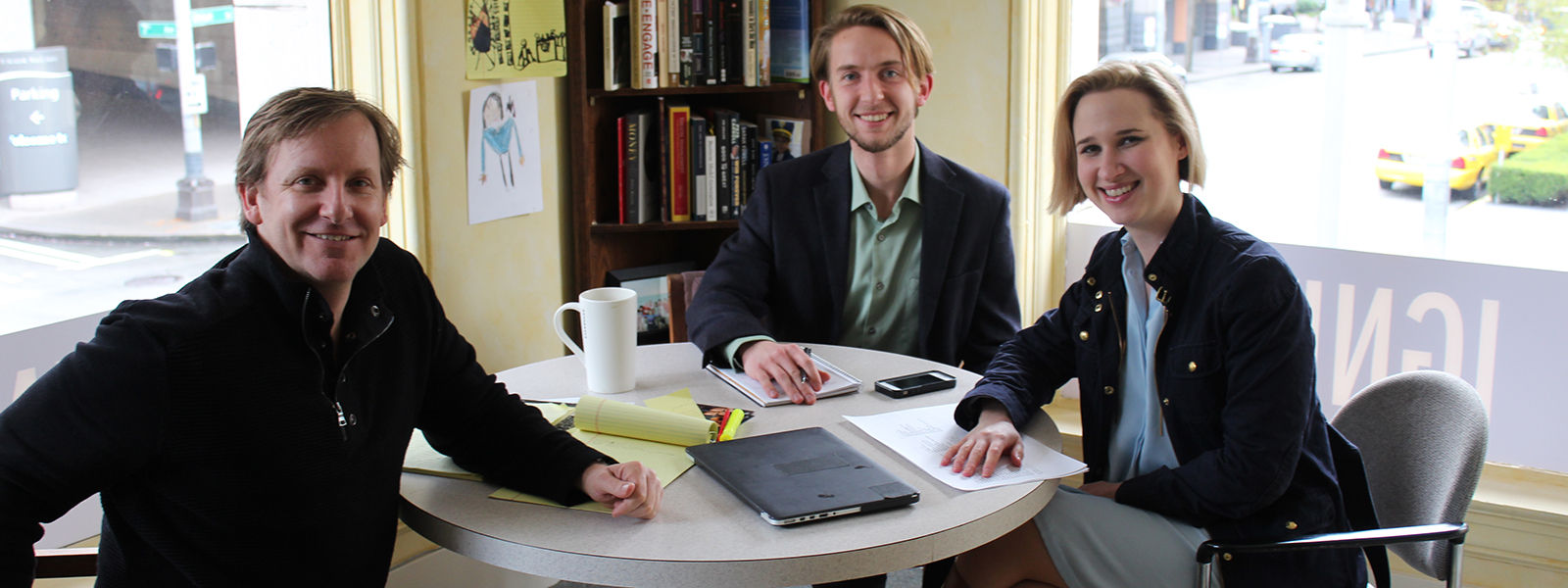
Langs was impressed by Bodine’s ability to network professionally while at ACT, which he considers one of the most important aspects of the fellowship. Bodine would love to return to Seattle one day because he felt so welcomed by the theatre community there.
“I met people who I think would have invited me back in the door at the end of my fellowship at ACT,” he says. “Anytime you go into a new market, it takes a lot of knocking to get someone to open the door. At ACT, you come in and all the doors swing wide.”
Changed and inspired by his experience in Seattle, Bodine now sees a master’s program as a possibility in his future. The fellowship helped him to better understand the skill sets he learned at UNCSA.
“I saw other working professionals applying those skill sets and people who weren’t, and I started to understand what is good process in craft and what is ineffective process in craft,” he explains.
“Now that I am back in a training environment as a teacher at UNCSA, I am watching my colleagues teach the same material I was taught three years ago, and I am getting so much more out of it now because I’ve seen it in the field. I’ve seen real-world application of these techniques. That’s why I feel like a master’s is in the books for me — I’ve learned how much I really don’t know.”
November 9, 2017