Artistry and applause: Cliff Odle's multi-hyphenate journey informs his teaching
“Eighth grade. ‘The Wizard of Oz.’ I was the cowardly lion.”
Cliff Odle remembers the exact moment he fell in love with theater. Skeptical during the audition process and nervous throughout rehearsals, he stepped on stage in front of a crowd and everything changed.
“There was this applause that I had never felt before in my life,” he recalls. “I have never forgotten that feeling and I’ve continued chasing it. It woke something up in me.”
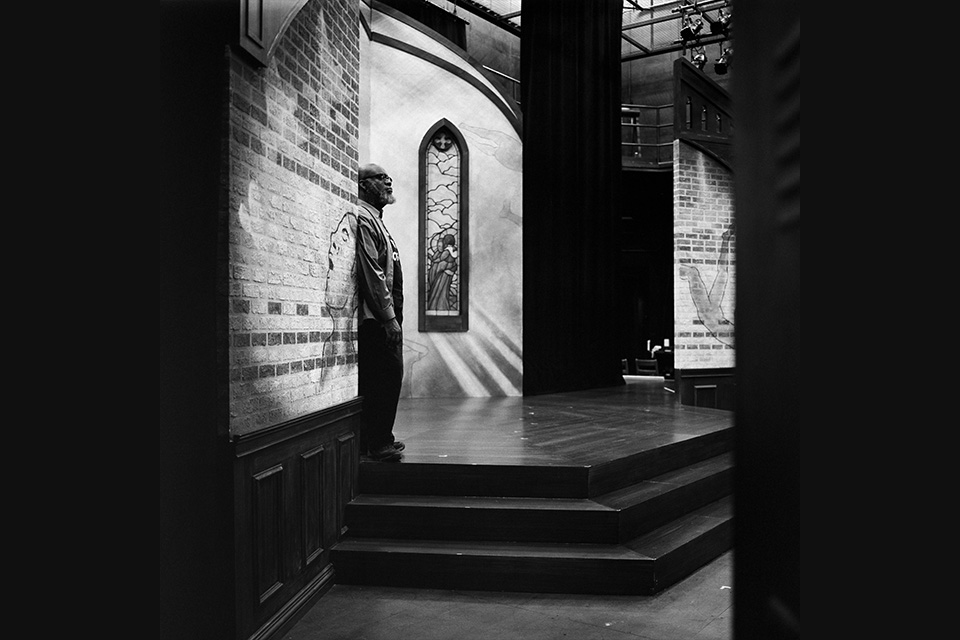
A portrait of Cliff Odle on the set of "Choir Boy" / Photo: Peter Mueller
Following the call
An accomplished actor, director and playwright, Odle has taught in the School of Drama since 2022. To his students he brings a wealth of experience from a multi-hyphenate career. Odle’s first love was acting, and he studied in the theatre arts program at Catawba College — ultimately choosing to major in communications with minors in theatre and political science. After graduating and returning home to New Jersey, Odle was hired by now-faculty colleague Carl Forsman to direct the first play for his new Horizon Theater company. “Carl was one of the first people outside of college that saw a director in me,” remembers Odle. “It inspired me to pursue more directing opportunities.”
Playwriting fell into place as another piece of the puzzle after Odle was an understudy in August Wilson’s “King Hedley II.” Jazz drummer, bebop pioneer and composer Max Roach joined him in the production. “I had many long talks with Max, and those conversations turned into a play I wrote that became my thesis for my M.F.A. program at Boston University,” he explains. And he has continued writing, inspired by both history and the world around him today. “I focus on stories in the African diaspora… stories that get overlooked and stories that I can uncover while connecting with my love of history.”
After completing the M.F.A. program, Odle looked for work anywhere he could: acting, directing or playwriting. He was soon offered a job as an adjunct professor at University of Massachusetts Boston, which introduced him to teaching. Bringing students into his artistic pursuits, he says, has stoked his love for the arts. “Teaching started with necessity,” Odle explains, “but it is now powered by my love of this artistic forum.”
The right fit at UNCSA
Odle, who had many teaching credits under his belt before moving to Winston-Salem, had UNCSA on his radar for years before he heard about an open faculty position. Initially unsure if it would be the right fit, Odle decided to apply and was surprised to find a natural connection with the students in his demo classes. “They had a drive I remembered having at their age,” he says, “and it connected me to something. I knew it would be a great place to teach.”
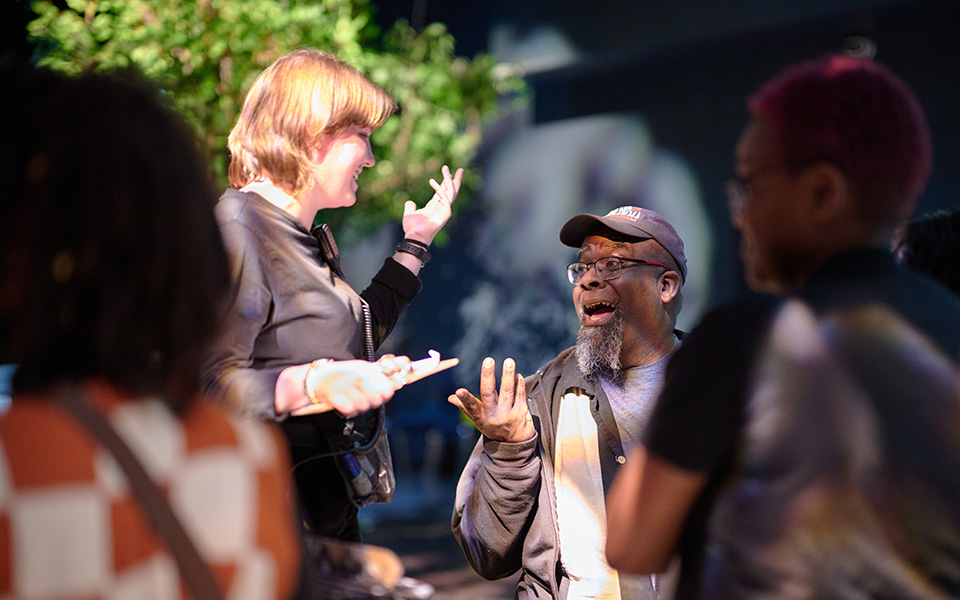
Cliff Odle speaking with the Production Stage Manager and other cast and crew on the set of "Barbeque." / Photo: Wayne Reich
His work at UNCSA is varied. Odle teaches acting for Studios 1 and 2, along with playwriting. He’ll soon lead, for the second time, a Division of Liberal Arts course that explores the history of Black theater in America. And he’s excited for an upcoming course for directors focused on new play development. Made possible by a grant earmarked for this type of development, the course will connect professional playwrights with third-year directors.
Outside of the classroom, Odle serves as chair of the scripting and casting committee — a group of faculty members and School of Drama leadership who select and plan productions for each academic year. “We narrow things down to identify the learning outcomes for students,” he says of the process. “That’s the most important thing. What do they need to work on? What are their strengths and weaknesses? What should we be supporting?”
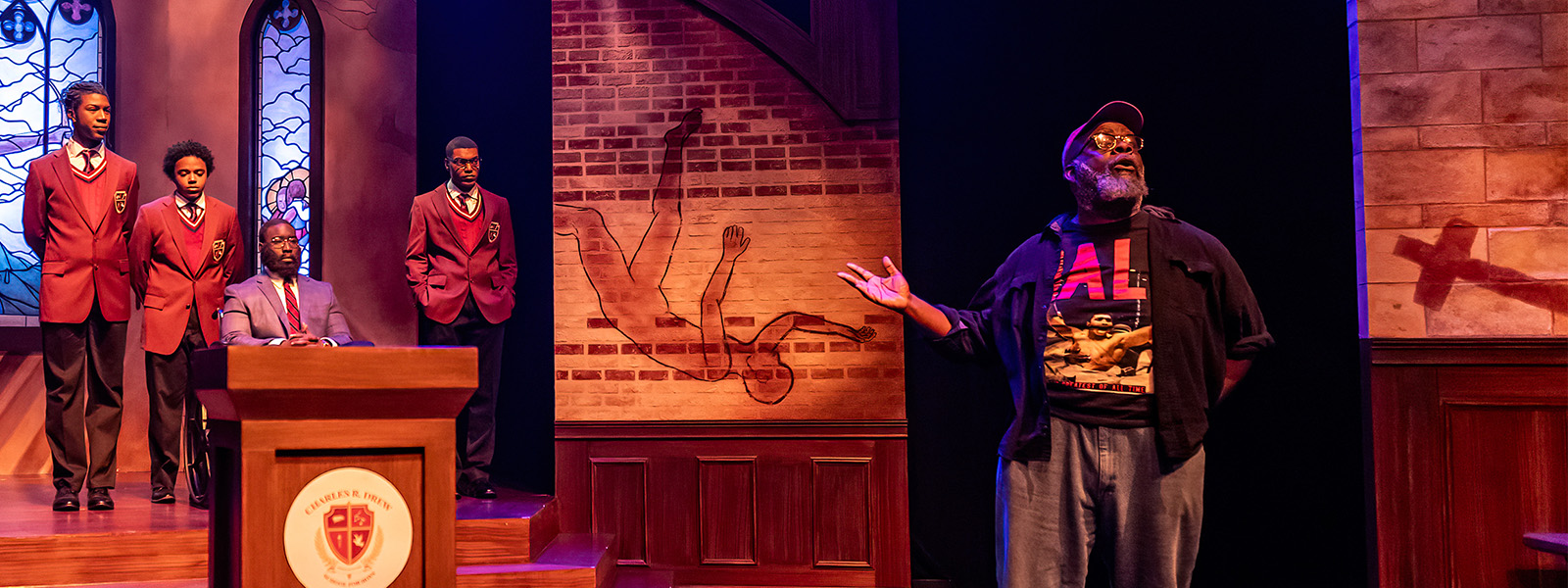
For example, Odle explains, there are a growing number of students who are strong singers. In response, the committee has selected more musicals in recent years than in the past. Drama students are assigned roles instead of auditioning for them, so the process requires precision to find fitting roles for around 60 students each year. Faculty directors are assigned based on interest and availability, while also considering opportunities for guest directors. During his tenure, Odle has directed several mainstage productions, including “Barbeque,” “The Wild Party” and, most recently, “Choir Boy.”
Teaching the whole artist
Whether in the classroom or in the rehearsal room, it’s important to Odle to focus on teaching the whole student. “The concept of critical thinking is so important,” he emphasizes. “I want students to be discerning and to look beyond the information they receive instead of taking everything at face value.” “The arts are rife for exploitation,” he continues, “and it’s important to arm students with not just skill but also penetrative thinking to help them protect themselves. I tell them to question everything… even me!”
The concept of critical thinking is so important. I want students to be discerning and to look beyond the information they receive instead of taking everything at face value.
Cliff Odle
Soon, Odle will have a new way to engage with students through the UNCSA Rep Forward series, which will bring to the stage plays inspired by, adapted from or otherwise related to classic works. The inaugural production, “TartuffeNation,” is inspired by Molière’s original work and was penned by Odle. “Tartuffe” is one of the classic plays with which he is most familiar, having performed as Orgon and Tartuffe in two different productions.
Playwriting is the hardest thing he does, admits Odle, but the writing process for “TartuffeNation” came together organically. “The challenge of rhyming everything was fun,” he explains. “It also allowed me to comment on political situations in a way that I think will be fun; pointing out absurdity and hypocrisy in a way that we see in politics today.” He hopes to bring playwriting to the same level of acting and directing within the School of Drama in the future. “I want students to explore writing for themselves,” he says. “It’s important to generate your own work, or at least to understand the process.”
Continuing to grow
With so much to keep him busy at UNCSA, Odle still finds the time to continue pursuing new acting, directing and playwriting work – like most conservatory faculty members, it’s deeply ingrained in him to continue sharpening his skills. In recent years, he has partnered with the North Carolina Black Repertory Company for a staged reading of his play, “Lost Tempo,” and performed in JuCoby Johnson’s “Heritage” at the International Black Theatre Festival. In the summer of 2025, he performed the role of Polonius in the Piedmont Shakespeare Company’s production of “Hamlet.”
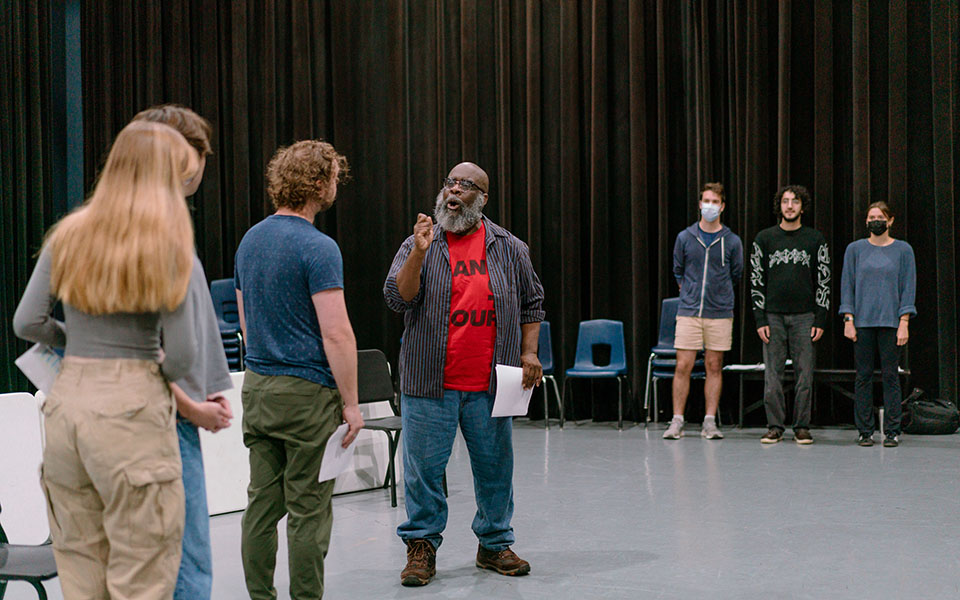
Cliff Odle rehearsing the role of Polonius in "Hamlet" with the Piedmont Shakespeare Company. / Photo: Jen Scheib
When there’s time and space, Odle continues to audition and write. And his students are a great audience for reading and providing feedback on his work. In turn, he describes UNCSA as a perfect sandbox for young actors and directors who are thinking about working with new play development. “The students are hungry,” says Odle. “And it makes me hungry… it’s a good example for them to have a teacher still pursuing the arts.
Odle still finds himself learning every day, thanks to his students and colleagues. And he’s appreciative of the freedom of expression students and faculty alike have on the UNCSA campus. “I don’t take that for granted,” he explains. “It’s not always the same at other institutions, and it’s up to us to step out of our bubble and reach out to our peers… to attend a show at another school; to make a connection.”
“Every play is a form of rebellion,” he continues, “against conformity and complacency.” He’s proud of this sentiment, but ever-vigilant, knowing that the landscape of the arts can quickly change. “Our job as artists is to reflect humanity and to tell humanity about itself,” Odle concludes. “It’s important to be in the community and to engage with others. These are the stories we must tell.”
Get the best news, performance and alumni stories from UNCSA.
SUBSCRIBE TO OUR NEWSLETTERS(OPENS IN NEW TAB)(OPENS IN NEW TAB)(OPENS IN NEW TAB)(OPENS IN NEW TAB)(OPENS IN NEW TAB)(OPENS IN NEW TAB)(OPENS IN NEW TAB)(OPENS IN NEW TAB)(OPENS IN NEW TAB)(opens in new tab)(opens in new tab)(opens in new tab)(opens in new tab)
November 19, 2025