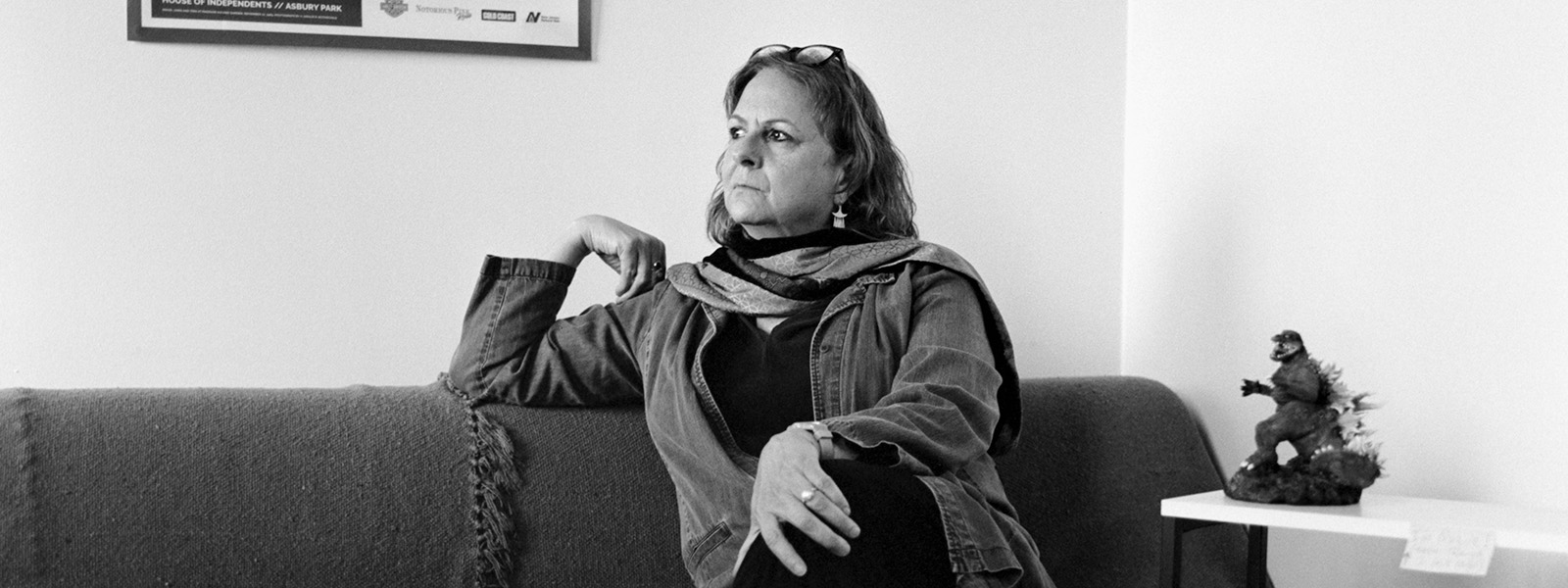
Film faculty Molly Bernstein brings her documentary filmmaking approach to UNCSA
“I really do learn by teaching,” says UNCSA Filmmaking faculty member Molly Bernstein. “It’s an incredibly enriching experience that’s different from the rest of my career.” Her pivot to the classroom and her onboarding as an editing faculty member in 2024 builds upon years of creating documentary films — experience she now shares with her students. “I’m so impressed by the breadth of their ideas and their sensibilities,” she adds. “It’s a fun challenge to try to help them develop the language needed to express both themselves and their ideas. It’s gratifying when it works and I’m able to contribute to their process.”
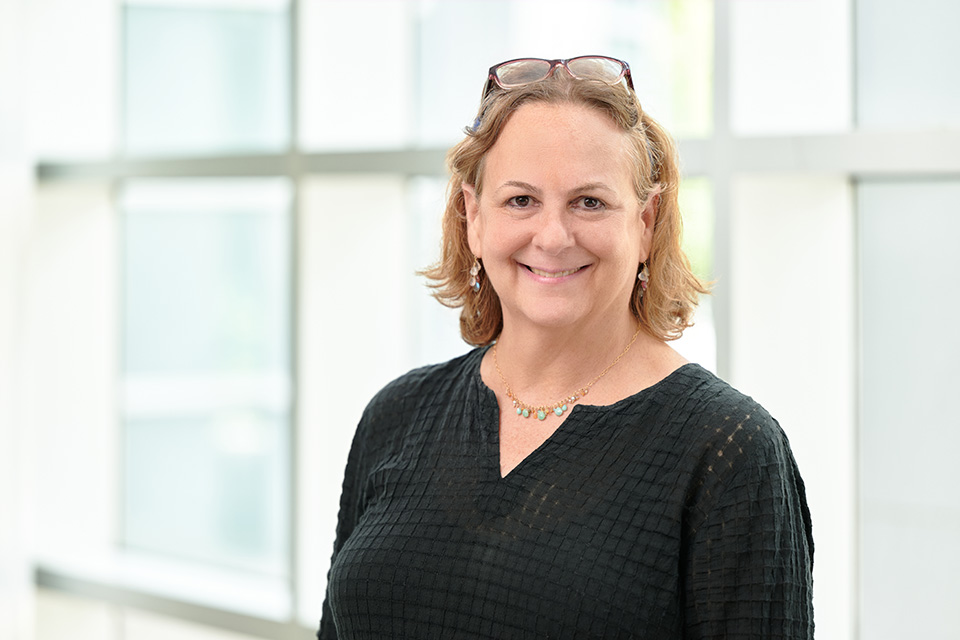
UNCSA School of Filmmaking faculty Molly Bertnstein.
Working with college students parallels Bernstein’s own discovery of the filmmaking craft as a student at Barnard College, where she studied history. “I saw the film ‘Aguirre: The Wrath of God’ and it was hugely inspiring and revelatory to me… an incredible mixture of history and art.” The German new wave film inspired her to seek out documentaries from the film’s director, Werner Herzog, whose blend of people and locations — infused with poetic interpretation — felt gripping. “I have always been fascinated by that mixture,” reflects Bernstein, “and how you can conjure visions of history through film.”
The magic of documentary filmmaking
Bernstein began working in the film industry in New York City while she completed her undergraduate degree. An internship with a public television station led to a role as an apprentice editor on an independent film, which cemented her interest in filmmaking as a career. She continued working in the independent film scene as an editor before returning to school for a master’s degree in film from Columbia University. While her studies focused on directing, Bernstein’s career has given her the opportunity to build strength in writing and producing in addition to editing and directing.
She didn’t set out to be a documentary filmmaker, nor did she intend her focus to be on artists exploring their creative process. However, as much of her career reveals, one thing led to another as stories and connections wove together to create new opportunities. Bernstein’s documentary work began in an unlikely way: She attended a magic show. Sleight of hand artist and magic historian Ricky Jay captured her attention in a small New York City theater, commanding the stage with only a deck of cards and small objects as he told stories about magicians from the past and recreated their effects. “It dazzled me,” she remembers. His story needed to be told.
Bernstein’s documentary, “Deceptive Practice: The Mysteries and Mentors of Ricky Jay,” took more than a decade to finish. Jay was guarded, as most magicians are; reluctant to give away too many details of his work so as not to ruin the illusion. “It’s better to experience the feeling of wonder,” he told Bernstein, who produced, directed and edited the film while continuing to work as an editor. The film premiered at the New York Film Festival and was accompanied by a theatrical release. It was later picked up by PBS’ American Masters.
Bernstein’s next film, “An Art That Nature Makes,” told the story of Rosamond Purcell (there will be a free screening of the film at a/perture in Winston-Salem on Feb. 26). A nature photographer who specializes in decaying objects, Purcell was hired by Ricky Jay to photograph his aging dice collection and was featured in the “Deceptive Practice” documentary. It allowed Bernstein to highlight a completely different form of art. Likewise, her music documentary “The Show's the Thing: The Legendary Promoters of Rock” was conceived from a conversation with Ricky Jay’s manager, Winston Simone, whose career primarily focused on managing musicians.
Continuing the thread which began with Bernstein’s initial magic show inspiration, Ricky Jay also introduced her to acclaimed cartoonist and graphic novelist Art Spiegelman — the subject of her latest documentary, “Disaster Is My Muse,” produced and directed with her partner, Philip Dolin. Following a release on PBS’ American Masters and at the New York Film Forum and theaters around the country, she screened the film for students as part of the School of Filmmaking’s Symposium series in 2025, inviting them directly into conversation around documentary filmmaking — an area of interest for many students.
Nonfiction filmmaking at UNCSA
“I intentionally weave it in,” says Bernstein in response to students who are interested in her documentary film experience. “There isn’t a black and white difference between fiction and nonfiction to me,” she continues. “It’s all filmmaking.” Bernstein is currently co-teaching a documentary workshop with Filmmaking faculty member Pooja Gupta and weaves nonfiction into both her editing and first-year “Story, Structure and Vision” classes as well. It’s an inclusive response to adapt classes to meet student interest — something that the School of Filmmaking takes seriously.
We encourage students to see all filmmaking crafts as important and interconnected. It’s an interdisciplinary approach.
Molly Bernstein
“We encourage students to see all filmmaking crafts as important and interconnected,” explains Bernstein. “It’s an interdisciplinary approach.” It’s easier now than in the past to make independent films with lower tech and to more freely exercise creativity in the approach. In some of Bernstein’s courses, students make projects using only their cell phones. And she’s appreciative of her colleagues for their dedication to mirroring the collaborative experience of filmmaking for students: “Working with the other faculty around course structure and workshops feels like working on a film,” she says.
From the lens of nonfiction filmmaking, Bernstein is also able to guide students through many of the integrated elements of filmmaking: writing, directing, editing and producing. They’re interconnected and the skills overlap. It’s not as broad as it may seem.” It was a natural process for Bernstein to work in hybrid roles to complete her films. Sometimes, she explains, there’s a script and a narration plan for documentaries as in their fiction counterparts. More often, you discover a story while in the field observing. An immense amount of research is required for either approach. And all approaches end in the same place: the editing room. During post production the structure changes, scenes are dropped, dialogue is adjusted and new elements are introduced. “The editing is the final rewrite of any film,” says Bernstein. “It’s what I love about filmmaking. Every film is different and changes throughout the process; it’s thrilling.”
With each film release, Bernstein is hopeful that audiences are creating their own
interpretations of her work. “I’m making something from my point of view with an intended
communication,” she explains, “but I always want to hear from them.” Sometimes, she
says, the goal of a documentary film is to be factual and to impart information. There’s
also poetic nonfiction work and hybrid work that mixes documentary and drama. The
goal at the end of the day is the same: storytelling that allows the viewer to form
their own conclusion.
Bernstein continues to work on nonfiction projects while teaching, but is quick to emphasize the importance of her faculty role: “Teaching is my main creative project right now,” she says. “Developing new courses, working with students and faculty members, designing the curriculum… that is very inspiring.”
Get the best news, performance and alumni stories from UNCSA.
SUBSCRIBE TO OUR NEWSLETTERS(OPENS IN NEW TAB)(OPENS IN NEW TAB)(OPENS IN NEW TAB)(OPENS IN NEW TAB)(opens in new tab)(opens in new tab)
February 3, 2026