Design & Production alumni bring the latest Met Opera season to life
The Metropolitan (Met) Opera in New York City has been regarded as the preeminent opera company in the United States since its founding in 1883. In 1966, they joined with other New York institutions in forming Lincoln Center for the Performing Arts, where they have hosted nearly 60 seasons of classical and contemporary works in the storied Metropolitan Opera House. It’s a mecca for artists who dream of gracing the Met Opera stage at Lincoln Center or landing a job behind the scenes, bringing productions to life.
Through the years, many UNCSA alumni have proudly worked on and off the Met stage, from René Barbera (M.M. Fletcher Opera ' 21), Paul Tazewell (B.F.A. Design & Production '86) and Camille A. Brown (B.F.A. Dance ’01) to alumni from many disciplines within the School of Design & Production. It’s an enduring place where the contributions of artists are elevated daily.
As a new season begins, several Design & Production alumni reflect on their Met journeys and what’s ahead:
All roads lead to the Met
“It’s the largest repertory opera company in the country,” says Production Stage Manager Terry Ganley (B.F.A. ’85). Ganley joined the Met in 2003 after a long stint at San Francisco Opera. “Met jobs come up very seldom and people stay forever,” she explains of her decision to move across the country for a new role.
Tera Willis (M.F.A. ’10) has spent 15 seasons at the Met; the last nine as the head of the wig and makeup department. Before joining the Met, she worked in a Broadway wig and makeup shop under the direction of Tom Watson, then-head of the Met’s wig and makeup department. “I came to work one day and there was a sticky note that said, ‘call Tom.’ Everybody knew he was going to move me over to the Met,” Willis recalls. “When he retired, he set me on the course to take over his role.”
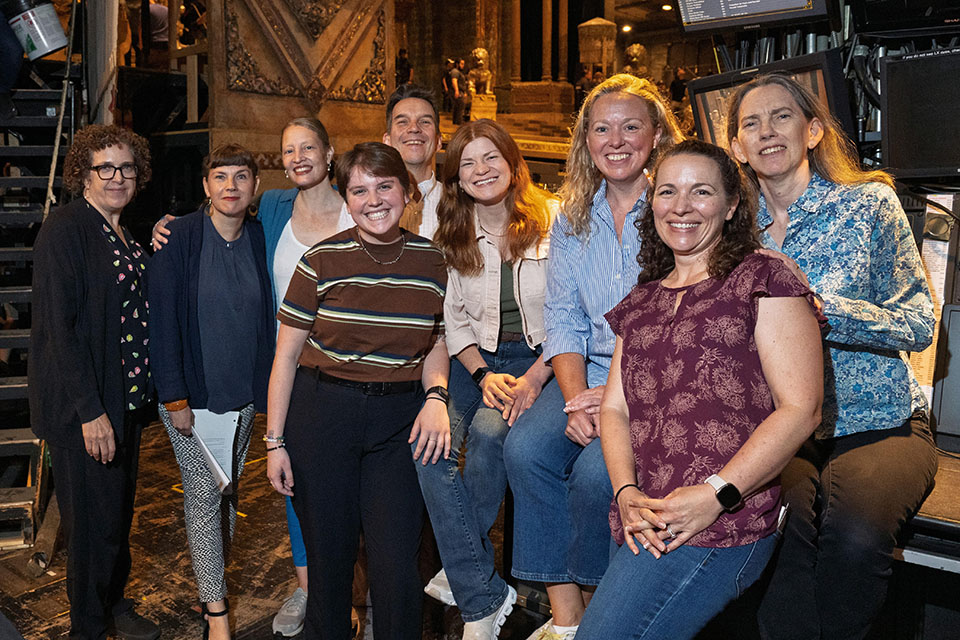
Terry Ganley and AJ Helms are pictured here with the Met Opera Stage Management team. / Photo courtesy of Helms
Shortly after becoming head of the department, Willis hired Susie Knowles (M.F.A. ’16) into a per diem position before extending to her an offer to join the staff. Jonathan Amaro (M.F.A. ’19) met Willis during a network trip to New York City, arranged by his UNCSA wig and makeup faculty members, and began his first season at the Met shortly after graduation.
Most recently, 2025 graduate AJ Helms joined the Met as a Stage Management Fellow— a 33-week paid, union-recognized fellowship that spans most of the Met Opera season. “You have to be a self-starter and be self-sufficient,” explains Helms of their interest in the fellowship. “I’m an independent person and it fits me well. They guide you, but they want you to take initiative.”
Keeping the curtain rising
To self-sufficiency, Ganley adds another skill necessary for Met Opera stage managers: flexibility. “We can all do the same things here but we are in charge of very different aspects depending on the show or night,” says Ganley of the stage management department. “We switch roles up and down a lot.” As production stage manager, Ganley not only oversees the staff of stage managers and their assignments but also stage manages herself. “I was just calling entrance cues yesterday,” she says as she describes the busy weeks leading up to the season opening, “and I’m also working as second stage manager on 'The Amazing Adventures of Kavalier and Clay' right now.”
Helms’ days also vary — though they almost always include attending rehearsals. “I help out assistant directors when they need me or I’m watching stage managers practice calling cues or editing blocking,” they describe. Early in the season, they’ll spend time observing and working on one production at a time. But as the season continues, Helms’ work will expand to include multiple shows at a time. “I love getting to help facilitate people putting their vision on stage,” describes Helms of what drew them to stage management. “You’re communicating with all departments so everyone can do their job to the fullest extent and you’re providing both the physical and emotional support they need to succeed.”
It’s important to be a person first, to be yourself... you’ll make mistakes. It’s part of the process. Understand that you’re human and so is everybody else.
Terry Ganley
Ganley co-created the stage management fellowship five years ago, and it’s a priority for her to guide each new fellow and share with them what’s needed to succeed at the Met and beyond. “You have to live your life completely,” she says, “and you have to learn the balance between work and life. Sometimes you’re committed to work when you don’t want to be there, but you show up and do it anyway. Sometimes you need to understand that there are bigger things in the world than the work at hand.”
A memory from her time at UNCSA illustrates Ganley’s point: “We were doing Portfolio Review and my grandfather had just died,” she recalls. “A lighting design professor recognized that I was floundering and he stopped me and told me that I needed to go home…. He said he’d help me to find a way to get home if I needed the support.”
Ganley carries forth this kindness and care in her relationships with the stage management team. “It’s important to be a person first, to be yourself,” she says. “You’ll make mistakes. It’s part of the process. Understand that you’re human and so is everybody else.”
Shaping style and defining character
Willis has the same dedication to the wig and makeup crew at the Met. “It’s nice to watch people grow,” she says. “I push them to find challenges and to problem-solve within each show. Nobody’s watching me now… I’m watching them grow on a daily basis. I have trust in the work they are producing.”
Team members have expertise in both wig and makeup design and production, whereas departments at other companies are often split between the two areas. “I feel very lucky that we work in a place where we get to do exactly what we studied,” says Knowles. “If you’re working on a Broadway production you’re usually just building a wig and passing it off. Here, we are building, styling and putting it on the performer and running the whole show… that’s very rare.”
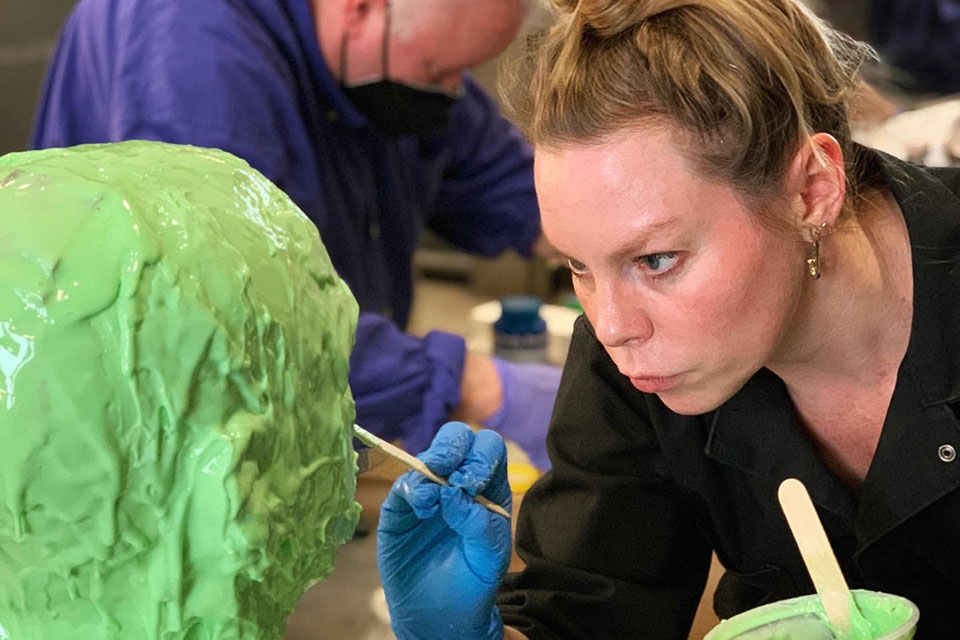
Head of Wig and Makeup Tera Willis hard at work creating transformative pieces for singers in the Spring 2025 Met Opera production of "Salome." / Photo courtesy of Willis
“It’s a game of working smart, being efficient in problem solving, managing the workflow
and prioritizing,” says Willis. There are 18 shows this season — many overlapping
— which is a heavy load for the department of 10. “Our time at [U]NCSA prepared us
for this very full production life we’re living because it was run so much like a
production house at school,” she adds.
“There’s a clear before and after in my life around my time at UNCSA” adds Amaro, who cites the many opportunities provided to him while a student — Job Fair, Portfolio Review and many internships and fellowships — as the key to his success. “I came out of school with a very solid foundation to get to here and with a very competitive skillset.”
And wig and makeup staff members sharpen each skill in their toolkit across a range of performances every season. “There are so many experiences at Met Opera,” says Willis. “It’s not only classic period opera, but also modern works, special effects, and so much more. We’re really utilizing all of our skills every day.”
The work at hand and the work ahead
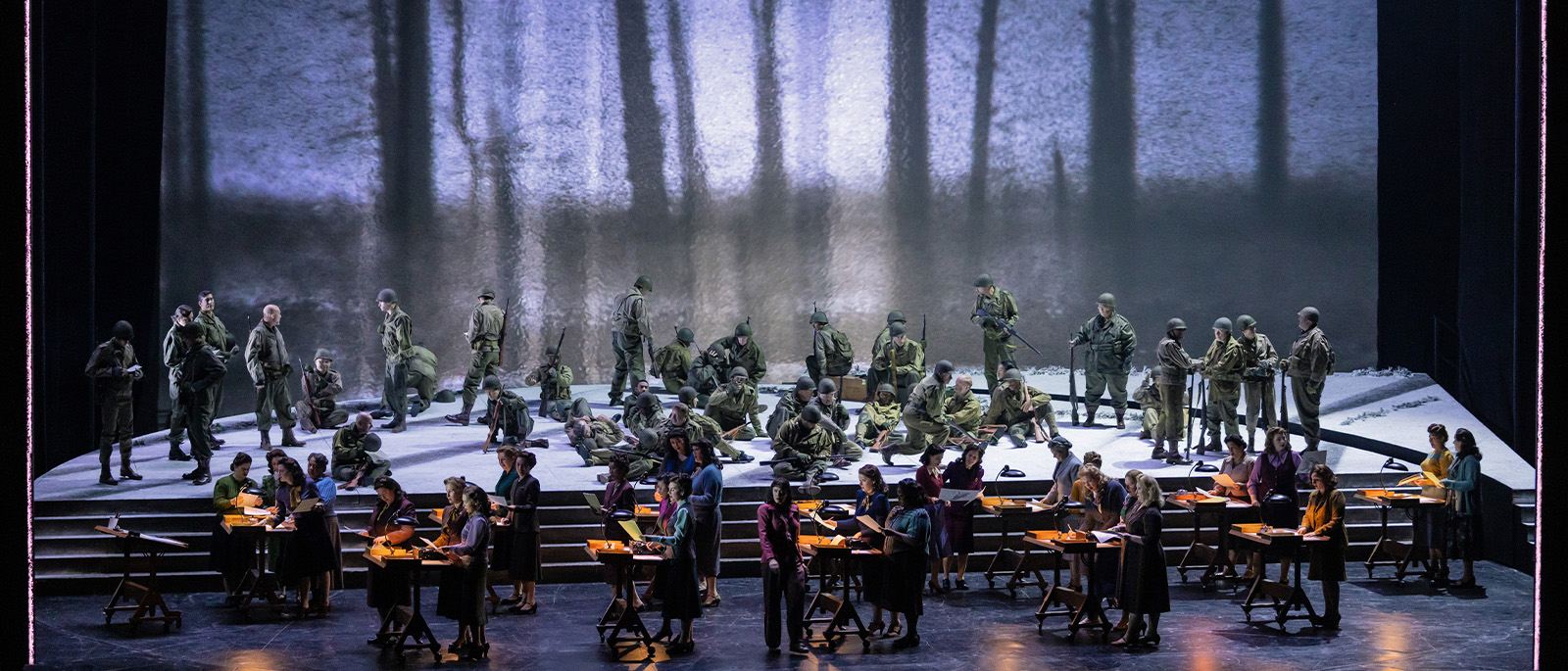
The 2025–26 season is underway, and those skills are already being put to the test. The season opener, “The Amazing Adventures of Kavalier & Clay,” is a favorite in the wig and makeup department. It follows the journey of two Jewish cousins at the outbreak of World War II who invent an anti-fascist superhero and launch their own comic book series.
“I’m a nerd, so working with something that has a comic book underlay has been fun,” says Knowles, adding that the 1940s is always a satisfying period to style. “It’s a unique show this season,” adds Amaro, “and it has been interesting to see how the comic book elements were incorporated by the creative team.”
Ganley’s sights are set on a spring performance of “Innocence.” The work, by Finnish composer Kaija Saariaho and directed by Simon Stone, follows the trauma around a school shooting. “It’s important to our world right now,” she says.
Helms is looking forward to the full season ahead, and for the opportunity to be part of the team running a Met Opera show for the first time. As for what comes after the conclusion of their fellowship? “I’d love to stay in the opera world,” they say. “I didn’t even know opera was a path I could pursue until I got to college. I want to take the skills I’m learning here and apply them in my next job.”
“It’s organized chaos in our department,” says Willis, considering the season ahead. “We have a very high bar for ourselves, coming from UNCSA. We’re dedicated to the quality of the work that goes out on the Met stage — not just because it’s the Met, but because we take so much pride in what we do.”
Along with Amaro, Ganley, Helms, Knowles and Willis, several more alumni currently call The Met their home including Assistant Production Manager Elizabeth Mills (B.F.A. Design & Production ’92), Stage and Shop Operations Cameron Whitehorne (M.F.A. Design & Production '07) and violinist and violist Garrett Fischbach (H.S. Music ’88).
“From my stage management colleagues, who I adore and trust, to the stage hands or major opera stars… what drives me is the breadth of humanity in this place,” says Ganley.
Get the best news, performance and alumni stories from UNCSA.
SUBSCRIBE TO OUR NEWSLETTERS(OPENS IN NEW TAB)(OPENS IN NEW TAB)(OPENS IN NEW TAB)(OPENS IN NEW TAB)(OPENS IN NEW TAB)(OPENS IN NEW TAB)(OPENS IN NEW TAB)(OPENS IN NEW TAB)(OPENS IN NEW TAB)(opens in new tab)
September 30, 2025