Music and dance align in 'Johnny Loves Johann,' co-commissioned by Kenan Arts
On stage, a violin resonates. Steps away, a dancer responds. The music is not accompaniment nor is the movement interpretation. Instead, they meet somewhere in between.
This is the world of “Johnny Loves Johann,” a multidisciplinary project created by Grammy Award-winning violinist Johnny Gandelsman that pairs his folk-inspired interpretation of Johann Sebastian Bach’s cello suites with choreographers to explore the relationship between sound and movement — not as parallel forms, but as collaborators. It’s a celebration of humanity, and a unique model to fuse disciplines on stage in a new and dynamic way.
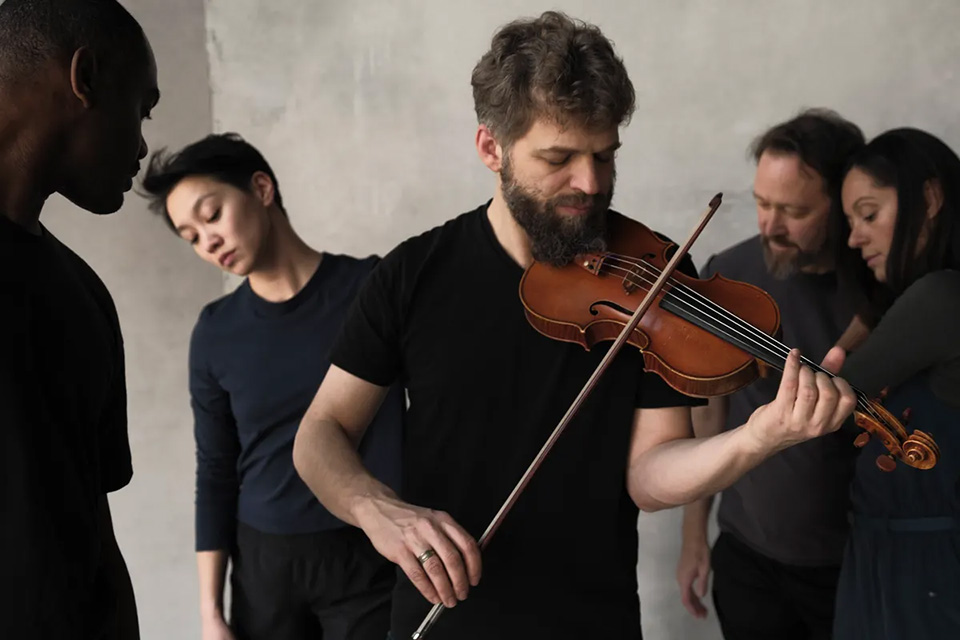
Jamar Roberts, Caili Quan, Johnny Gandelsman, John Heginbotham and Melissa Toogood / Photo: Marco Giannavola
The Thomas S. Kenan Institute for the Arts (Kenan Arts) at UNCSA serves as a lead co-commissioner on “Johnny Loves Johann” with Carolina Performing Arts (CPA) at the University of North Carolina at Chapel Hill. Developed through creative residencies in 2025 at CPA in Chapel Hill, as well as with The Joyce Theater and Works & Process in New York City and The Yard on Martha's Vineyard, “Johnny Loves Johann” reflects a collaborative process among musicians, choreographers and partner institutions.
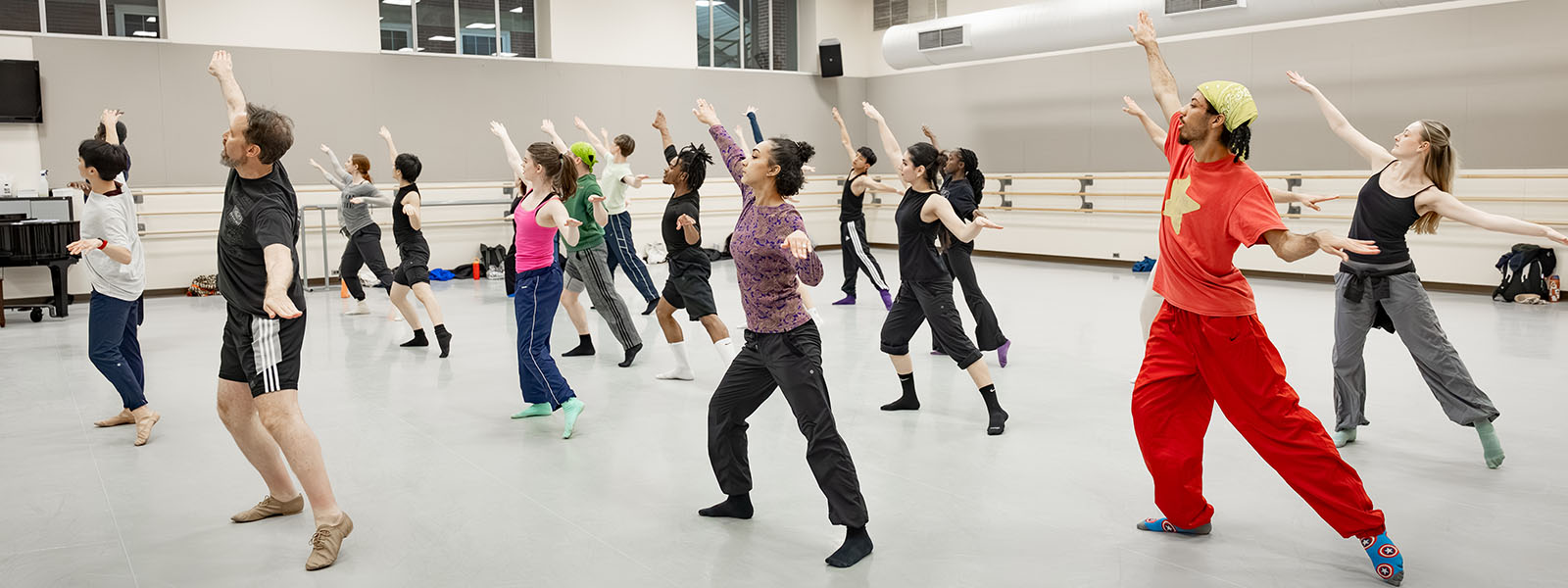
Development of the work was supported by a weeklong residency hosted by Kenan Arts at UNCSA in December 2025, which included educational engagement with students from the Schools of Dance and Music. Now, Winston-Salem audiences have the opportunity to see the live-performance May 1-3 at UNCSA following a successful run at the Joyce Theater in New York City.
Building connections between artists, organizations and communities is central to Kenan Arts. ‘Johnny Loves Johann’ is a vivid example — a creative collaboration where violin and choreography meet as equals.
Kevin Bitterman
“Building connections between artists, organizations and communities is central to Kenan Arts,” says Kevin Bitterman, executive director of the Thomas S. Kenan Institute for the Arts. “‘Johnny Loves Johann’ is a vivid example — a creative collaboration where violin and choreography meet as equals. By supporting Johnny Gandelsman through residencies, student mentorship at UNCSA and partnerships with Carolina Performing Arts and national presenters, we’re helping bring new work to communities across the country and giving audiences an intimate, unforgettable encounter between music and dance.”
Reimagining collaborative performance
For Gandelsman, Bach’s cello suites are not static masterpieces, but rather living works that invite continued exploration. “They’ve been with me for a long time,” he reflects, describing his relationship to the music. What began as a personal artistic inquiry grew into something more expansive: a collaborative project that invites choreographers and dancers into dialogue with the music itself.
Gandelsman invited four choreographers with whom he had existing creative relationships — John Heginbotham, Caili Quan, Jamar Roberts and Melissa Toogood — to create new works in response to each suite, performed in tandem with his live violin. “Johnny Loves Johann” Executive Producer Cristin Bagnall describes the approach as structured, but open-ended — grounded in Bach’s compositions, but shaped by the artists who take the stage together. “There’s a framework,” she explains, “but within that, there’s space for discovery.”
Extending the work to students
The “Johnny Loves Johann” team’s first visit to UNCSA was in spring 2025 — a site visit to attend Spring Dance that would set the tone for future partnership. ”There was a level of commitment with the students executing at the highest level,” recalls Bagnall, “and we began to have conversations with Kenan Arts and the deans. How could we contribute to the extraordinary work happening at UNCSA every day?”
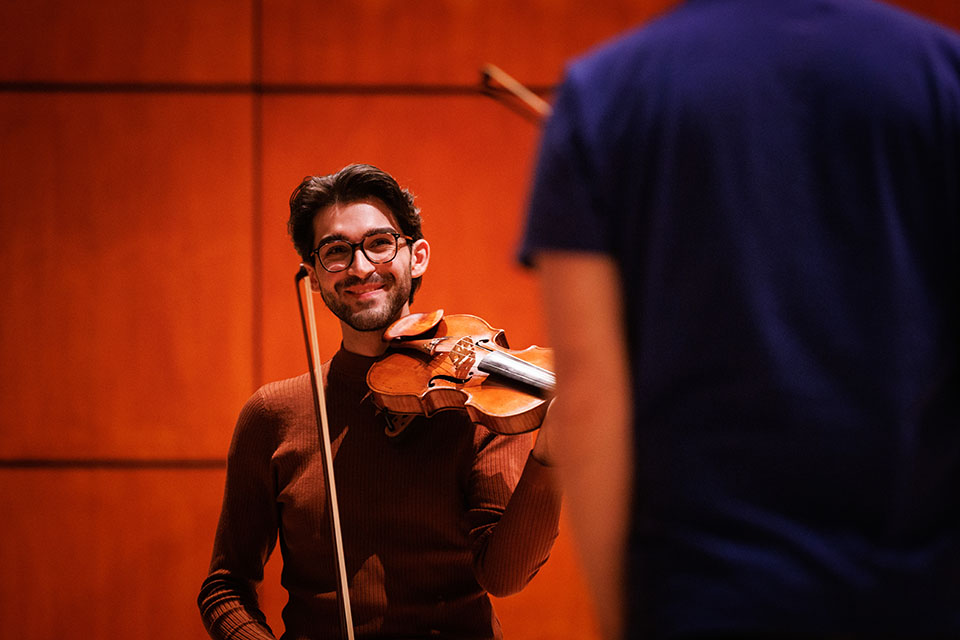
A School of Music student at a workshop with Johnny Gandelsman / Photo: Allison Lee Isley
The answer soon came in the form of a “Johnny Loves Johann residency,” offering students mentorship to emphasize the process of creating work together and allow them to embrace the tenets of the project to create their own new work. Violinist Yaali Mamerud (B.M. ’27) rehearsed closely with Gandelsman. Rather than focusing solely on precision, he encouraged a deeper engagement with the music to ask questions about phrasing, intention and emotional resonance. For Mamerud, that shift reframed her understanding of performance. “It can be scary to touch Bach's music,” she shares. “I learned that sometimes we need to humanize the music to be able to dance to it.”
For contemporary dancer Sophie Bennett (H.S. Dance ’23, B.F.A. Dance ’26), the experience unfolded differently, but with a similar sense of discovery. Bennett was selected as one of three student choreographers invited to develop original work as part of the residency. Each student was paired with one of the “Johnny Loves Johann” choreographers to develop a piece to perform. Echoing Bagnall’s description of the original project work, Bennett shared that she was given a framework intentionally without specifics. “It was more about what we would bring to it [as choreographers],” she says.
Bennett embraced research and dug into the origins of the music, its structure and its relationship to Baroque dance traditions to develop her piece. “It became about understanding where it came from,” she explains, “and then figuring out how I can connect to that.”
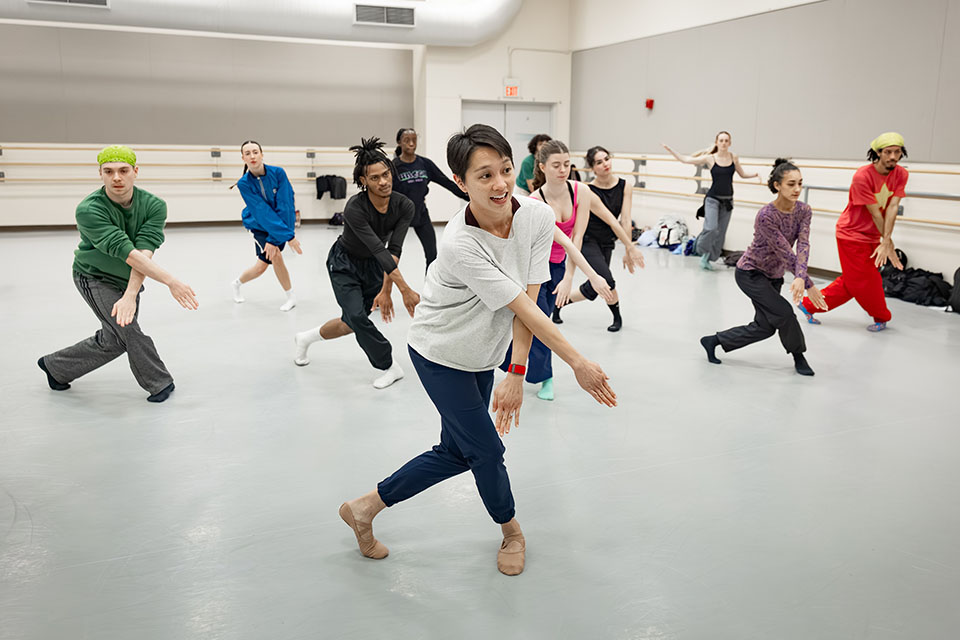
Choreographer Caili Quan works with students in the UNCSA School of Dance / Photo: Tony Spielberg
Mamerud’s viewpoint is similar. “These are pieces I have played for a long time,” she shares. “But hearing the dancers talk about it from their perspective, and talk about the movement in the music, has affected the way I play [the suites] for the rest of my life.”
At the end of the residency, student choreographers were invited to perform informal works-in-progress alongside Mamerud before continuing to refine them for a campus showcase performance in March 2026.
Supporting work in motion
The sense of connection reflected in the residency experience is one of the most distinctive aspects of the project’s model. While music and dance often coexist within the same performance space, they are not always in direct dialogue. Here, that nuance is not only nurtured — but required. The project continues to evolve as an ongoing exploration that is shaped by the artists who engage with it and the contexts in which it is experienced. “We always have hoped for this to have a long performance life,” says Gandelsman. “Each choreographer worked with additional collaborators so the work can carry forward, even as the original artists move on.”
For Kenan Arts, championing the “Johnny Loves Johann” work from the beginning and into the future is about more than presenting performances. It’s about incubating new ideas and investing in processes that celebrate artistic unity and cultural connection. Together in that space — between music and movement — something new begins to take shape.
Get the best news, performance and alumni stories from UNCSA.
SUBSCRIBE TO OUR NEWSLETTERS(OPENS IN NEW TAB)(OPENS IN NEW TAB)(OPENS IN NEW TAB)(OPENS IN NEW TAB)(OPENS IN NEW TAB)(OPENS IN NEW TAB)(OPENS IN NEW TAB)(OPENS IN NEW TAB)(OPENS IN NEW TAB)(OPENS IN NEW TAB)(OPENS IN NEW TAB)(OPENS IN NEW TAB)(OPENS IN NEW TAB)(OPENS IN NEW TAB)(OPENS IN NEW TAB)(OPENS IN NEW TAB)(OPENS IN NEW TAB)(OPENS IN NEW TAB)(OPENS IN NEW TAB)(OPENS IN NEW TAB)(OPENS IN NEW TAB)(OPENS IN NEW TAB)(OPENS IN NEW TAB)(OPENS IN NEW TAB)(opens in new tab)(opens in new tab)
April 22, 2026