
Professor Hans Gabriel creates momentum for a flourishing German Studies program
Professor of German Studies Hans Gabriel remembers the ad campaign the German chemical company BASF ran throughout the 1990s, just before he arrived at what was then still the NCSA in 1999: "We don’t make a lot of the products you buy;" the tag line went, "we make a lot of the products you buy better."
It’s a fitting example to highlight the value of the Division of Liberal Arts (DLA) at UNCSA, where top faculty in a variety of academic disciplines use their expertise to offer courses designed not just to satisfy the requirements students need to graduate with bachelor’s degrees, but also to connect with and enhance their conservatory training.
“We don’t make majors in Chemistry or in German Studies… but we make what the students are doing better,” he explains. And for the past 25 years, Gabriel — the Michael and Amy Tiemann Distinguished Professor in DLA — has been strengthening the German Studies program at UNCSA and building community in Winston-Salem.
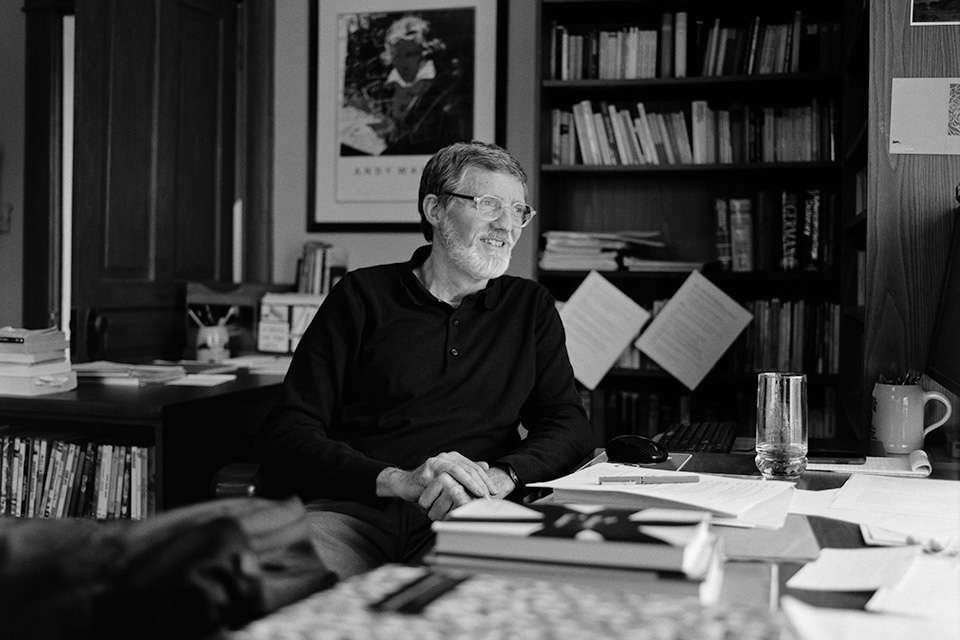
Division of Liberal Arts German Studies faculty member Hans Gabriel. / Photo: Peter Mueller
Language and literature
Gabriel’s interest in German began in high school and expanded into a double major in German and Spanish Language and Literature at UNC Chapel Hill, with a study abroad in Germany and Spain. Captivated by the German-language literature he read as an undergraduate, he went on to receive his doctorate in German Language and Literature at the University of Virginia, where he specialized in 19th-century Swiss and Austrian German works and spent two more years in Germany during and after the fall of the Berlin Wall. From there, teaching became a natural calling. “At UVA, we graduate students taught most of the elementary and intermediate language classes. I enjoyed the balance of teaching against my research work in literature, and I still do.”
Gabriel began his professional career at Ohio University and Washington State University before his aging parents in Charlotte led him to look for a position back in North Carolina. So when a job at UNCSA, then NCSA, opened up in 1999, Gabriel left his tenure-track position at an R-1 university for what was then just a language teaching position. “During the interview process, colleagues I met in both the Liberal Arts and in the Arts Schools expressed their interest in offering students a broader range of German Studies courses in German and English. That, plus my love of teaching and my interest in the arts, helped inspire me to take the plunge.”
A perfect fit at UNCSA
Now, Gabriel teaches undergraduate German language courses along with courses on literary translation and adaptation and courses on literature and culture in German and in English translation. “What I think is wonderful at UNCSA is how relevant German Studies is to a traditional conservatory program,” he says. “For example, a huge amount of the opera and art song repertoire is written by German composers or is performed in German. German-language influence has helped shape not just music, but all of the arts our students study, from ballet and modern dance to film and drama, to stage production and design.”
Whenever he teaches a course in English translation, Gabriel tries to integrate UNCSA productions into the class syllabus. In 2023, for example, Gabriel included the School of Drama production of Bertolt Brecht’s “Mother Courage and Her Children” in his class on “Translation, Adaptation, Interpretation.” “I built part of the class around the translation they were using by Tony Kushner,” he explains, “and students were required to go see the play and think about [director and School of Drama Faculty] Carl Forsman’s interpretation of Kushner’s translation… some were even involved in the production. It was a great fit.”
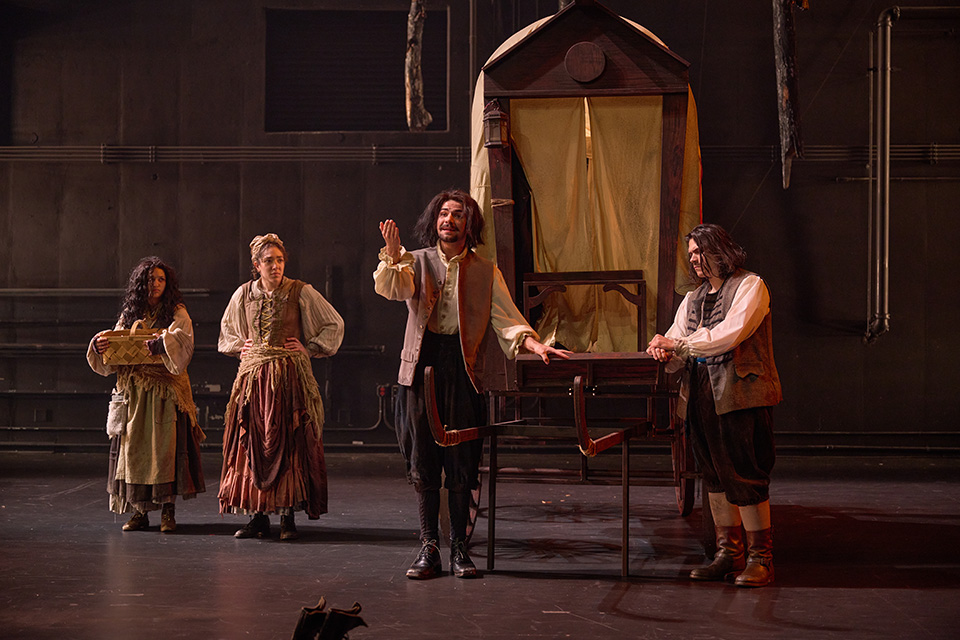
Gabriel aligned his coursework with the School of Drama Spring 2023 production of Brecht’s "Mother Courage and Her Children" / Photo: Wayne Reich
A longstanding UNCSA holiday tradition, “The Nutcracker,” has even made its way into Gabriel’s classroom on occasion. Russian composer Pytor Ilyich Tchaikovsky penned the famed ballet in 1892, based on the 1816 German short story “The Nutcracker and the Mouse King” by Ernst Theodor Amadeus Hoffman. Gabriel has studied both Hoffman’s original German text and various English translations and adaptations. He has also taught two other Hoffmann stories, “Der Sandman” and “Krespel,” in English translation. Probably the most famous tales of Hoffmann, they also serve as the basis of Offenbach’s famous French opera of that name, which both Piedmont Opera and the UNCSA School of Music have performed in Winston-Salem during Gabriel’s tenure in the DLA.
Gabriel's commitment to teaching excellence was recognized in 2015 with the UNC Board of Governors Excellence in Teaching Award — a distinction that underscores not only his skill in the classroom but also why UNCSA has been such a fitting home for his work.
Creating a minor
Gabriel’s classes have been popular, and in 2020, a German Studies minor was added to the DLA curriculum. “Students were already taking the classes that a traditional university would consider for a minor,” he recalls. “We had the courses in place, and with the help and support of the Dean of DLA and especially of Vice Provost Karen Beres, we were able to get the minor up and running on the eve of the pandemic. Amazingly, even during the pandemic, the program built its own momentum.” Averaging about five students per year, the minor is comparable in size to programs at institutions with many times the overall enrollment of UNCSA. “It’s a small industry,” Gabriel says. “I attribute our success here to the administrative support, to interested and dedicated students and to the fact that German is so closely connected to the arts.”
One of the brightest outcomes of the minor, he shares, is that it has enabled graduates to be more competitive for the prestigious U.S. Fulbright English Teaching Assistant (ETA) and Austria Fulbright USTA (US Teaching Assistant) programs. Over the last five years, multiple UNCSA graduates who completed the German Studies minor have been awarded spots in both of these nationally competitive programs.
Austria Fulbright USTA recipient Caleb Horner (B.M. ’25) recently reached out to Gabriel to share that in addition to his paid work as a US Teaching Assistant at two schools in Austria, he has landed a job singing with the Bach Choir of Salzburg and will soon be performing with the Berlin Philharmonic. Another recipient of this same award, Onyx Velez (B.M. ’24), shared that he is currently a US Teaching Assistant at the Vienna Boys’ Choir Academy. Neither of these notable opportunities in their arts field would have been possible without the German language foundation afforded by the minor.
I attribute our success here in large part to the fact that German is so closely connected to the arts.
Hans Gabriel on the success of the German Studies minor
It’s not uncommon for Gabriel to receive this type of correspondence from alumni who continue to draw inspiration from their German education long into their careers and their lives in and outside of the arts: A violinist with the New Orleans Symphony emailed to say that when they performed Engelbert Humperdinck’s “Haensel and Gretel,” it reminded them of studying it in Gabriel's class at UNCSA. Another alum living in Japan reached out to share that taking German classes helped him to learn Japanese. And an alum with a career in finance still writes to Gabriel about their experiences as one of the inaugural group of German Studies minors.
German community-building
But what they remember most of all is Stammtisch, a German-language meetup at local restaurants and pubs around Winston-Salem. Gabriel has been organizing the weekly gathering for all of his 26 years at (U)NCSA. “It might just be UNCSA’s second-longest-running tradition after ‘The Nutcracker,’” he says, smiling. Translated to “conversation table,” Stammtisch brings together UNCSA German Studies students with native German speakers from the community and students from other area universities. It’s an informal, German-only gathering where all levels are welcome; everyone is invited to converse in German or just listen while sharing a drink or a meal. Community members have included Swiss, Austrian and Afro-German natives and others who have lived, worked and/or and studied in the various German-speaking countries and regions, giving students exposure to a variety of accents and dialects.
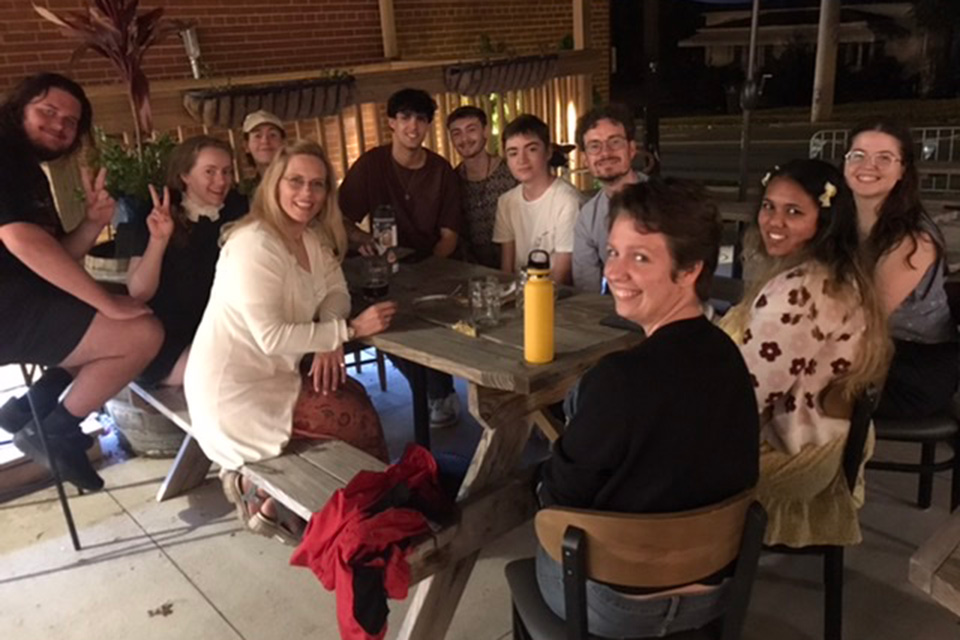
Recent Stammtisch meet up. / Photo courtesy of Gabriel
On one occasion, Gabriel shares, the table next to them overheard the conversation and introduced themselves. “They were a group of musicians visiting from the Munich Philharmonic and they invited us to their performance at Wake Forest University the next evening.” Sometimes the invitation is reversed. Newcomers to the Stammtisch who are unfamiliar with UNCSA will end up coming to campus to see a performance because they have gotten to know some of the students.
Sustained momentum
Gabriel's expertise also extends beyond UNCSA — he has taught in Middlebury College’s prestigious Summer Language Program and its renowned German for Singers program, both widely respected for their intensive, immersive training.
Meanwhile, there is sustained momentum for the German Studies program at UNCSA, and Gabriel hopes to plant seeds for a future where students might have the opportunity to study abroad as part of their undergraduate experience. This work began in 2015 when he cold-emailed Konrad Wolf Film University in Babelsberg, Germany, to discuss bringing students for a visit during a trip to Austria and Germany and to tell them about UNCSA. A short-term exchange program blossomed between Konrad Wolf and the School of Filmmaking, which has recently grown with support from the Semans Art Fund.
Opportunities for students in all five conservatories are abundant throughout Austria and Germany, Gabriel maintains. “My dream is that each of our arts schools would be connected with a German conservatory like Konrad Wolf for a semester abroad exchange,” he says. “We have the German offerings to prepare them, and having German students on our campus enriches all our students’ educations here as well.” At the end of the day, it’s the connection with his students that inspires Gabriel to continue digging — seeking new opportunities for growth and engagement through German Studies. “I’m the only full-time faculty member for this subject [at UNCSA],” he reflects. “It gives me the opportunity to connect with them and to build a community.”
Get the best news, performance and alumni stories from UNCSA.
SUBSCRIBE TO OUR NEWSLETTERS(OPENS IN NEW TAB)(OPENS IN NEW TAB)(OPENS IN NEW TAB)(OPENS IN NEW TAB)(OPENS IN NEW TAB)(OPENS IN NEW TAB)(OPENS IN NEW TAB)(OPENS IN NEW TAB)(OPENS IN NEW TAB)(OPENS IN NEW TAB)(OPENS IN NEW TAB)(OPENS IN NEW TAB)(OPENS IN NEW TAB)(OPENS IN NEW TAB)(OPENS IN NEW TAB)(OPENS IN NEW TAB)(OPENS IN NEW TAB)(OPENS IN NEW TAB)(OPENS IN NEW TAB)(OPENS IN NEW TAB)(OPENS IN NEW TAB)(OPENS IN NEW TAB)(OPENS IN NEW TAB)(OPENS IN NEW TAB)(opens in new tab)(opens in new tab)(opens in new tab)
December 2, 2025