"The Arts & The Sound of America" brings together musicians across genres as the United States marks 250 years
UNCSA has released a new episode of its podcast, “The Arts & Everything,” hosted by Chancellor Brian Cole, exploring the artists, traditions and lived experiences that have shaped the country’s musical identity. In “The Arts & The Sound of America,” Cole asks musicians from across the country and across genres a seemingly simple question: What does American music mean to you?
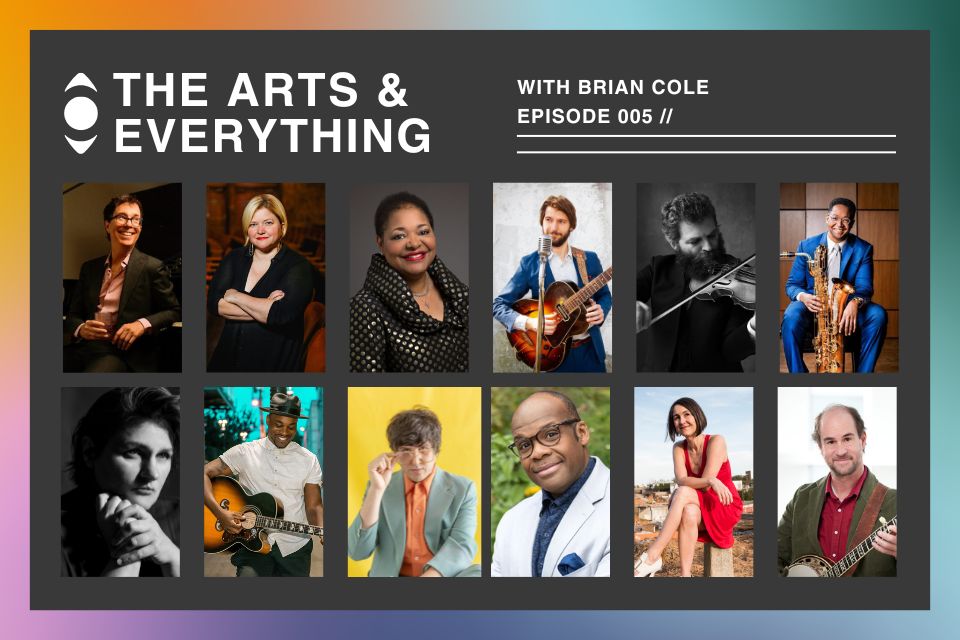
From left to right, top row: Ben Folds, Mary-Mitchell Campbell, Ollie Watts Davis, Justin Poindexter, Johnny Gandelsman and Steven Banks. Bottom row: Madeleine Peyroux, Aristotle Jones, Eric Slick, G. Phillip Shoultz, Martha Bassett and Rex McGee.
The episode features reflections from beloved North Carolina singer and bandleader Martha Bassett; pianist and frontman Ben Folds; Black Sacred Music Symposium Founder and Director Ollie Watts Davis; singer, guitarist, educator and Music alumnus Justin Poindexter (HS ’01, BM ‘06); celebrated Appalachian singer, songwriter and storyteller Aristotle Jones; indie singer-songwriter Eric Slick, who has performed and recorded with Dr. Dog, Taylor Swift and more; the acclaimed jazz singer and songwriter Madeleine Peyroux; saxophone virtuoso and Music alumnus and faculty member Steven Banks (H.S. ’11); Innovative American roots multi-instrumentalist Rex McGee; Artistic Director of Sing Democracy 250 G. Phillip Shoultz; award-winning music director, conductor, and Music alumna Mary-Mitchell Campbell (HS ’92); and Grammy Award-winning violinist and producer Johnny Gandelsman. Together, their perspectives span classical, jazz, rock, roots, gospel, musical theater, soul, indie music and more.
Released as the United States marks its 250th anniversary, “The Arts & The Sound of America” considers American music not as a single genre or tradition, but as an evolving conversation shaped by generations of people bringing their histories, cultures and experiences with them.
Poindexter demonstrates that evolution through the traditional ballad “Wayfaring Stranger,” tracing how its musical structure can move through Appalachian folk, blues, ragtime, gospel, jazz and popular song.
“The sound keeps changing, but the soul of the song stays intact,” Poindexter says. “To me, that’s the sound of American music.”
Davis, founder and director of the Black Sacred Music Symposium, which UNCSA and the Thomas S. Kenan Institute for the Arts have hosted in Winston-Salem, reflects on Black American music as both an artistic tradition and an archive of lived experience.
“The music of Black Americans is a shield,” Davis says. “It is armor for trauma. It is shelter, a haven in times of storm.”
Pianist and singer-songwriter Folds reflects on how touring internationally deepened his appreciation for the complexity and influence of American music.
“I could feel how complex the melting pot in my system was,” Folds says. “I could tell that it’s something that might grow on trees here but can’t be imitated elsewhere.”
Several guests describe American music as an ongoing exchange among traditions, communities and generations. North Carolina singer and bandleader Bassett connects that evolution to the people and places surrounding each artist.
“American music is who we are based on where we’ve been, and it’s never static,” Bassett says.
Jazz singer and songwriter Peyroux considers both the creative freedom and contradictions within the American experience.
“From within this enormous, messy, barbaric landscape, the American people influence the world with creative freedom, secular passion, open-mindedness, life-giving ideas and beauty,” Peyroux says.
Indie singer-songwriter Slick expands on that tension, describing American music as both experimental and deeply connected to the experiences of people pushing against social and creative boundaries.
“American music dares to be different, but it’s also rooted in deep pain and the yearning to break out of traditional boxes,” Slick says.
Together, these perspectives show how musicians build upon inherited traditions while introducing their own experiences and creative points of view. Saxophonist and composer Banks describes music made in America as a reflection of the country’s cultural, social, political and spiritual life.
“We ask questions, imagine better futures, and express and inspire feelings from joy to frustration to hope and determination,” Banks says. “American music is as diverse as the people are, with an endless array of stories to tell.”
Other guests explore the influence of immigration, musical theater, regional communities and artists working beyond conventional creative boundaries. Their reflections trace connections among spirituals, blues, jazz, gospel, country, rock, roots, hip-hop and other forms that have developed in the United States.
Cole concludes the episode by recognizing the many cultures and communities whose contributions made those traditions possible.
“For all of the incredible musical riches that we have in the United States of America, we are indebted to the many diverse peoples that brought their culture to this land from elsewhere,” Cole says. “On this nation’s 250th birthday, we celebrate how so many different traditions of music-making made our music what it is today.”
“The Arts & Everything” examines timely issues shaping the arts and their future through conversations with thought leaders and arts and entertainment industry experts. Past episodes have explored artificial intelligence and creativity, the realities behind an artist’s “big break,” and the relationship between the arts and brain health.
“The Arts & The Sound of America” is now available on major podcast platforms.
Visit www.uncsa.edu/artsandeverything to listen to “The Arts & The Sound of America” and for past and future episodes of the podcast.
About host Brian Cole
Brian Cole is the ninth chancellor of the University of North Carolina School of the Arts (UNCSA). Since becoming chancellor in 2020, he has led the development and implementation of the university’s strategic plan, “UNCSA Forward,” guiding the institution as it adapts to a transforming arts and entertainment landscape. His initiatives include expanding industry partnerships; launching the university’s mission-driven media publishing arm, UNCSA Media; and elevating campuswide mental health and wellness efforts. Cole has filled key leadership roles, overseen several major capital projects, and is leading the comprehensive $85 million renovation of the university’s performing arts center and learning laboratory, the Stevens Center in downtown Winston-Salem. An experienced conductor, Cole previously served as dean of the School of Music at UNCSA, founding dean of academic affairs at Berklee Valencia, and associate dean of academic affairs at the Puerto Rico Conservatory, and holds degrees from Louisiana State University and the University of Illinois.
About “The Arts & Everything”
“The Arts & Everything” is a production of UNCSA Media, supported in part by the Thomas S. Kenan Institute for the Arts. The podcast is produced in part by UNCSA alumni and faculty, including School of Design and Production alumna Maria Wurttele. Music was composed by School of Music faculty member and Filmmaking alumnus Chris Heckman and performed by André Vasconcelos, Chris Heckman, and School of Music students Miah K. Cardoza and Gabe Lopez.
Get the best news, performance and alumni stories from UNCSA.
SUBSCRIBE TO OUR NEWSLETTERS(OPENS IN NEW TAB)(OPENS IN NEW TAB)(OPENS IN NEW TAB)(OPENS IN NEW TAB)(OPENS IN NEW TAB)(OPENS IN NEW TAB)(OPENS IN NEW TAB)(OPENS IN NEW TAB)(OPENS IN NEW TAB)(OPENS IN NEW TAB)
July 2, 2026